
The Internet of Things (IoT) has revolutionized initiatives by enabling seamless connectivity between devices, sensors, and systems. However, for these smart devices to function effectively, their physical design is crucial. From form factors to energy efficiency, each design aspect determines how well a Physical Design of IoT operates within its intended environment. This article explores the core elements of IoT device and sensor design, providing insight into how engineers optimize them for various applications.
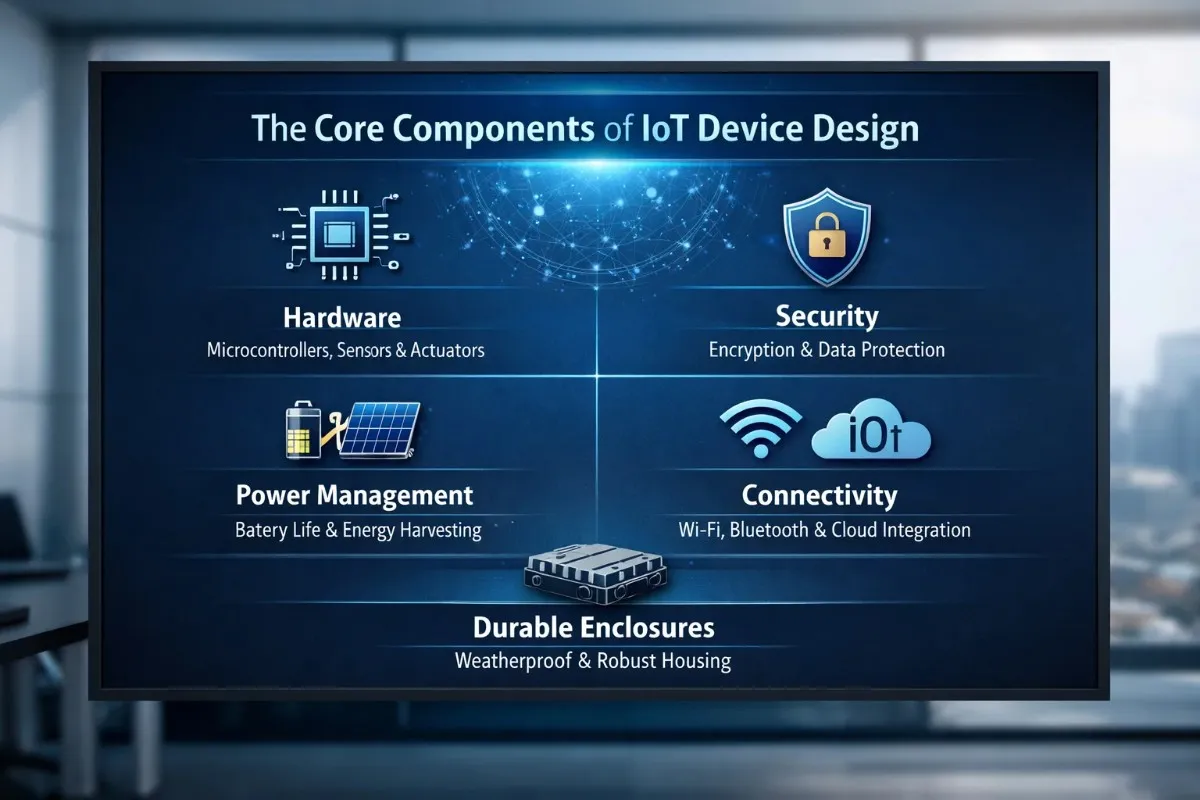
The Core Components Of IoT Device Design
IoT devices and sensors have multiple interconnected components, each serving a distinct purpose. Understanding these components helps in designing more efficient and reliable devices.
Microcontrollers and Processors
The microcontroller (MCU) or processor serves as the brain of an IoT physical design, handling data processing, controlling sensor operations, and managing communication with other devices. Low-power microcontrollers, such as ARM Cortex-M, are commonly used in battery-powered IoT devices, while more complex IoT applications often rely on powerful processors similar to those used in edge computing to handle intensive tasks efficiently.
Sensors and Actuators
Sensors collect real-world data, allowing IoT devices to monitor their environment, while actuators enable these devices to interact and respond to it. Common types of sensors include temperature, humidity, motion, pressure, and proximity sensors. Actuators, such as motors, valves, relays, and other mechanisms, allow the device to perform actions based on the collected data.
Communication Modules
IoT devices rely on communication modules to transmit and receive data, using various connectivity options depending on their needs. Wi-Fi provides high-speed connectivity, making it suitable for smart home and industrial applications. Bluetooth and BLE (Bluetooth Low Energy) are ideal for low-power devices like wearables, while Zigbee and Z-Wave are commonly used in smart home automation for energy-efficient, low-data transmission.
Cellular technologies, including 4G/5G, NB-IoT, and LTE-M, support long-range applications such as asset tracking. For low-power, long-range applications such as agricultural monitoring, protocols like LoRa and Sigfox are commonly used.
Power Management and Energy Efficiency
Efficient power management is essential in the physical design of IoT devices, especially for battery-powered devices. Choosing the right battery type, such as lithium-ion, alkaline, or solid-state, depends on the device’s energy requirements. Energy-harvesting methods, including solar, RF, and kinetic energy, can help extend battery life, while low-power modes such as deep sleep and hibernation further conserve energy and enhance device longevity.
Memory and Storage
IoT devices require memory to efficiently handle data processing and temporary storage. RAM (Random Access Memory) is used for real-time processing, while flash memory stores firmware and configuration settings. Integration with cloud storage further reduces the need for extensive local storage and allows seamless access to data from anywhere.
Factors Influencing The Physical Design Of IoT Devices
Form Factor and Size Constraints
Compact designs are essential for wearables and embedded IoT devices, enabling lightweight, unobtrusive devices. In contrast, larger IoT devices can accommodate more sensors and provide extended battery life, supporting more complex functions and longer operation.
Material Selection
Plastic enclosures provide a lightweight and cost-effective solution for IoT devices, while metal casings offer greater durability and improved heat dissipation. Additionally, waterproofing and dustproofing, indicated by IP ratings, enhance the reliability of devices used in outdoor or harsh environments.
Thermal Management
Heat sinks and thermal pads help improve heat dissipation, ensuring that devices operate efficiently without excessive temperature buildup. Proper ventilation also plays a key role in preventing overheating, especially in high-performance IoT devices, maintaining reliability and longevity.
Environmental Considerations
Devices deployed outdoors must be designed to withstand extreme temperatures and high humidity levels. Similarly, industrial Internet of Things (IoT) devices need rugged construction to endure harsh environments and maintain reliable operation under demanding conditions.
IoT Sensor Design Considerations

Case Studies: Real-World Applications
Smart Home Devices
Thermostats, such as Nest Thermostat, use temperature and humidity sensors to provide precise climate control in homes and offices. Smart security cameras incorporate motion detection and night-vision sensors, enabling enhanced surveillance and monitoring capabilities across various lighting conditions.
Healthcare Wearables
Smartwatches monitor vital signs such as heart rate, oxygen levels, and movement patterns, helping users track their health and fitness in real time. Implantable IoT devices go a step further by tracking glucose levels and delivering medication as needed, providing continuous health management for medical conditions.
Industrial IoT
Predictive maintenance sensors help detect potential equipment failures before they occur, allowing timely interventions and minimizing costly breakdowns. Smart factories leverage IoT technology to optimize workflows, improve efficiency, and reduce downtime, ensuring smoother and more reliable industrial operations.
Future Trends In IoT Device and Sensor Design
AI-Powered Edge Computing
AI enhances real-time processing and decision-making at the edge, enabling devices to act quickly without waiting for cloud-based analysis. This reduces reliance on cloud computing, improves response times, and allows for faster, more efficient operations in IoT applications.
Advancements in Energy Harvesting
New materials and advanced technologies enhance the efficiency of energy harvesting in IoT devices. This enables the creation of self-sustaining IoT networks that require minimal maintenance, ensuring longer operation and greater reliability.
Miniaturization and Flexible Electronics
The development of ultra-thin, flexible sensors enables seamless integration into clothing, skin patches, and other innovative designs. This advancement enables IoT devices to become more wearable, unobtrusive, and versatile in a wide range of applications.
Conclusion
The physical design of IoT devices and sensors is critical to their functionality, efficiency, and durability. Every design aspect contributes to the device’s overall performance, from choosing the right microcontroller to optimizing energy efficiency. As IoT technology evolves, future sensor miniaturization, AI processing, and energy harvesting innovations will further enhance Internet of Things (IoT) capabilities. Whether for smart homes, healthcare, or industrial applications, understanding the physical design of IoT devices ensures the creation of more innovative, more efficient, and reliable solutions.
Frequently Asked Questions (FAQs)
What is meant by the physical design of IoT devices?
The physical design of IoT devices refers to the hardware architecture, including microcontrollers, sensors, actuators, enclosures, and power systems, that enables the device to function effectively in its environment.
Why is power management important in IoT physical design?
Efficient power management ensures that battery-powered IoT devices last longer, supports energy harvesting, and optimizes low-power modes to maintain reliable operation.
How do enclosures affect IoT device performance?
Enclosures protect devices from environmental factors, enhance durability, improve heat dissipation, and can be designed for water- and dust-resistance (IP ratings), especially for outdoor or industrial applications.
What role do sensors and actuators play in IoT physical design?
Sensors collect real-world data, while actuators allow devices to interact with their environment, enabling automation and responsive actions in IoT systems.
How do device size and material impact IoT applications?
Compact and lightweight designs are ideal for wearables and embedded devices, while larger devices can support more sensors and extended battery life. Material choice, such as plastic or metal, affects durability, heat management, and overall device reliability.