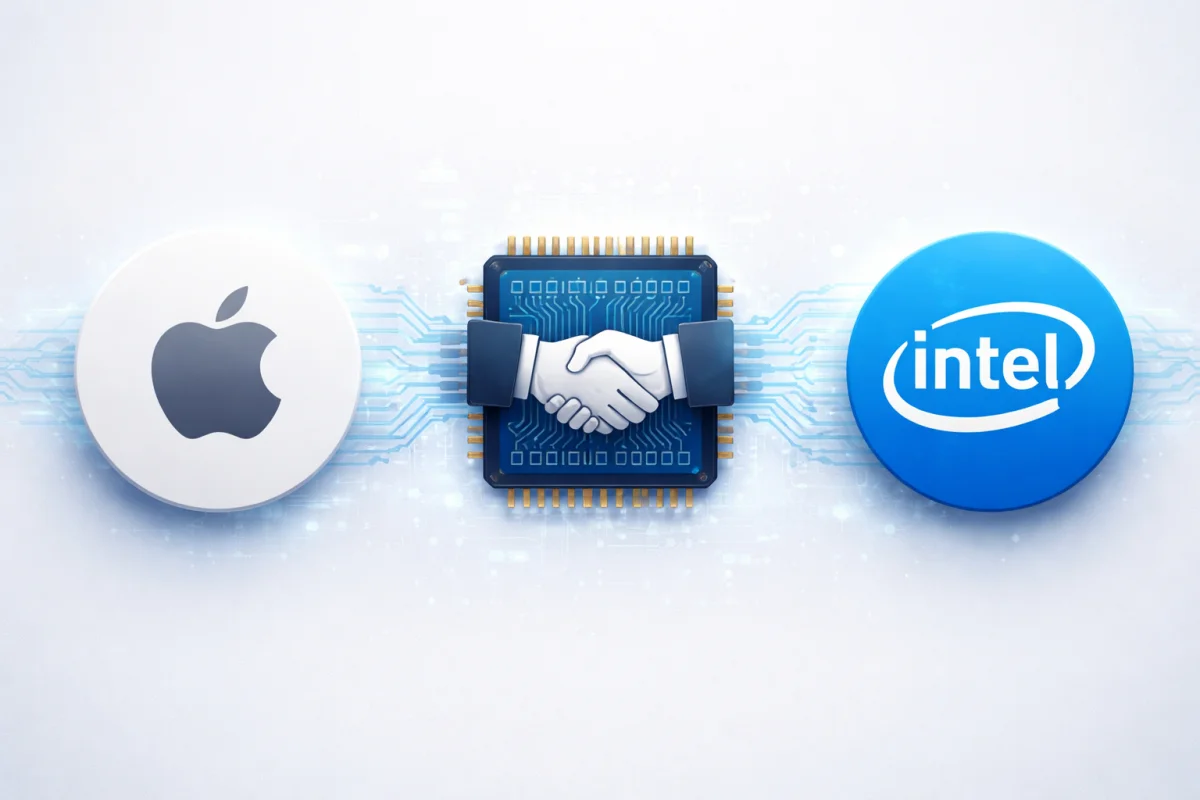
Apple is moving closer to diversifying its chip supply chain by entering into a preliminary agreement with Intel to manufacture some of its semiconductor components.
The potential partnership marks a notable shift in the global chip industry and could reshape Apple’s long-standing reliance on Taiwan Semiconductor Manufacturing Company (TSMC), which currently produces nearly all of its custom silicon.
A Strategic Shift in Apple’s Chip Strategy
Intensive talks between the two companies have been ongoing for more than a year, and Apple has maintained one of the world’s most tightly controlled semiconductor supply chains. Since transitioning away from Intel processors in its Mac lineup in 2020, Apple has relied exclusively on TSMC to manufacture its custom-designed Apple Silicon chips used across iPhone, iPad, and Mac devices.
However, increasing demand for advanced chips—driven in part by AI workloads and next-generation Mac systems—has placed pressure on Apple’s supply chain. According to recent reports, constraints at TSMC have already affected Mac availability, particularly for high-performance models like the Mac Studio and Mac mini. In response, Apple has begun exploring alternative manufacturing partners to reduce risk and expand capacity.
Intel’s Foundry Revival Gains Momentum
For Intel, the agreement represents a potential breakthrough in its ambitious effort to rebuild its semiconductor manufacturing business. Once the dominant force in chip production, Intel has struggled in recent years to compete with TSMC and Samsung in advanced fabrication.
Under CEO Lip-Bu Tan, Intel has doubled down on its foundry strategy, seeking external customers to validate its next-generation manufacturing technologies. A partnership with Apple—one of the world’s most demanding chip designers—would be a major endorsement of Intel’s progress.
Recent reporting indicates Intel has already attracted increased government and industry backing as part of a broader push to strengthen domestic chip production in the United States.
What the Agreement Could Include
The reported agreement is still in the early stages and does not yet specify which Apple products or chips Intel would manufacture. Industry analysts suggest that if the deal advances, it would likely begin with lower-end or secondary processors rather than Apple’s most advanced M-series chips. iApple would continue designing its own silicon, while Intel would act strictly as a contract manufacturer.
Some reports also indicate that Apple AI settlement has been evaluating additional U.S.-based suppliers, including Intel and Samsung, as part of a broader effort to localize more of its supply chain.
Government Involvement and Geopolitical Context
The potential collaboration also aligns with broader U.S. industrial policy aimed at reducing dependence on Asian semiconductor manufacturing. The U.S. government has actively supported Intel’s expansion efforts, including financial incentives and strategic investments designed to boost domestic chip production capacity.
This backdrop has accelerated discussions between major U.S. tech firms and Intel, with policymakers reportedly encouraging partnerships that strengthen local manufacturing ecosystems.
Market Reaction and Industry Implications
News of the preliminary agreement has already moved markets, with Intel shares surging on investor optimism about new revenue streams and the foundry’s long-term viability. icompany shares also rose modestly as investors weighed the benefits of supply chain diversification.
If finalized and expanded, the deal could mark a turning point in the semiconductor industry—potentially establishing Intel as a credible alternative to TSMC for advanced chip manufacturing, while giving icompany greater flexibility in managing supply constraints.
Outlook
Despite the significance of the announcement, the agreement remains non-binding and highly preliminary. Neither company has publicly confirmed the specifics, and many technical and operational hurdles remain.
Still, the development signals a strategic realignment in the global chip ecosystem—one in which icompany is actively broadening its supplier base and Intel is working to re-establish itself as a leading manufacturer in the semiconductor era.