
If you are thinking about entering the cybersecurity field, one of the most common questions is: Does cybersecurity require coding? The short answer is no, coding is not mandatory for every cybersecurity role. However, the more accurate answer is that coding can significantly expand your opportunities and long-term career growth. Cybersecurity is a broad domain, and the need for programming depends entirely on the specific role you choose.
This guide provides a detailed, structured explanation so you can clearly understand where coding is essential, where it is optional, and how to build a successful cybersecurity career either way.
Understanding the Scope of Cybersecurity

Cybersecurity is the practice of protecting systems, networks, software, and data from digital attacks. It is not limited to hacking. The field includes defensive monitoring, compliance management, cloud security, penetration testing, malware analysis, digital forensics, and security architecture. Because the industry covers such a wide range of responsibilities, the technical requirements vary significantly between positions.
Some roles focus on analysing alerts and managing risks, while others involve building security tools or dissecting malicious code. This diversity explains why coding is sometimes required and sometimes not.
Does Cybersecurity Require Coding? The Realistic Answer
Cybersecurity does not universally require coding skills. Many entry-level and mid-level positions can be performed effectively without writing complex programs. However, coding becomes important in highly technical roles that involve automation, tool development, vulnerability research, or exploit creation.
Think of coding as a professional advantage rather than a mandatory requirement. It enhances your capability but does not automatically determine whether you can enter the field. The short answer is Yes and No. Coding is not mandatory for all cybersecurity roles, but it is a valuable skill that can enhance your career prospects.
Cybersecurity Roles That Require Coding
Penetration testing, also known as ethical hacking, involves simulating cyberattacks to uncover system vulnerabilities, often requiring custom scripts written in languages like Python, JavaScript, or Ruby. In security software development, professionals build protective tools and applications using languages such as C, C++, Python, or Java.
Malware analysis requires decompiling and examining malicious code to understand threats and assess risks effectively. Additionally, many cybersecurity tasks, including log analysis and network scanning, are streamlined through automation and scripting using languages such as Python or Bash.
Cybersecurity Roles That Do Not Require Coding
A Security Analyst monitors networks, detects threats, and implements protective measures, where basic scripting knowledge can be helpful but is not mandatory. An Incident Response Specialist focuses on investigating and mitigating security breaches, relying more on forensic analysis than programming skills.
Roles in Compliance and Risk Management ensure that organisations comply with regulations such as GDPR and HIPAA without requiring coding expertise. Similarly, Security Awareness Training professionals educate employees on cybersecurity best practices through structured training sessions rather than technical development work.
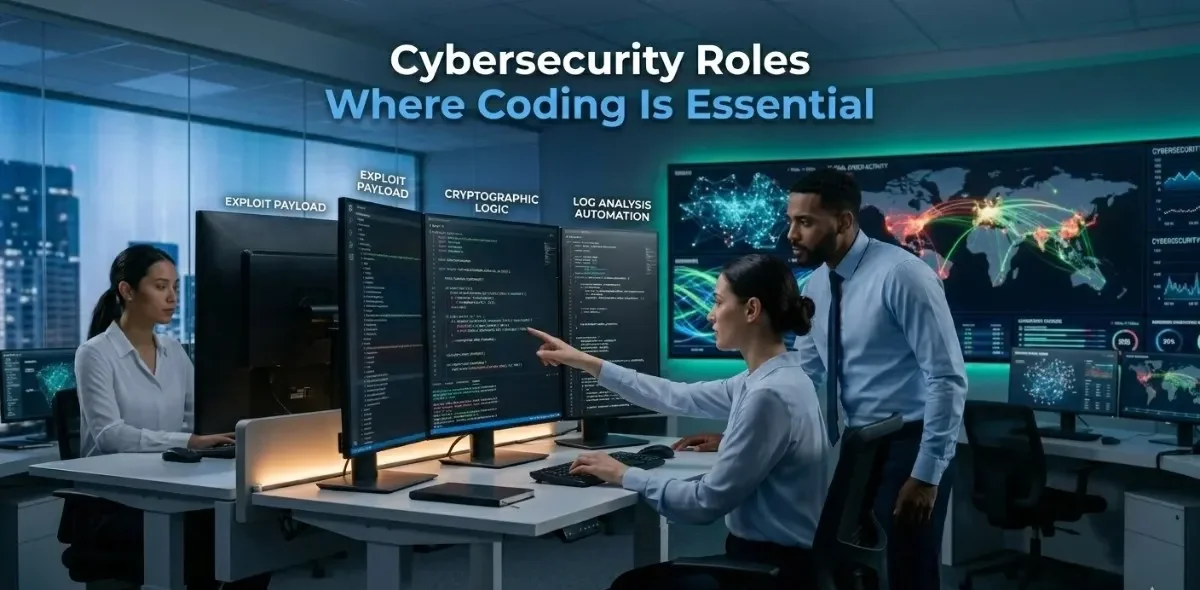
Cybersecurity Roles Where Coding Is Essential
Certain advanced cybersecurity roles demand strong programming knowledge because the work directly involves interacting with code, building scripts, or analysing software behaviour.
Penetration Testing and Ethical Hacking
Penetration testers simulate cyberattacks to identify vulnerabilities in systems and applications. While many security tools exist, serious ethical hackers often need to modify scripts, customise exploits, and understand how applications process data internally. Without coding knowledge, a penetration tester is limited to using automated tools without truly understanding what is happening behind the scenes. Programming languages like Python and JavaScript are commonly used in this domain, while lower-level languages such as C or C++ may be required for advanced exploit development.
Malware Analysis and Reverse Engineering
Malware analysts examine malicious software to understand how it operates and how to detect or prevent it. This work requires reading code, analysing compiled binaries, and sometimes disassembling programs. Coding is absolutely essential here because the role requires a deep technical understanding of software logic. Professionals in this field often need knowledge of C, C++, Assembly, and Python to accurately interpret malware behaviour.
Application Security Engineering
Application security engineers focus on identifying vulnerabilities within software applications before attackers can exploit them. This role involves reviewing source code, identifying insecure coding patterns, and advising development teams on secure programming practices. Without understanding programming languages and software architecture, it is impossible to perform this job effectively.
Cybersecurity Roles Where Coding Is Optional
Many cybersecurity careers do not require heavy programming skills, especially at the entry level.
Security Operations Centre (SOC) Analyst
SOC analysts monitor security alerts, investigate suspicious activity, and respond to potential incidents. Most of the work involves analysing logs, reviewing alerts, and following response procedures. While scripting skills can help automate repetitive tasks, many entry-level SOC positions do not require coding knowledge.
Governance, Risk, and Compliance (GRC)
GRC cybersecurity professionals focus on policy development, regulatory compliance, risk assessments, and security frameworks. Their work is strategic rather than technical. Coding is typically unnecessary because the role centres on documentation, audits, and risk evaluation instead of software development.
Cybersecurity Consulting
Consultants assess organisational security posture and provide recommendations. Although technical understanding is important, programming is not always required. Many consultants work on architecture design, risk analysis, and high-level strategy rather than writing code.
How to Get Started With Coding in Cybersecurity
If you’re convinced that coding can boost your cybersecurity career, here’s how you can begin:

Choose the Right Programming Language
Selecting the right programming language is essential for building cybersecurity skills. Python is widely used for scripting, automation, and penetration testing, while Bash helps automate tasks on Linux systems. JavaScript supports web security testing, and C or C++ is important for understanding malware and low-level security threats.
Use Online Learning Platforms
Online learning platforms provide structured guidance for cybersecurity coding. Websites like Coursera, Udemy, Codecademy, and Cybrary offer specialised courses. These platforms help learners build practical coding skills tailored to security roles.
Join Cybersecurity Communities
Engaging with cybersecurity communities accelerates learning and problem-solving skills. Forums such as Stack Overflow, GitHub, and Reddit allow professionals to exchange knowledge. Participating in discussions exposes you to real-world coding challenges and expert insights.
Practice Regularly
Consistent hands-on practice is crucial for mastering cybersecurity coding. Work on personal projects, experiment with scripts, and test security tools in controlled environments. Participating in Capture The Flag (CTF) competitions and coding exercises strengthens both technical and analytical skills.
Coding vs. Scripting in Cybersecurity
It is important to distinguish between full programming and basic scripting. Many cybersecurity professionals do not build large software systems but instead write small scripts to automate tasks. Scripting languages such as Python or PowerShell are commonly used to analyse logs, automate repetitive processes, or extract data. Full programming, on the other hand, involves designing applications or creating complex tools. In many cybersecurity roles, scripting knowledge is far more relevant than advanced software engineering.
Why Coding Still Matters in Cybersecurity
Even if coding is not required for every job, it provides long-term advantages. Professionals who understand programming can customise tools, automate workflows, and analyse vulnerabilities more deeply. Coding strengthens logical thinking and problem-solving skills, both of which are essential in cybersecurity. As the industry shifts toward automation, cloud security, and DevSecOps practices, scripting skills are becoming increasingly valuable. Security teams often integrate automated detection systems, and professionals who can write scripts to improve efficiency are highly sought after.
What Programming Languages Are Most Useful?
Python is widely considered the most practical language for cybersecurity because it is beginner-friendly and versatile. It is commonly used for automation, data analysis, exploit development, and scripting. PowerShell and Bash are important for managing systems and automating administrative tasks, particularly in blue team roles. JavaScript knowledge is valuable for web application security, especially when identifying client-side vulnerabilities. C and C++ are more advanced but useful for malware analysis and low-level security research.
Can You Enter Cybersecurity Without Coding?
Yes, many professionals enter cybersecurity without a programming background. A strong foundation in networking, operating systems, and security principles is often more important early on. Entry-level certifications and practical lab experience can help you secure your first role without writing complex code. However, gradually learning to script can significantly enhance your career prospects. It is often easier to add programming skills later than to delay entering the field because you feel unprepared.
Industry Trends in 2026
Modern cybersecurity increasingly involves cloud platforms, remote work environments, and automated threat detection systems. While artificial intelligence and automation tools are becoming more common, human expertise remains critical. Security professionals who can combine analytical skills with basic scripting knowledge are positioned for long-term success. The industry does not require every professional to be a software developer, but technical adaptability is becoming more important as systems grow more complex.
Final Answer: Does Cybersecurity Require Coding?
Cybersecurity does not strictly require coding, but coding can dramatically expand your career options. Entry-level analyst roles and compliance positions often do not demand programming skills. However, advanced technical roles such as penetration testing, malware analysis, and application security engineering require solid coding knowledge. If your goal is to enter the field quickly, focus first on security fundamentals and networking. Once you are comfortable, begin learning Python or another scripting language to strengthen your technical foundation. Coding is not a barrier to entry, but it is a powerful tool for advancement.
Conclusion
If you are asking whether cybersecurity requires coding, the better question might be: what kind of cybersecurity professional do you want to become? The field offers multiple paths, from technical engineering to strategic risk management. Coding is essential in some paths and optional in others. The smartest strategy is to start with core security knowledge, build hands-on experience, and gradually add scripting skills. This balanced approach allows you to enter the industry without unnecessary delay while still preparing yourself for higher-level opportunities in the future.
Frequently Asked Questions (FAQs)
Does cybersecurity require coding for beginners?
No, cybersecurity does not require coding at the beginner level. Many entry-level roles, such as SOC analyst or risk analyst, focus more on monitoring, investigation, and understanding security fundamentals rather than writing code.
Can I get a cybersecurity job without learning programming?
Yes, you can get a cybersecurity job without programming, especially in governance, risk, and compliance roles, as well as entry-level analyst roles. However, learning basic scripting later can improve your career growth and salary potential.
Which programming language is best for cybersecurity?
Python is considered the most useful programming language for cybersecurity because it is beginner-friendly and widely used for automation, scripting, and security testing. PowerShell and Bash are also valuable for system-level tasks.
Do ethical hackers need coding skills?
Ethical hackers benefit greatly from coding skills. While some testing can be done using automated tools, advanced penetration testing requires understanding and modifying code to identify deeper vulnerabilities.
Is cybersecurity harder than programming?
Cybersecurity and programming require different skill sets. Cybersecurity focuses on protecting systems, analysing threats, and understanding networks, while programming focuses on building software. The difficulty depends on your strengths and interests.


