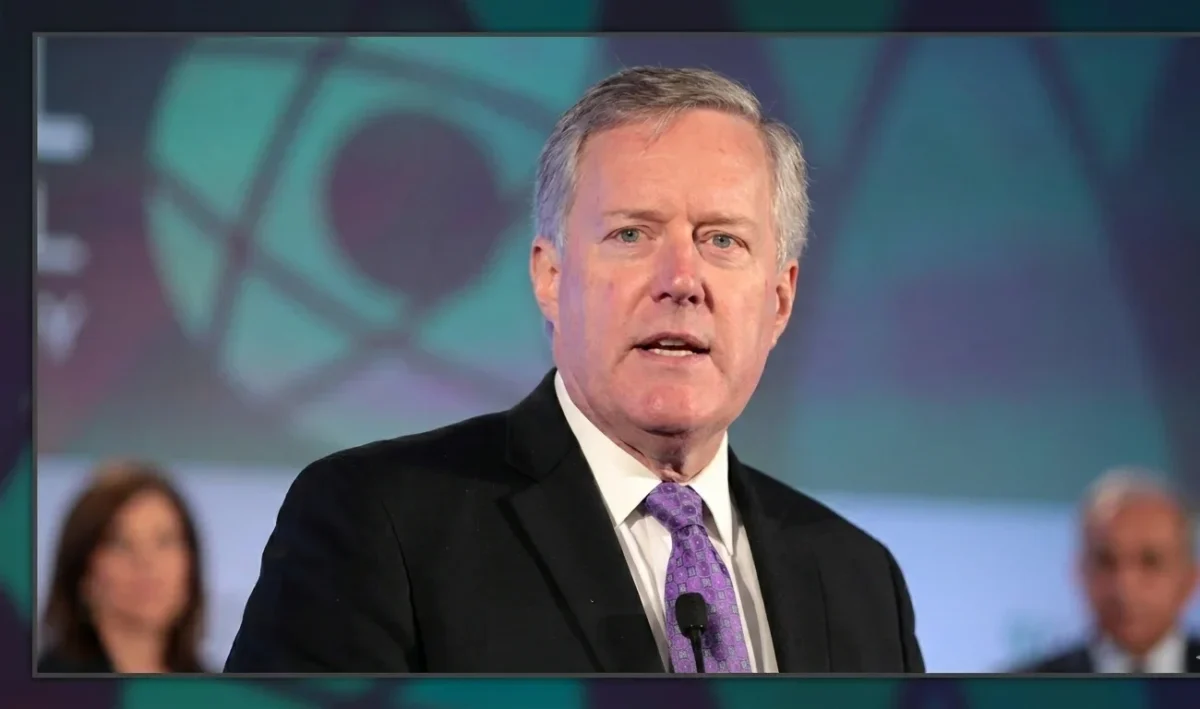
Mark Meadows, the former White House Chief of Staff under President Donald Trump, has formally asked the U.S. Department of Justice to cover his legal fees and costs incurred during investigations by multiple federal and state authorities tied to Trump’s efforts to overturn the 2020 presidential election. The Meadows DOJ reimbursement request is now one of the most closely watched legal developments in Washington, arriving at a time when the Justice Department is already processing a wave of similar financial claims from Trump allies and even the former president himself.
Here is a complete breakdown of what happened, how much money is involved, and what it could mean going forward.
What Is the Meadows DOJ Reimbursement Request?
Meadows is asking the Justice Department to reimburse him for legal expenses he incurred during several federal and state investigations related to President Trump. The request was submitted by his attorney, George Terwilliger, in early February, according to sources with direct knowledge of the matter.
This is not an isolated development. The DOJ is simultaneously handling a range of financial claims from Donald Trump himself, as well as demands from pardoned January 6 rioters who are seeking compensation for injuries they say they suffered at the hands of Capitol Police. Trump and his sons have also separately filed a $10 billion lawsuit against the IRS over the leak of his tax returns, and Trump’s legal team has submitted $230 million in administrative claims against the Justice Department across two separate filings.
What Role Did Meadows Play in the Trump Investigations?
To understand why this reimbursement request is generating significant attention, it helps to understand exactly what Meadows was investigated for in the first place.
According to the House Select Committee on the January 6th Attack, Meadows played a meaningful role in Trump’s push to reverse the results of the 2020 election. He was among those who pressured the Justice Department to open investigations into unsubstantiated conspiracy theories, and he was present on a call during which Trump asked Georgia Secretary of State Brad Raffensperger to help find enough votes to change the state’s outcome.
A subsequent Senate Judiciary Committee investigation uncovered evidence suggesting that Meadows pushed DOJ officials to take steps to reverse the election results, with emails, interviews, and notes from Republican Justice Department officials supporting those findings.
Despite all of this scrutiny, Meadows was never charged in special counsel Jack Smith’s federal indictment against Trump related to the 2020 election, though he did face criminal charges in parallel state-level cases in both Georgia and Arizona.
In November, Trump pardoned Meadows along with others who had supported his efforts to challenge the election outcome. The Georgia prosecutor subsequently dropped the charges against Meadows and others. However, legal uncertainty persists in Arizona, where Meadows still faces charges related to the fake electors scheme to reverse the 2020 election results.
Throughout all of this, Meadows has consistently denied any wrongdoing, maintaining that every action he took was within the scope of his official duties as Trump’s chief of staff.
How Much Did Meadows Actually Spend on Legal Fees?
The dollar figures emerging from court filings paint a striking picture of just how expensive this legal exposure has been.
In the Georgia case alone, Meadows paid the law firm Griffin Durham more than $569,000, with an additional $19,000 in outstanding unpaid fees still on the books.
Separately, attorneys at the firm McGuireWoods billed Meadows close to $1.3 million, of which he paid approximately $650,000.
After attorney Terwilliger departed McGuireWoods and continued representing Meadows independently, covering the Georgia case and matters related to Smith’s investigations, he charged a flat monthly fee of $20,000 through 2024, which dropped to $12,000 per month in 2025.
Meadows also paid a flat fee of $200,000 to Paul Clement, a former senior DOJ appellate lawyer, who represented him in his unsuccessful attempt to have his Georgia state case transferred to federal court.
It remains unclear exactly how Meadows funded all of this, though earlier reporting by Notus indicates that at least some of his legal bills may have been covered by Personnel Policy Operations, a nonprofit affiliated with his employer, the Conservative Partnership Institute. A progressive watchdog group previously asked the D.C. Attorney General to investigate whether that arrangement violated IRS regulations governing nonprofits.
Does the DOJ Have the Legal Authority to Reimburse Meadows?
This is where the story gets particularly nuanced and legally significant.
Federal regulations grant the Justice Department authority, under specific circumstances, to provide legal counsel or reimburse former government officials for private legal representation costs, provided those officials were acting within the scope of their official duties when the relevant proceedings arose.
The DOJ also maintains an internal administrative directive that sets the reimbursement rates it applies, which are typically far below what lawyers actually charge on the open market.
A Justice Department spokesperson confirmed the agency evaluates such requests individually, applying its established regulations and parameters to determine eligibility on a case-by-case basis.
Historically, requests are most commonly denied when a former employee failed to seek reimbursement from the outset of proceedings, though the department retains discretion to make exceptions when circumstances warrant it. Key factors in the evaluation include whether the individual was acting in an official capacity at the time and whether reimbursing them would serve the interests of the United States government.
A relevant precedent exists from 2020, when the Office of Legal Counsel found that government employees who hired private lawyers as witnesses in special counsel Robert Mueller’s Russia investigation were eligible for reimbursement, provided they were neither a subject nor a target of that investigation. Whether the DOJ would apply a similar interpretation to Meadows’ situation remains entirely unclear.
The Georgia Reimbursement Case Running in Parallel
Separate from the federal request, Meadows is also pursuing reimbursement for his Georgia legal costs under a state law that allows defendants to seek such compensation when a prosecutor is disqualified for misconduct.
Meadows is one of several defendants in the Georgia case collectively seeking more than $17 million in legal fee reimbursements. However, the legal basis for those claims is being actively challenged. Lawyers for the county have argued that the defendants’ requests are unconstitutional under the Georgia Constitution because they seek retroactive payments under a law that did not take effect until May 2025, well after the 2023 indictment. The Georgia Court of Appeals is currently reviewing whether to take up the case.
On the federal side, the DOJ is not expected to weigh in on the Georgia portion of Meadows’ request until the state reaches its own conclusion first.
Read more: FBI Retrieves Deleted Signal Messages
Will the Public Ever Know the Outcome?
Probably not. Unlike DOJ tort settlements, which can be obtained through public records requests, decisions about whether to reimburse former employees for attorney fees are treated as legally privileged, even though any reimbursement would ultimately be funded by American taxpayers.
This lack of transparency has drawn criticism from good-government advocates, who argue that financial decisions of this nature, especially those involving politically prominent figures, should be subject to public accountability.
What This Means Going Forward
The Meadows DOJ reimbursement request sits at the intersection of law, politics, and public accountability. It raises fundamental questions about where official government duty ends, and personal legal liability begins, questions that have no clean, settled answers in American law.
With the Arizona case still unresolved, the Georgia appeals process ongoing, and the DOJ’s internal deliberation shielded from public view, the full outcome of this situation could take months or even years to fully emerge. What is certain is that it will continue to draw scrutiny from both legal experts and the public who, in one way or another, may ultimately be footing the bill.