
AI robot dogs have gone from a niche robotics curiosity to one of the most searched tech gadgets of the year, and it’s easy to see why. Between viral ads showing eerily lifelike quadruped robots trotting around backyards and headlines about models like the Unitree Go2 Pro, plenty of people are left wondering what’s actually real, what these things cost, and whether the ad they just scrolled past is legitimate or a scam.
This guide breaks it all down in one place. You’ll learn how AI robot dogs work, which models are worth your money, what realistic pricing looks like, and who they’re actually built for. We’ll also walk through the red flags that separate a genuine product listing from a misleading ad so that you can make a confident decision either way. By the end, you’ll know exactly whether an AI robot dog is worth adding to your cart.
What Is an AI Robot Dog?
An AI robot dog is a four-legged robotic companion built with onboard artificial intelligence, sensors, and motorized joints that let it walk, balance, and react to its surroundings much like a real animal. Unlike the wind-up or remote-controlled toy dogs of the past, these machines use cameras, LiDAR, and machine learning models to map their environment, avoid obstacles, and respond to voice commands or gestures. Some are designed purely for entertainment and companionship. In contrast, others, like the Unitree Go2 Pro, are built with enough power and sensor precision to handle security patrols, research, or rugged outdoor terrain.
What makes them “AI” rather than just “robotic” is the decision-making layer running underneath the hardware. The dog isn’t simply following a pre-programmed path. It’s constantly processing data in real time to decide how to move, what to avoid, and how to respond to the person interacting with it.
How AI Robot Dogs Actually Work
At the core of every AI robot dog is a combination of motors, joint actuators, and a central processing unit that acts like the robot’s brain. Sensors such as cameras, depth sensors, and sometimes LiDAR feed constant data into this processor, which uses AI models to interpret what’s around it, whether that’s a wall, a person, or a set of stairs. The robot then adjusts its leg movements dozens of times per second to stay balanced, similar to how a real dog shifts its weight without thinking about it.
Voice recognition and companion apps add another layer of interaction, letting owners issue commands, program routines, or check status updates like battery life and location. Higher-end models add obstacle mapping and autonomous navigation, so the robot can learn a space over time rather than needing constant guidance.
AI Robot Dog vs Traditional Robot Toy
The biggest difference between an AI robot dog and a traditional robot toy comes down to autonomy. A traditional robot toy dog typically runs on simple pre-set movements or basic remote control, with little to no ability to understand its environment. If it hits a wall, it either stops or keeps pushing against it, because it has no real awareness of what’s in front of it.
An AI robot dog, on the other hand, actively senses and adapts. It can recognize obstacles, adjust its gait on uneven ground, and in more advanced models, follow a person or return to a charging dock on its own. This is also why the price gap between the two categories is so wide. You’re not just paying for a toy with moving parts; you’re paying for sensors, processors, and software that let the robot genuinely think through basic tasks on its own.
Best AI Robot Dogs to Consider
Not every AI robot dog on the market is built for the same purpose, which is why picking the “best” one really comes down to what you need it for. Someone looking for a fun desk companion has very different requirements than someone who wants a rugged unit for outdoor patrol or research use. Below is a breakdown of what stands out in each category right now.
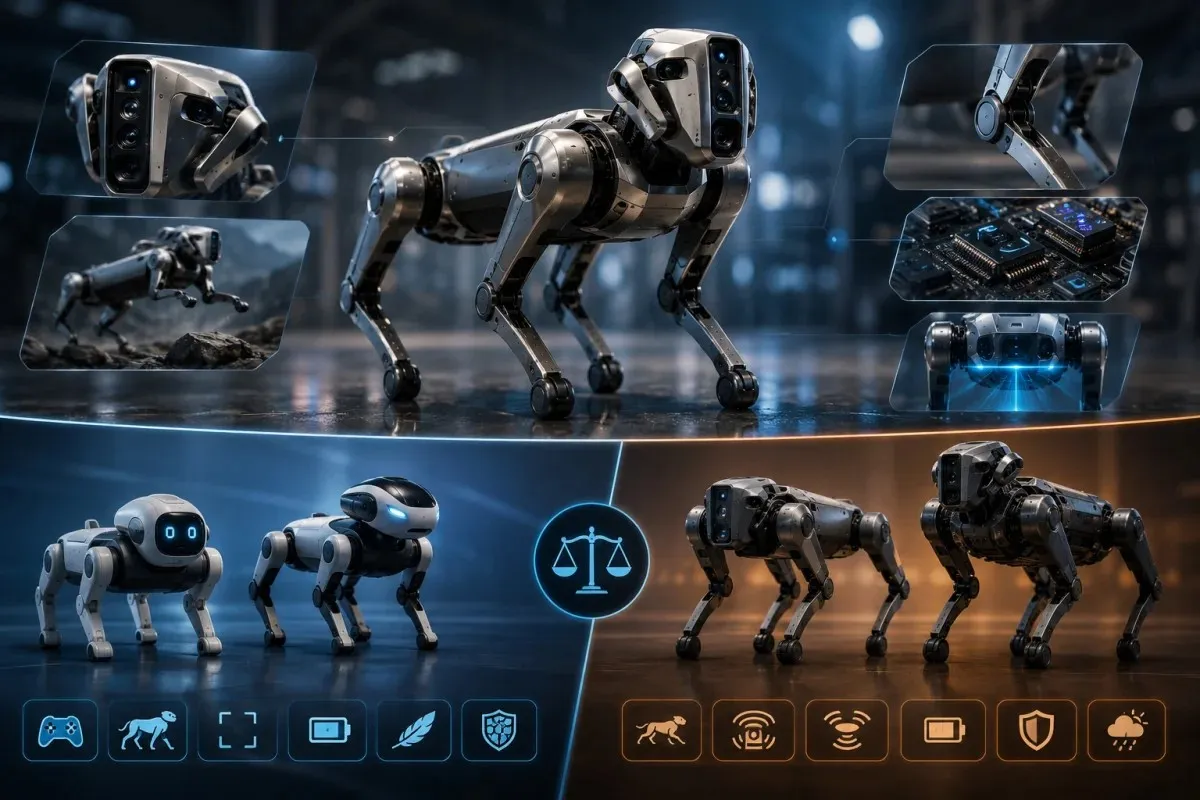
Unitree Go2 Pro AI Quadruped Robot Dog Features Breakdown
The Unitree Go2 Pro is one of the most talked-about models in the AI robot dog space, and it’s built for people who want serious performance rather than a novelty toy. It comes with a high-resolution depth camera and LiDAR-based obstacle mapping, letting it navigate uneven terrain, stairs, and cluttered rooms with minimal guidance. Its joint motors allow for a wider range of movement than most competitors, including running, jumping, and recovering its balance after being pushed off course.
Battery life on the Go2 Pro tends to outlast entry-level models, and it supports app-based control along with voice commands. Because of its sturdier build and stronger processing power, it’s often positioned less as a toy and more as a functional robotics platform, appealing to hobbyists, researchers, and small businesses experimenting with automated patrol or delivery tasks.
Budget vs Premium AI Robot Dogs Compared
| Feature | Budget AI Robot Dogs | Premium AI Robot Dogs (e.g., Unitree Go2 Pro tier) |
| Movement | Basic walking, limited turning | Running, jumping, terrain adaptation |
| Sensors | Simple proximity sensors | Depth cameras, LiDAR mapping |
| Navigation | Manual or remote-guided | Autonomous obstacle avoidance |
| Build material | Lightweight plastic | Reinforced, weather-resistant materials |
| Battery life | Shorter, 30–60 minutes | Longer, often 90+ minutes |
| Best for | Kids, casual entertainment | Adults, hobbyists, functional use cases |
Budget models are a reasonable entry point if you or your family just want a fun interactive gadget without a big investment. But if you’re looking for something closer to a genuine robotics platform, one that can actually learn a space and move through it intelligently, the premium tier is where that capability lives.
AI Robot Dog Price Guide
Pricing for AI robot dogs varies more than most gadget categories, mainly because “AI robot dog” covers everything from a $50 toy that walks in a straight line to a several-thousand-dollar robotics platform. Knowing where a product sits on that spectrum helps you avoid overpaying for something basic, or underestimating what a serious unit actually costs.
What Affects the Price
The biggest price driver is the sensor package. A robot dog with only basic proximity sensors will always cost less than one equipped with depth cameras and LiDAR, since that hardware is expensive to manufacture and requires more processing power to run. Build quality plays a similar role. Reinforced, weather-resistant frames designed for outdoor use cost more to produce than lightweight plastic shells meant for indoor play.
Battery capacity and motor quality also factor in. Longer runtime and stronger joint motors capable of running, jumping, or carrying light loads push the price up considerably. Finally, brand and software ecosystem matter. Companies that build out companion apps, cloud-based learning features, or ongoing firmware updates typically charge a premium over generic imports with no software support.
Price Ranges by Category
Entry-level (roughly $50–$200): These are closer to toys than true robotics platforms. Expect basic walking motion, simple obstacle bumping rather than true avoidance, and app or remote control with limited AI decision-making.
Mid-range (roughly $200–$800): This tier starts introducing real sensor-based navigation, more durable builds, and longer battery life. Voice command support and basic obstacle avoidance become standard here.
Premium/Unitree-tier (roughly $1,500–$5,000+): This is where units like the Unitree Go2 Pro sit. You’re paying for genuine autonomous navigation, rugged construction, strong battery life, and hardware capable of handling real-world terrain rather than a smooth living room floor.
If you see an “AI robot dog” priced at $30–$50 with premium-looking marketing photos, that’s a strong signal to check the listing carefully before buying, since it likely doesn’t match the capabilities shown in the ad.
Who Are AI Robot Dogs For?
AI robot dogs get marketed to a surprisingly wide range of buyers, from parents looking for a tech-forward gift to adults building out a smart home or robotics hobby. Understanding which category you fall into makes it much easier to pick the right price tier from the guide above, instead of overpaying for features you won’t use or underbuying something that can’t do what you need.
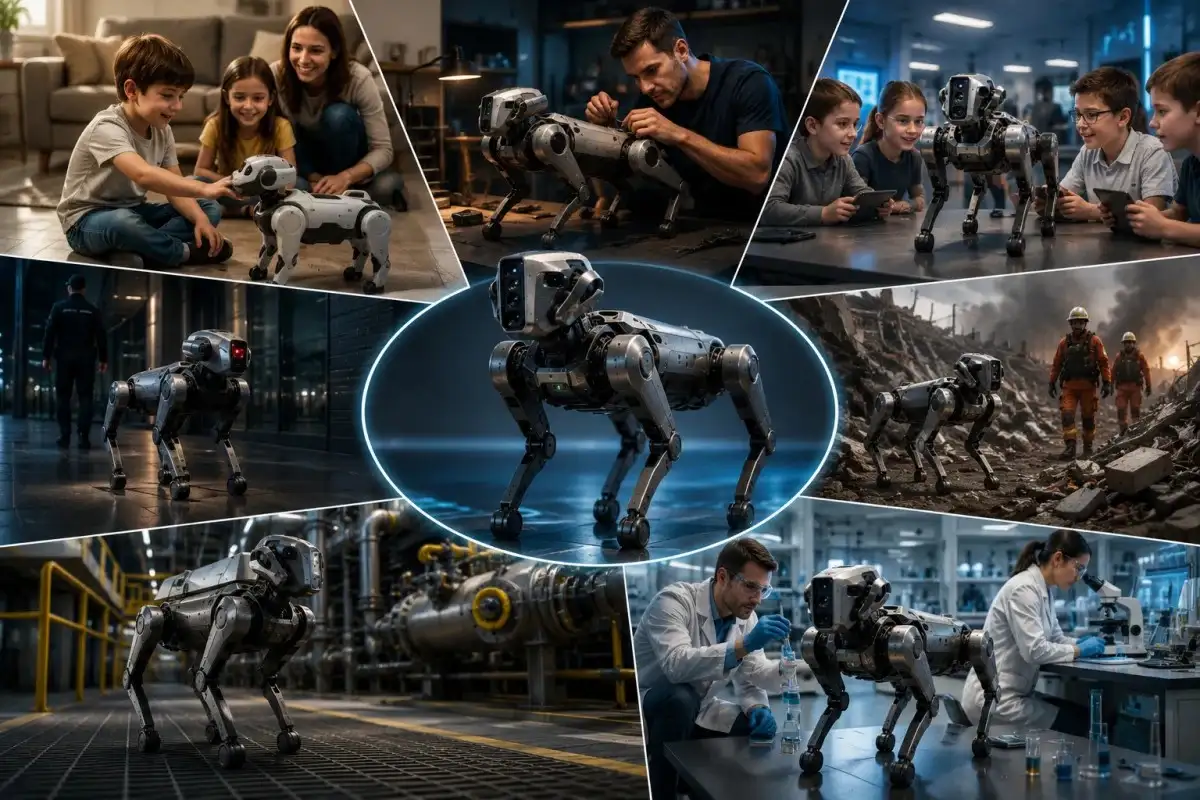
AI Robot Dogs for Adults vs Kids
For kids, the appeal is mostly interactive play. Entry-level and mid-range models are usually the better fit here, since they offer enough responsiveness to feel engaging without the cost or complexity of a premium unit. Durability against drops and rough handling matters more than advanced navigation for this age group.
For adults, the draw tends to split into two directions: novelty and function. Some adults want a robot dog purely as a desk companion or conversation piece, in which case a mid-range model covers the experience well. Others are drawn to the technology itself, using premium models like the Unitree Go2 Pro as an entry point into robotics, programming, or automation projects. This is also where the price jump to the premium tier tends to make more sense, since the added sensors and processing power actually get used.
Real-World Use Cases
Beyond entertainment, AI robot dogs are increasingly showing up in practical roles. Some owners use premium models for basic home patrol, letting the robot’s cameras and mapping capabilities monitor a property or alert them to movement. Others use them in educational settings, where the visible mechanics and AI decision-making offer a hands-on way to teach robotics and coding concepts.
Research and small business use cases are growing too, particularly for tasks like inspecting hard-to-reach spaces, carrying light equipment, or testing automation software in a real physical environment rather than a simulation. These use cases almost always call for the premium tier, since reliable terrain handling and battery life become essential once the robot is doing more than walking across a living room.
AI Robot Dog Ads: What’s Real and What’s Not
If you’ve spent any time scrolling social media, chances are you’ve seen an ad for an AI robot dog that looks almost too advanced to be real, jumping, dancing, or reacting with lifelike precision for a price that seems far too low. This section exists because many people search for AI robot dogs after seeing one of these ads and want to know if it’s legitimate before they buy.
Common Ad Claims and How to Verify Them
Many viral AI robot dog ads use footage that isn’t actually from the product being sold. It’s common for scam listings to repurpose demo videos from premium robotics companies, like Unitree, and pair them with a cheap toy-grade product at checkout. If an ad shows fluid running, jumping, or complex terrain navigation, but the listed price is under $100, that’s a mismatch worth investigating before purchasing.
A quick way to verify a claim is to search for the exact product name or model number listed in the ad, separate from the ad itself, and see whether it shows up on the manufacturer’s official site or a well-known retailer. If the only place the product exists is the ad’s own checkout page, treat that as a warning sign rather than proof of legitimacy.
Red Flags of a Scam Listing
A few patterns show up consistently across misleading AI robot dog ads. Watch for prices that are dramatically lower than the price ranges outlined in the pricing section above, especially when paired with premium-looking marketing visuals. Countdown timers claiming a limited-time discount, vague seller information with no verifiable business name, and checkout pages that only accept unusual payment methods are all common tactics.
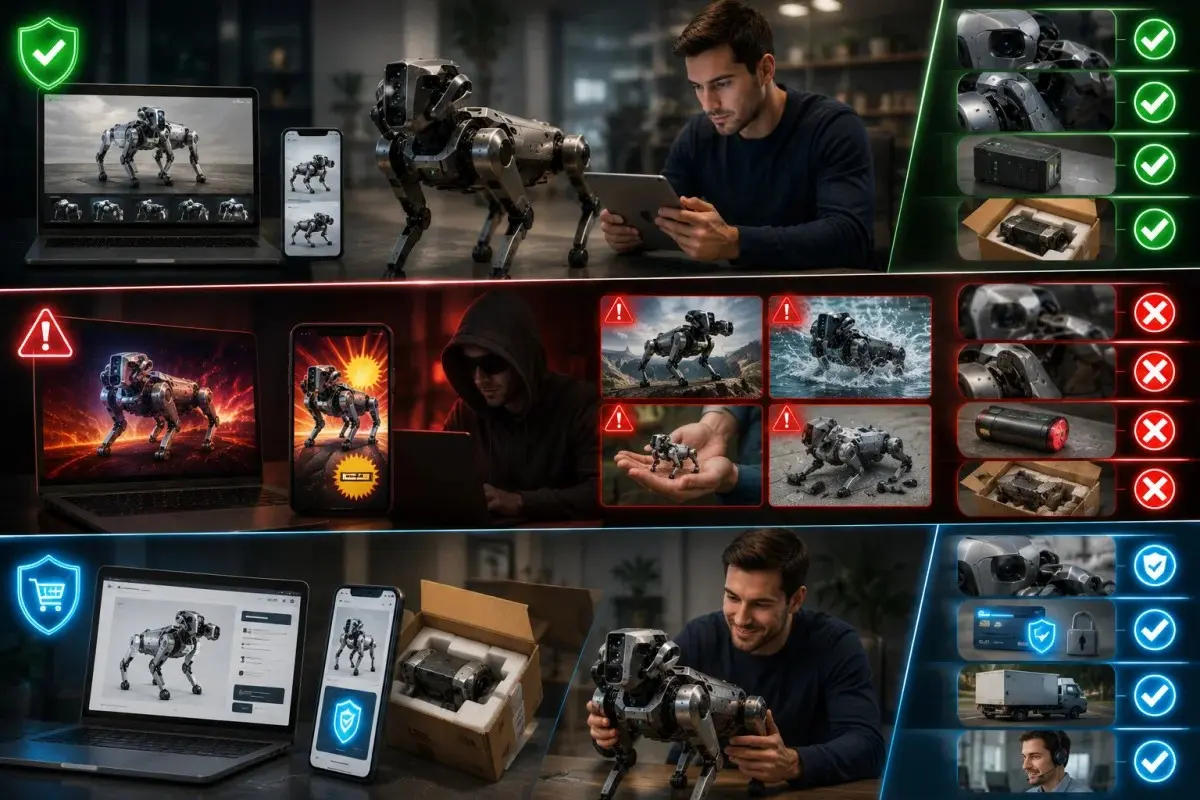
Reviews are another useful signal. A legitimate product usually has a visible trail of reviews across multiple platforms, not just curated testimonials on the seller’s own page. If a product has thousands of ad views but almost no independent reviews anywhere else online, that gap is worth paying attention to.
How to Buy From a Legitimate Seller
The safest path is to buy directly from the manufacturer’s official website or from a well-established retailer that lists the same product with consistent specifications and pricing. Cross-checking the price against the ranges in this guide, entry-level, mid-range, and premium, helps quickly confirm whether a listing is realistic. It’s also worth using a payment method with buyer protection, such as a credit card, rather than direct bank transfers or less traceable payment apps, especially when buying from a seller you haven’t heard of before.
See It in Action
Photos and spec sheets only tell part of the story with AI robot dogs. Since so much of the appeal comes from watching how naturally these robots move, video is often the deciding factor for people trying to figure out if a model is worth buying, or whether an ad they saw is actually accurate.
What to Look for in Demo Videos Before Buying
Not all demo footage is created equal, so it helps to know what you’re actually looking at. Genuine manufacturer demo videos, like those from Unitree, typically show the robot in unedited, real-world conditions: uneven ground, stairs, or outdoor terrain, often with visible imperfections like a stumble or recovery step. This kind of footage is a good sign, since it shows the robot’s actual capabilities rather than a highlight reel.
Be more cautious with videos that only show smooth, studio-lit clips with no visible flaws, especially if that same footage appears across multiple unrelated seller pages. That’s often a sign the video has been repurposed rather than filmed with the specific product being sold. Where possible, look for demo videos on the manufacturer’s official channel or verified retailer listings rather than the ad itself, and compare the movement quality against the price tier it’s supposedly in. A $60 toy that moves exactly like a $2,000 premium unit in its demo video is a mismatch worth double-checking.
Frequently Asked Questions
Is the AI robot dog ad a scam?
Not every ad is a scam, but many viral ones reuse premium demo footage to sell cheap, toy-grade products. Check the price against realistic ranges, search for the product independently of the ad, and look for reviews outside the seller’s own page before buying.
How much does a real AI robot dog cost?
Realistic pricing runs from around $50–$200 for basic toy-grade models, $200–$800 for mid-range units with real sensor-based navigation, and $1,500–$5,000+ for premium platforms like the Unitree Go2 Pro.
Is the Unitree Go2 Pro worth it?
For hobbyists, researchers, or anyone wanting genuine autonomous navigation and rugged build quality, yes. It’s overkill if you just want a fun desk companion, where a mid-range model is a better fit.
Can adults use AI robot dog toys, or are they for kids?
Both. Kids tend to do well with entry-level and mid-range models built for interactive play, while adults interested in robotics or automation get more value from premium units with real sensor and processing power.