You opened a tab to find the answer to one simple question: Is DeepSeek better than ChatGPT? And honestly, you’re not alone. This has become one of the most-searched AI questions of 2026, and for good reason.
Earlier this year, DeepSeek didn’t just show up quietly. It crashed the AI party, shot to the top of app store charts, and caused OpenAI’s stock to take a hit all within days of its release. Tech Twitter went wild. Engineers started stress-testing it. Businesses started asking whether they’d been overpaying for AI tools.
But here’s the honest answer no one seems to give you: there is no single winner. It depends entirely on what you need from an AI assistant. This comparison breaks it all down, benchmarks, pricing, privacy, use cases, and the exact scenarios where each tool wins. By the time you finish reading, you won’t need to check another source. Let’s get into it.
What Is DeepSeek and Why Is Everyone Talking About It?
DeepSeek is an AI research lab based in China, founded as a subsidiary of the quantitative hedge fund High-Flyer. Unlike OpenAI, which guards its model architecture closely, DeepSeek took a radically different approach: it made its models open-source and free to use, with weights you can download and self-host on your own infrastructure.
The model that grabbed global attention was DeepSeek R1, a reasoning model that matched or surpassed OpenAI’s o1 on several key benchmarks but was trained at a fraction of the cost. That combination of performance, price, and openness is what made developers, researchers, and businesses stop and pay attention. Since then, DeepSeek has released:
- DeepSeek V3 – A general-purpose chat model (685B parameters, MoE architecture)
- DeepSeek V3.2 / Speciale – An enhanced version with stronger benchmark performance.
- DeepSeek R1 – A reasoning-focused model optimized for math, coding, and logic.
- DeepSeek R2 – A next-generation reasoning model reportedly in testing as of April 2026.
On the other side, ChatGPT is OpenAI’s flagship product, now powered by GPT-5.4, its most capable model to date. It’s multimodal, deeply integrated into Microsoft 365, and has over 3 years of consumer polish behind it. So the real matchup isn’t just two chatbots. It’s an open-source efficiency engine vs. a closed, full-stack AI platform.
Key Takeaways (Before We Dive Deep)
- DeepSeek wins on math and coding benchmarks and on raw cost efficiency.
- ChatGPT wins on multimodal tasks, creative writing, and ecosystem depth.
- DeepSeek’s API is up to 54x cheaper per million tokens than ChatGPT’s
- ChatGPT has a more polished, feature-rich consumer experience.
- DeepSeek raises legitimate data privacy concerns for enterprise users.
- Neither tool is universally better; the right choice depends on your workflow.
Architecture: How Each Model Is Built
Understanding what’s under the hood helps you predict how each model behaves.
DeepSeek: The Efficiency-First Design
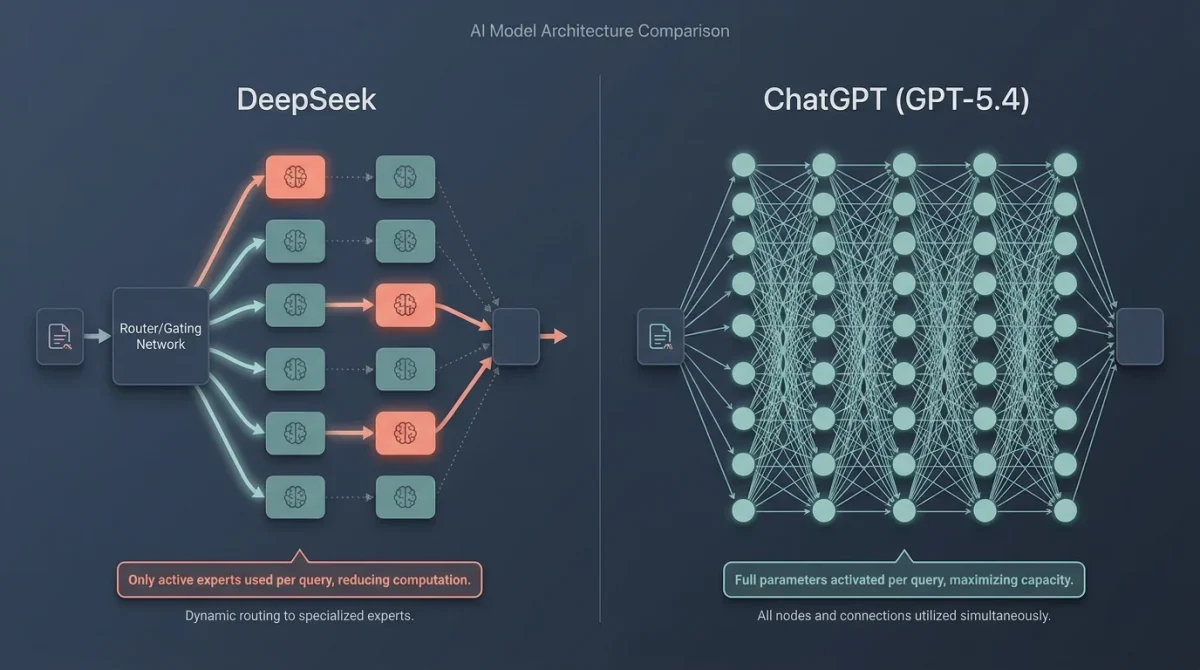
DeepSeek uses a Mixture-of-Experts (MoE) architecture, which means it does not activate all 685 billion parameters for every query. Instead, it intelligently routes each request to the most relevant subset of specialized expert networks. This approach significantly reduces the computational load per query, resulting in lower inference costs and faster response times, especially for focused, structured tasks. It also achieves an impressive performance-to-compute ratio compared to traditional models.
This is a major advantage because it allows DeepSeek to deliver near–frontier–level results without the massive computational overhead of dense models. In simple terms, it combines efficiency with high performance, making advanced AI capabilities more scalable and cost-effective.
ChatGPT: The Full-Stack Approach
ChatGPT, powered by GPT-5.4, operates as a closed and proprietary system, meaning its full architectural details are not publicly disclosed. However, it is known to include a range of advanced capabilities that set it apart. These include a massive 1-million-token context window, which is especially valuable for handling long documents and complex, multi-step tasks with continuity and depth.
In addition, it offers native multimodal functionality, enabling seamless integration with text, images, voice, and video, including Sora. It also supports computer-use features for agentic workflows, enabling more autonomous task execution. All of this is backed by deep integration with Microsoft Azure infrastructure, providing scalability, reliability, and enterprise-grade performance.
Pro Tip
If you’re a developer evaluating models for self-hosting or API cost management, DeepSeek’s architecture gives you significantly more flexibility. If you need an all-in-one consumer AI with voice, image, and deep integrations, GPT-5.4 has no open-source rival yet.
Performance Benchmarks: The Numbers Don’t Lie
This is where things get interesting. Let’s look at what the actual data shows.
Math and Reasoning
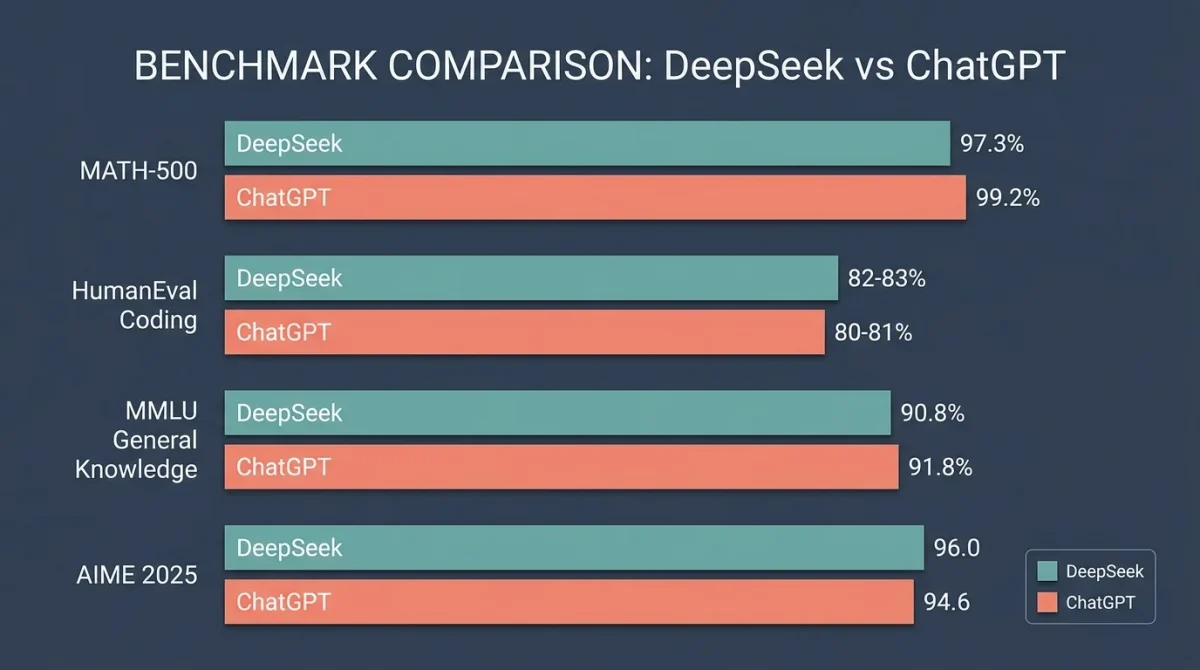
DeepSeek R1 scores 97.3% on MATH-500, compared to OpenAI’s o3 at 99.2%, a gap that has narrowed to a single digit. On AIME 2025, DeepSeek V3.2 Speciale scored 96.0 while GPT-5 High achieved 94.6, meaning DeepSeek actually edged ahead on that specific benchmark.
For pure mathematical reasoning, DeepSeek R1’s reinforcement-learning-based approach helps it decompose problems step by step, making it excellent for explainability in complex calculations.
Coding
On HumanEval, DeepSeek scores 82–83% compared to ChatGPT’s 80–81%, a narrow but measurable lead in raw code generation accuracy. On SWE-bench Verified, DeepSeek scored 73.1 while GPT-5 High received 77.2, giving ChatGPT the edge on real-world software engineering tasks.
As one developer assessment put it: DeepSeek R1 gives you roughly 95% of o3’s math capability at 20% of the cost, making it an attractive option for coding infrastructure where precision matters more than UX polish.
General Knowledge (MMLU)
On MMLU (Massive Multitask Language Understanding), ChatGPT maintains a slight edge: 91.8% vs. DeepSeek’s 90.8%. This reflects ChatGPT’s stronger performance in broad, cross-domain knowledge tasks.
Humanities Last Exam
On the Humanity’s Last Exam benchmark, one of the most difficult AI evaluation sets, DeepSeek scored 30.6, and ChatGPT scored 26.3. DeepSeek wins this one.
Speed
DeepSeek also processes complex tasks up to 2x faster in inference benchmarks, which matters at scale for API-heavy applications.
Bottom Line on Benchmarks
DeepSeek leads in math and structured reasoning. ChatGPT leads in general knowledge, complex software engineering, and multimodal tasks. For most technical benchmarks, both are in the same tier, but DeepSeek is cheaper to run.
Pricing: The Biggest Gap of All
This might be the single most compelling reason developers and businesses are switching to (or at least evaluating) DeepSeek.
API Pricing Comparison
| Model | Input Cost (per 1M tokens) | Output Cost (per 1M tokens) |
| DeepSeek V3/R1 | ~$0.28 | ~$0.55 |
| GPT-5.4 (OpenAI) | $2.50 | $15.00 |
| GPT-4o | $2.50 | $10.00 |
That’s roughly a 54x difference on input tokens and a 27x difference on output tokens between DeepSeek and GPT-5.4. For businesses running high-volume API workloads, think customer support bots, document processing pipelines, or coding assistants. This isn’t a minor cost optimization. It’s a fundamental shift in economics.
Consumer Plans
For individual users, DeepSeek’s free tier is substantially more capable than ChatGPT’s free offering. You get access to a frontier-level reasoning model without spending a dollar.
- DeepSeek: Free tier with generous daily limits; no paywalled features for the base models
- ChatGPT: Free tier (GPT-4o mini access); Plus at $20/month; Pro at $200/month for GPT-5.4 Pro
Pro Tip
If you’re a developer evaluating AI for a startup, run DeepSeek’s API for a month on your actual use case. The cost savings, even at a moderate scale, can fund other parts of your infrastructure.
Feature Comparison: What Each Tool Can Actually Do
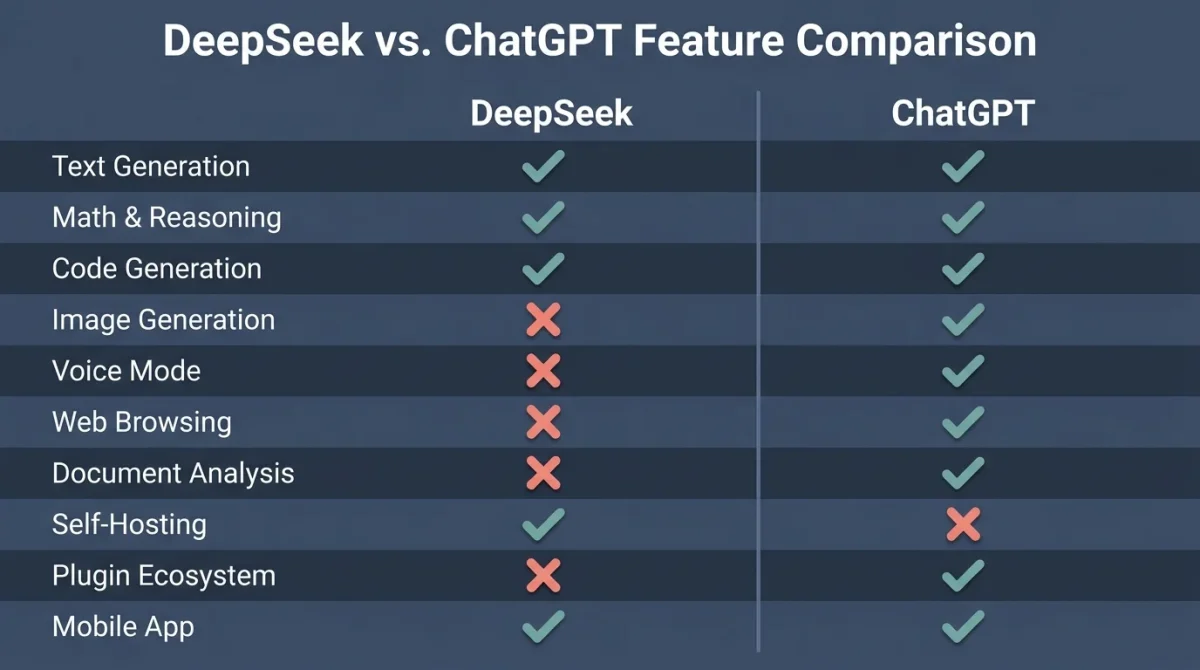
The gap is clearest in multimodal capabilities. ChatGPT can generate images, handle voice conversations, analyze photos, and browse the web in a deeply integrated way. DeepSeek is still primarily a text-in, text-out tool, which limits its use for non-technical users and content creators.
| Feature | DeepSeek | ChatGPT |
| Text generation | Excellent | Excellent |
| Math & reasoning | Top-tier | Strong |
| Code generation | Very strong | Strong |
| Image generation | Not available | DALL-E 3 integrated |
| Voice mode | Not available | Advanced Voice Mode |
| Web browsing | Limited | Full integration |
| Document analysis | Yes | Yes |
| Context window | 128K tokens | 1M tokens (GPT-5.4) |
| Self-hosting | Open weights | Closed model |
| API availability | Yes | Yes |
| Plugin ecosystem | Limited | Extensive |
| Mobile app | iOS & Android | iOS & Android |
| Enterprise tier | Via API only | Full enterprise support |
Who Should Use DeepSeek?
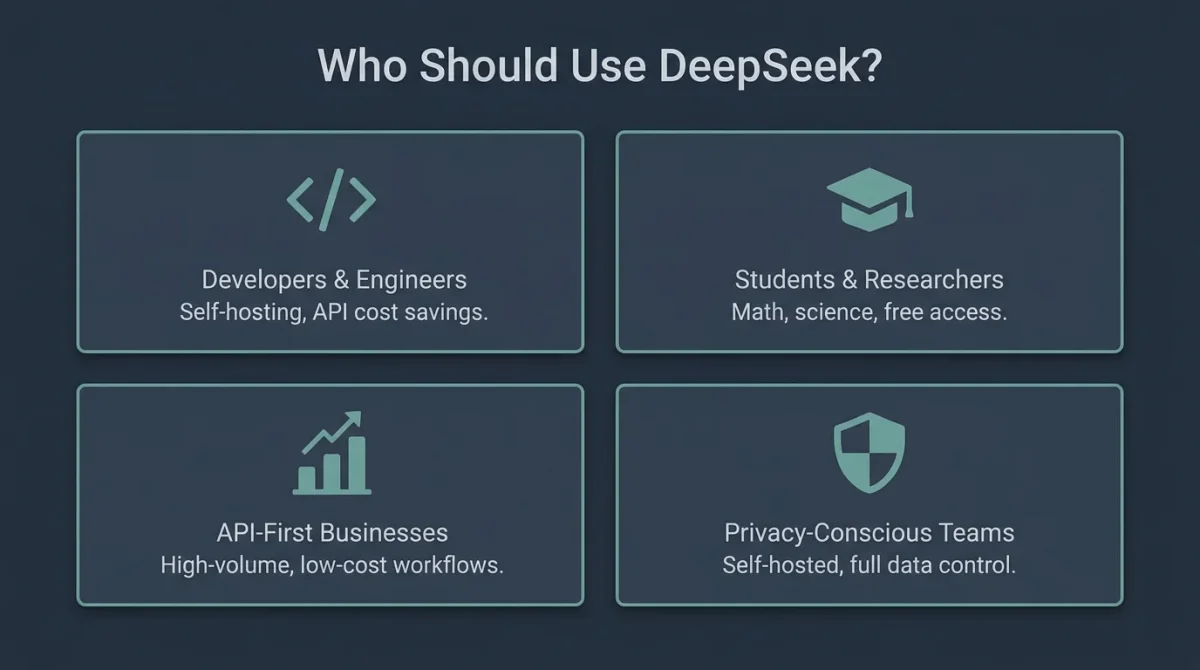
DeepSeek is purpose-built for users who care most about technical performance and cost efficiency. Here’s exactly who it serves best:
Developers and Engineers
If you’re building products that involve coding assistance, algorithmic reasoning, or technical documentation, DeepSeek’s combination of MoE architecture and open weights is a major advantage. You can run it locally, integrate it into your private infrastructure, and eliminate per-token API costs entirely by self-hosting.
Students and Researchers
For anyone working on math-heavy problems, scientific reasoning, or structured analytical tasks, DeepSeek R1’s chain-of-thought reasoning makes it exceptional. Its free tier means students anywhere in the world can access frontier-level AI at no cost.
API-First Businesses
If your core product involves processing large volumes of text, such as legal document summarization, financial analysis, or data extraction, DeepSeek’s API pricing makes it the most economically rational choice at scale.
Privacy-Conscious Self-Hosters
DeepSeek’s open weights allow organizations to download the model and run it entirely on their own servers. This eliminates concerns about data leaving the organization, which is critical in highly regulated sectors like healthcare, along with dental X or defense, but is not an issue when using DeepSeek’s cloud API.
Who Should Use ChatGPT?
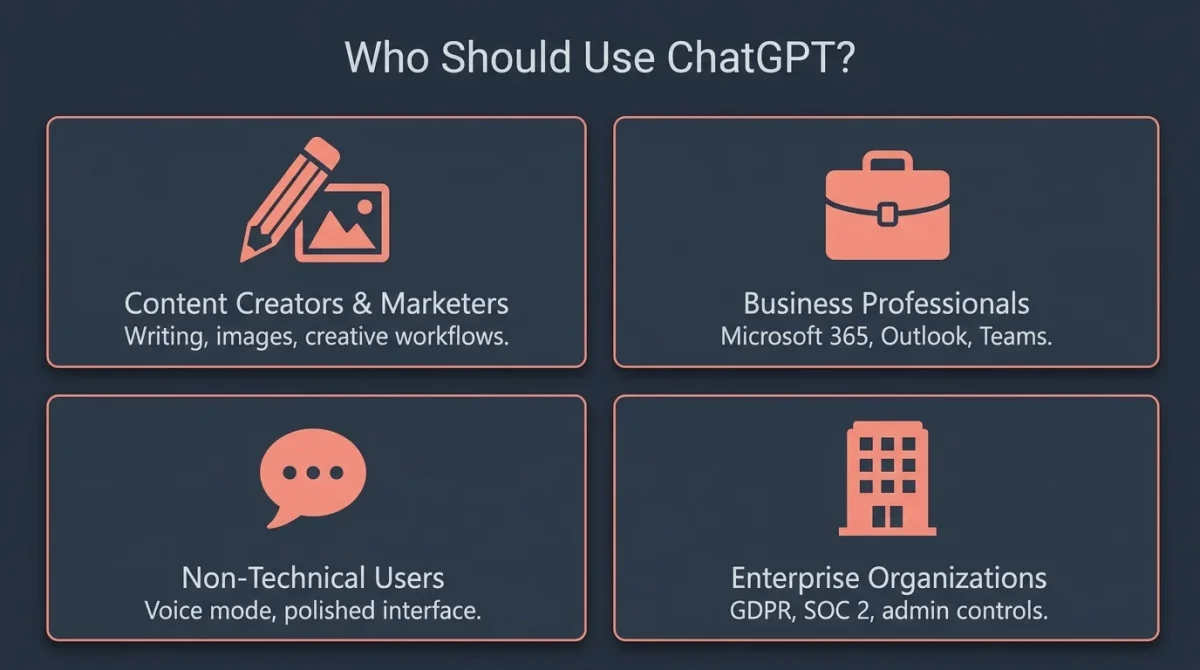
ChatGPT is the better choice when you need breadth, polish, and multimodal capability.
Content Creators and Marketers
ChatGPT’s conversational nuance, creative writing quality, and direct integration with DALL-E for image generation make it a stronger tool for content workflows. Whether you’re drafting blog posts, social media copy, or visual assets, ChatGPT’s all-in-one nature saves significant time.
Business Professionals
The Microsoft 365 Copilot integration means ChatGPT’s capabilities are available directly inside Word, Excel, Outlook, and Teams. For business users who live inside the Microsoft ecosystem, this integration is hard to replicate.
Non-Technical Users
For someone who isn’t a developer, ChatGPT’s polished interface, voice mode, and extensive app integrations make it dramatically easier to use. The UX gap between the two platforms is real and noticeable.
Enterprise Organizations
ChatGPT offers formal enterprise tiers with SOC 2 compliance, admin controls, audit logs, and dedicated support. For compliance-heavy industries, this matters enormously.
Privacy and Security: The Conversation You Need to Have
This is where the DeepSeek conversation becomes significantly more complicated and where many tech articles gloss over the details.
DeepSeek’s Data Concerns
DeepSeek is developed by a Chinese company. When you use its cloud API or web interface, your data routes through servers in China. This creates several concrete risks:
Regulatory non-compliance
DeepSeek’s privacy policy does not comply with the EU’s GDPR. When Italy’s data protection authority requested information about the company’s data practices, DeepSeek stated that EU law did not apply to its services. Italy subsequently banned the service. This adversarial posture toward data regulators is a red flag for enterprise users in regulated markets.
Government data access
Under China’s data laws, including national security regulations, Chinese companies can be compelled to share data with government authorities. For users submitting confidential business strategies, source code, or customer records via the cloud API, this is not a hypothetical risk.
Enterprise liability
Organizations that use DeepSeek’s cloud API without proper safeguards may face GDPR fines of up to €20 million or 4% of global annual revenue, along with reputational damage from any data breach.
The self-hosting exception
It’s worth noting that many of these risks apply specifically to the cloud API. Organizations that self-host DeepSeek’s open-weight models on their own servers eliminate the risk of data transmission entirely. For technical teams with the infrastructure to do this, self-hosted DeepSeek is a genuinely privacy-respecting option.
ChatGPT’s Privacy Position
ChatGPT is not without its own privacy considerations. OpenAI has faced scrutiny over its data handling, particularly regarding free-tier users, whose inputs may be used to improve the model. However, OpenAI’s enterprise tier includes data processing agreements, GDPR compliance mechanisms, and SOC 2 certification, providing a structured legal framework for enterprise use.
Pro Tip
Before using either tool with sensitive company data, read the actual privacy policy. For DeepSeek, assume that any data entered via the cloud API may be accessible to Chinese servers. For ChatGPT, check whether your plan includes a data processing agreement if you’re in the EU.
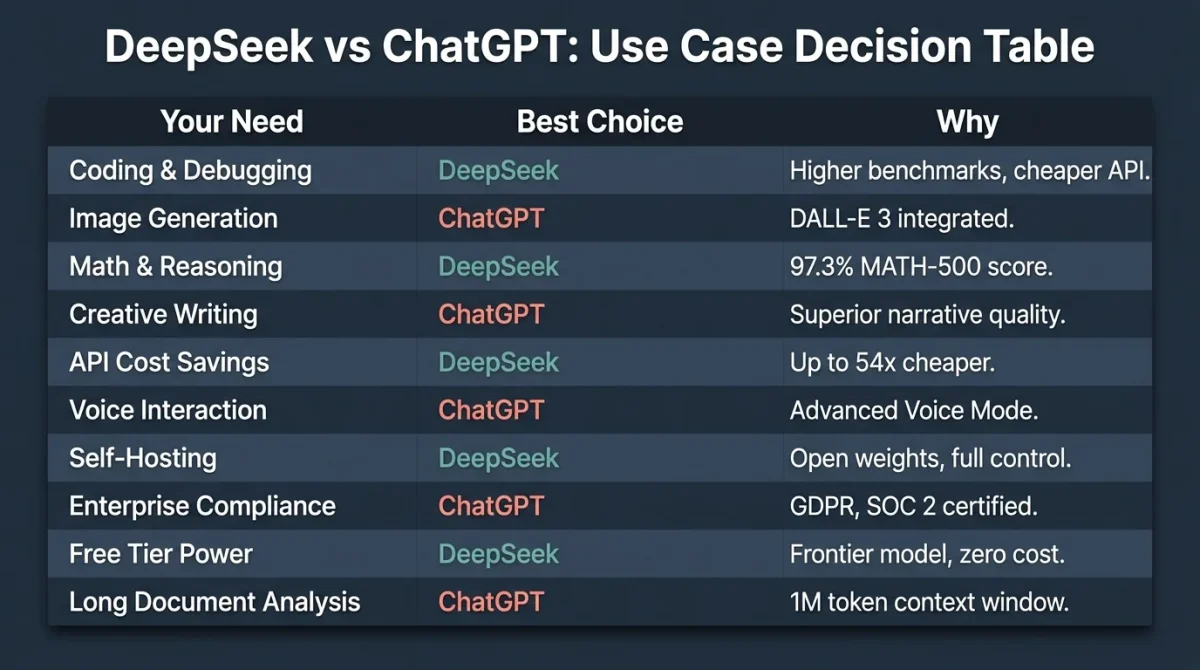
DeepSeek vs ChatGPT: Use Case Decision Table
| Your Primary Need | Best Choice | Why |
| Coding and debugging | DeepSeek R1 | Higher HumanEval, cheaper API |
| Image generation | ChatGPT | DALL-E 3 integrated; DeepSeek has none |
| Math and reasoning | DeepSeek R1 | 97.3% MATH-500, chain-of-thought |
| Creative writing | ChatGPT | Superior narrative quality and nuance |
| API cost optimization | DeepSeek | Up to 54x cheaper per million tokens |
| Voice interaction | ChatGPT | Advanced Voice Mode: DeepSeek has none |
| Self-hosting / privacy | DeepSeek (self-hosted) | Open weights, full control |
| Enterprise compliance | ChatGPT | GDPR, SOC 2, admin controls |
| Free-tier power users | DeepSeek | Frontier model access at zero cost |
| Long document analysis | ChatGPT GPT-5.4 | 1M token context window |
| Microsoft 365 users | ChatGPT | Native Copilot integration |
The Best of Both Worlds Approach
Here’s what high-performing teams are actually doing in 2026: they’re using both. This isn’t fence-sitting, it’s practical workflow design. The tools are genuinely complementary:
- Use DeepSeek R1 for code generation, debugging, data analysis, and structured reasoning tasks where speed and cost matter.
- Use ChatGPT for creative work, client-facing communications, visual content creation, and tasks requiring deep conversational context.
Many developers are building hybrid pipelines: routing logic-heavy tasks to DeepSeek’s API and routing creative or multimodal tasks to GPT-5.4. The cost savings from the DeepSeek portion can effectively subsidize the GPT-5.4 usage, making the overall AI spend more sustainable.
What’s Coming Next: The Roadmap Ahead
The open-source vs. closed-source tension in AI is far from resolved. But one thing is clear: DeepSeek’s emergence has permanently raised the bar for what an AI product needs to offer to justify its price. The AI landscape is moving fast, and the gap between these two platforms is narrowing.
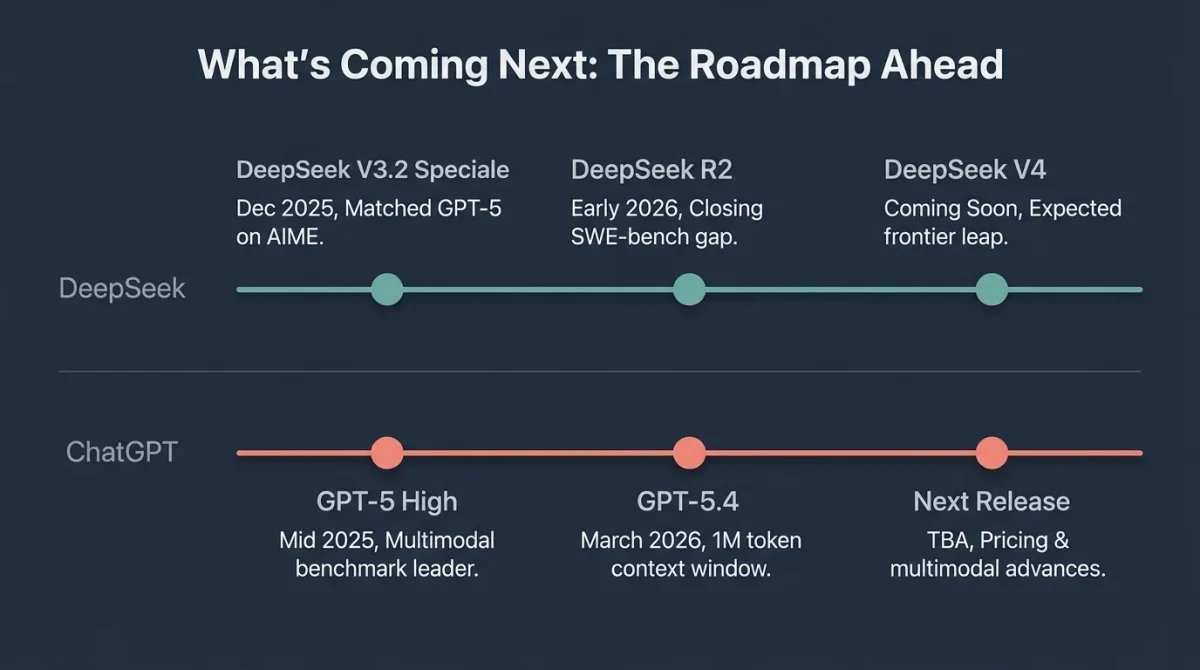
DeepSeek V4
DeepSeek V4 is reportedly in development as of April 2026, with early rumors suggesting it will close or potentially eliminate DeepSeek’s remaining disadvantages in software engineering benchmarks. If V4 delivers on those expectations, the competitive calculus will shift again.
GPT-5.4
GPT-5.4 currently leads in multimodal tasks and context window size, but OpenAI is also facing increased pricing pressure from DeepSeek’s cost advantage. This competition is already driving prices down across the industry, ultimately benefiting every user on every platform.
Conclusion
When comparing DeepSeek and ChatGPT, each platform clearly excels in different areas. DeepSeek tends to outperform in reasoning and mathematical tasks, while ChatGPT leads in multimodal capabilities and overall ecosystem integration. In terms of cost, DeepSeek offers a significant advantage, especially for users looking for high performance at minimal expense.
For enterprise privacy, ChatGPT is generally safer when used in managed cloud environments, though DeepSeek can offer stronger control when self-hosted. DeepSeek also provides better value in its free tier, whereas ChatGPT delivers a more polished and comprehensive consumer experience. Ultimately, the most accurate conclusion is that neither tool is universally better; they are optimized for different use cases. The smartest approach is to match the tool to your specific needs rather than relying on a single tool.
Developers, students, and budget-conscious users who need strong reasoning and coding capabilities may find DeepSeek exceptionally valuable. On the other hand, business professionals, content creators, and users who need an all-in-one solution with voice and image support and integrations will likely alternate to ChatGPT. As both platforms continue to compete, they are driving rapid improvements across the AI industry, delivering more value at lower cost for everyone.
Frequently Asked Questions (FAQs)
Is DeepSeek completely free to use?
Yes, DeepSeek offers a free tier that provides access to its frontier models via its web interface and mobile app. The API is also available at a very low cost, significantly cheaper than OpenAI’s API. Free-tier users can access capable reasoning and chat models without a subscription.
Can DeepSeek replace ChatGPT for everyday use?
For most text-based everyday tasks, such as writing assistance, Q&A, coding help, and research, DeepSeek is a capable replacement. However, if you rely on image generation, voice conversation, or deep integrations with third-party apps, ChatGPT still has a clear advantage.
Is DeepSeek safe to use for work-related tasks?
This depends on your data sensitivity. If you’re using the cloud version of DeepSeek and entering confidential company data, there are real privacy risks related to data residency in China. If you self-host DeepSeek’s open-weight models, this concern is eliminated. For non-sensitive tasks, the cloud version is generally usable, but enterprise users should consult their compliance teams first.
Which AI is better for coding: DeepSeek or ChatGPT?
Both are excellent coding tools. DeepSeek R1 has a slight edge in raw code-generation benchmarks (HumanEval: 82-83% vs. 80-81%) and is significantly cheaper via the API. ChatGPT (GPT-5.4) scores higher on SWE-bench, which tests real-world software engineering tasks. For cost-sensitive developer workflows, DeepSeek is often the better choice. For complex, multi-step engineering projects, GPT-5.4 may deliver more reliable results.
Which is better for content creation?
ChatGPT is a stronger tool for content creation. It offers better narrative quality, integrates directly with DALL-E for image generation, and delivers more nuanced creative brief outputs. DeepSeek is technically capable of writing content, but its strengths are better suited to structured, logical tasks.
Does DeepSeek work in all countries?
DeepSeek’s web and mobile interfaces have faced restrictions or bans in several countries due to data privacy concerns, including in Italy and in some government agencies worldwide. ChatGPT is more broadly available and has clearer legal standing in most Western markets.
Is DeepSeek better than ChatGPT for students?
For students focused on math, science, or programming, DeepSeek’s free tier and strong reasoning performance make it an excellent choice, often better than ChatGPT’s free tier. For general writing, research, and humanities tasks, ChatGPT’s output quality and conversational depth give it an edge.