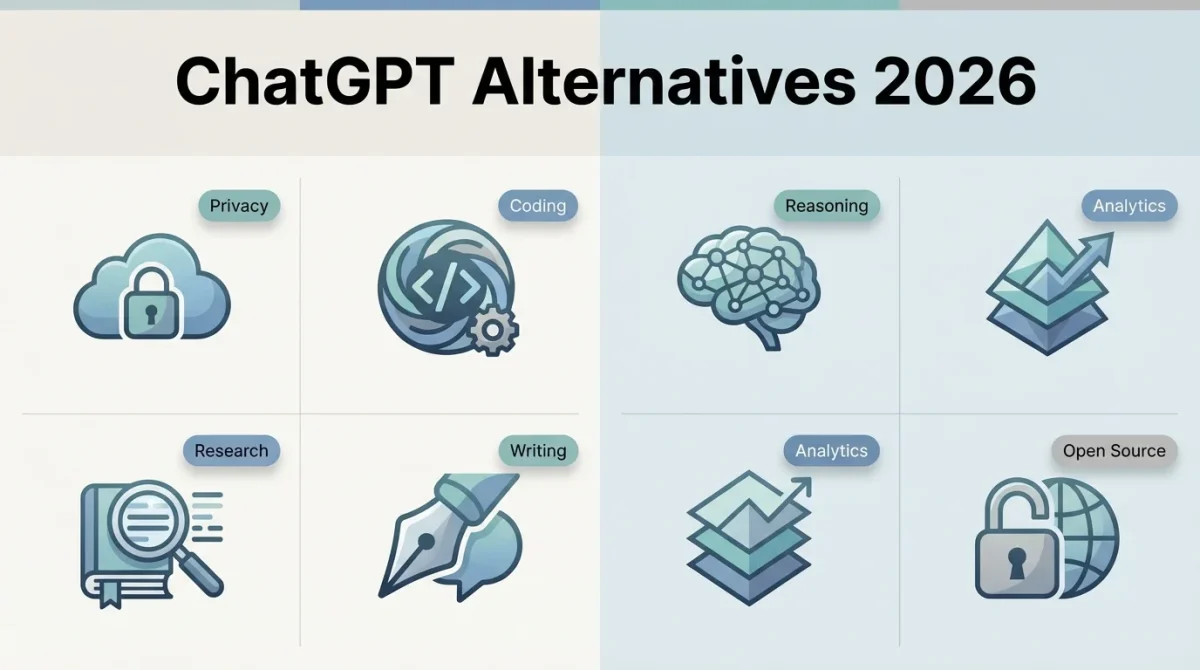
 If you’ve been relying solely on ChatGPT, you might be leaving a lot on the table. The AI landscape in 2026 has matured dramatically, and depending on what you actually need, whether that’s better privacy, stronger coding help, real-time search, or a completely free option, there’s a solid chance one of these alternatives fits your workflow better.
We tested seven of the most talked-about ChatGPT alternatives hands-on, across real tasks: writing long-form content, debugging code, summarizing PDFs, answering research questions, and handling sensitive data. Here’s everything you need to know.
Quick-Reference Verdict
| 1 | Claude (Anthropic) | Overall / Writing | Top-tier reasoning, nuanced outputs, and document analysis. | 9.4 / 10 | High |
| 2 | Google Gemini | Multimodal | Deep Google ecosystem integration; superior image + text understanding. | 9.1 / 10 | Medium |
| 3 | Microsoft Copilot | Office Productivity | Seamlessly embedded in Microsoft 365 with live web access. | 8.8 / 10 | Medium |
| 4 | Perplexity AI | Research & Search | Real-time web search with verified citations and zero hallucinations. | 8.9 / 10 | Medium |
| 5 | Mistral AI | Data Privacy | GDPR-compliant, European-based models with self-hosting options. | 8.5 / 10 | Very High |
| 6 | DeepSeek | Coding & STEM | Competitive with GPT-4 for code generation at a lower cost. | 8.7 / 10 | Low |
| 7 | Meta AI (Llama) | Free Access | No signup needed; accessible via WhatsApp, Instagram, and FB. | 8.2 / 10 | Low–Medium |
Why Look for Alternatives to ChatGPT in 2026?
ChatGPT is still a powerful tool; no one is denying that. But it comes with real limitations that users bump into every day.
The free tier of ChatGPT still throttles access to GPT-4o during peak hours. The Plus plan costs $20/month, and if you need advanced features like custom GPTs, memory, or higher usage limits, you’ll pay $200/month for the Pro plan. That’s a significant investment, especially when competitors are offering comparable, sometimes superior performance at lower or zero cost.
Privacy is another growing concern. Many professionals, especially those in legal, medical, or financial fields, aren’t comfortable with their prompts being used to train future models. ChatGPT’s default data settings have improved, but they’re still not the most transparent in the industry.
Then there’s the question of specialization. ChatGPT is a generalist. It’s good at almost everything but exceptional at very little. If you’re a developer who spends most of your time in a code editor or a researcher who needs real-time, cited information, a purpose-built tool will serve you better.
These are the reasons millions of users have started exploring alternatives to ChatGPT and why we put seven of the best to the test.
How We Tested These ChatGPT Alternatives
Before diving into the list, here’s how we evaluated each tool so you know our verdict is grounded in actual use, not just spec sheets. We tested every tool across five key task categories: long-form writing and editing, coding and debugging, real-time research, document summarization, and conversational reasoning.
We scored each on response quality, response speed, accuracy, ease of use, transparency of privacy policy, and value for money. Privacy ratings are based on each company’s published data policies, regional compliance (especially GDPR), and whether the tool offers a no-training opt-out.

1. Claude by Anthropic — Best Overall Alternative to ChatGPT
If you want the most well-rounded, thoughtful, and safe alternative to ChatGPT available right now, Claude is it.
Developed by Anthropic, a company founded specifically for AI safety research, Claude has consistently outperformed ChatGPT in our tests across long-form writing, nuanced reasoning, and document analysis. Where ChatGPT sometimes rushes to an answer, Claude takes a more measured approach, resulting in more accurate, better-structured outputs.
What Claude Does Best
Claude handles lengthy documents exceptionally well. You can upload a 50-page PDF and ask it to summarize, compare, or extract specific information, and it does so accurately without hallucinating details. It’s also the tool we’d recommend most for professionals who need to draft reports, legal summaries, or detailed content briefs.
Privacy
Anthropic has a strong privacy stance. Claude does not use your conversations to train its models by default in the paid plans. For enterprise users, data isolation is built in.
Pricing
Claude has a free tier with access to Claude Sonnet. The Pro plan runs $20/month and gives you access to Claude Opus, the most capable model in the lineup.
Best For
Writers, researchers, legal and medical professionals, content marketers, and anyone who works with long documents regularly.
- Efficiency score: 9.4/10
- Privacy: High
2. Google Gemini — Best for Multimodal Tasks
Google Gemini is the most capable multimodal AI assistant available to general users in 2026. If your work involves a mix of text, images, data, and real-time information, Gemini pulls ahead of almost every competitor.
Built on Google’s infrastructure, Gemini has something no other AI tool on this list can fully replicate: native, deep integration with Google Search, Google Docs, Gmail, Google Sheets, and the broader Workspace ecosystem. When you ask Gemini a question that requires current information, it doesn’t just pull from training data. It searches the web in real time and surfaces relevant, up-to-date answers.
What Gemini Does Best
Image understanding is a genuine strength. You can upload a chart, a photograph, or a diagram and ask complex questions about it. Gemini’s ability to reason across different input types, text, image, audio, and video, makes it uniquely useful for marketers, designers, educators, and product teams.
Privacy
Google’s privacy record is mixed. Gemini activity is tied to your Google account, and depending on your settings, your data may be reviewed by human reviewers. If privacy is a top priority, Gemini is not your strongest option. That said, Google Workspace enterprise accounts offer stronger data controls.
Pricing
Gemini is free to use via Google. The Gemini Advanced plan, which gives access to Gemini Ultra, is included in the Google One AI Premium plan at $19.99/month.
Best For
Google Workspace users, marketers, educators, and anyone who frequently works with images, documents, and real-time web data.
- Efficiency score: 9.1/10
- Privacy: Medium
3. Microsoft Copilot — Best for Office and Workplace Productivity
If your work life revolves around Microsoft 365 Word, Excel, Outlook, Teams, and PowerPoint, Microsoft Copilot is not just a ChatGPT alternative. It’s practically a different tool category.
Copilot is deeply embedded in the Microsoft ecosystem, meaning it can read your emails, summarize your Teams meetings, draft documents in Word, and build Excel formulas all within the apps you already use every day. It’s powered by GPT-4o under the hood, but the real value is in how seamlessly it integrates into your existing workflow.
What Copilot Does Best
Workplace automation. The ability to say “summarize the last 10 emails from this client” or “draft a follow-up based on this meeting transcript” saves meaningful time. For business users, this kind of integrated productivity boost is hard to replicate elsewhere.
Privacy
Microsoft has invested heavily in enterprise compliance. Copilot for Microsoft 365 (the paid enterprise version) operates under Microsoft’s commercial data protection commitments, meaning your data is not used to train the underlying models.
Pricing
Copilot is free at the basic level via Copilot.microsoft.com. Copilot Pro is $20/month. The full Microsoft 365 Copilot for business starts at $30/user/month.
Best for
Business professionals, office workers, project managers, and teams are already using Microsoft 365.
- Efficiency score: 8.8/10
- Privacy: Medium–High (enterprise)
4. Perplexity AI — Best for Real-Time Research
Perplexity AI sits in its own lane. It’s not trying to be a general-purpose chatbot; it’s trying to be the most accurate, transparent research assistant available. And in that niche, it genuinely succeeds.
Every answer Perplexity AI provides includes cited sources. You can see exactly where the information came from and click through to verify it. This is a massive advantage over ChatGPT, which can confidently produce hallucinated citations that don’t exist. For journalists, students, researchers, and fact-conscious professionals, this alone makes Perplexity worth using.
What Perplexity Does Best
Real-time web research with source citations. It’s also excellent at threading a research topic; you can ask follow-up questions, and it maintains context, building a coherent research thread rather than treating each message as isolated.
Privacy
Perplexity’s privacy policy is relatively straightforward. It does collect usage data, but it doesn’t have the same level of user data entanglement as Google. There’s also an option to disable search history.
Pricing
Free tier available with a limited number of Pro searches per day. Perplexity Pro is $20/month and removes limits while adding access to more powerful models, including Claude and GPT-4o.
Best For
Researchers, journalists, students, fact-checkers, and professionals who need cited, current information.
- Efficiency score: 8.9/10
- Privacy: Medium
5. Mistral AI — Best ChatGPT Alternative for Privacy
If data privacy is your primary concern, Mistral AI is the most credible alternative to ChatGPT on this list.
Mistral is a French AI company, which means it operates under the strictest data protection regulations in the world, namely GDPR. Unlike many US-based AI providers whose data practices are open to interpretation, Mistral’s European foundation gives privacy-conscious users a firmer legal footing. On top of that, Mistral offers open-weight models, meaning you can download and run them locally on your own hardware, keeping your data entirely off external servers.
What Mistral Does Best
Lightweight, fast, efficient models with strong multilingual capabilities. Mistral’s smaller models punch well above their weight class. For developers who want to self-host a capable model without the compute overhead of larger systems, Mistral’s lineup is genuinely excellent.
Privacy
The strongest on this list. GDPR-compliant, no US data jurisdiction, open-weight models available for full local deployment. For businesses in the legal, healthcare, and finance sectors that handle sensitive data, Mistral deserves serious consideration.
Pricing
Mistral’s models are available via API with competitive pricing. The Le Chat interface (Mistral’s consumer chatbot) has a free tier and a Pro tier at $14.99/month.
Best For
Privacy-conscious individuals and businesses, European organizations, developers who want self-hosted AI, and multilingual users.
- Efficiency score: 8.5/10
- Privacy: Very High
6. DeepSeek — Best for Coding and STEM Tasks
DeepSeek’s rise has been one of the most talked-about stories in AI in 2025 and 2026, and for good reason. For a model that costs dramatically less to run than GPT-4o, its performance on coding and technical tasks is genuinely impressive.
DeepSeek R1, in particular, performs at a level that rivals GPT-4o and Claude on mathematical reasoning, code generation, and STEM problem-solving. It’s transparent about its reasoning process, showing step-by-step logic that makes it easier to verify outputs, something developers and students find extremely useful.
What DeepSeek Does Best
Code generation, debugging, and technical reasoning. If you spend most of your AI usage writing or reviewing code, DeepSeek is worth trying. It handles Python, JavaScript, SQL, C++, and most popular languages with high accuracy.
Privacy
This is DeepSeek’s weakest point, and every user should be aware of it. DeepSeek is a Chinese company, and its data practices have raised regulatory concerns in several countries. Data may be stored on servers in China. For personal coding projects, the risk is low. For professional or sensitive work, consider self-hosting the open-source model rather than using a hosted service.
Pricing
DeepSeek is extremely affordable via API. The web interface is free to use.
Best For
Developers, data scientists, engineering students, and STEM researchers who prioritize technical capability over privacy.
- Efficiency score: 8.7/10
- Privacy: Low (hosted) / High (self-hosted)
7. Meta AI (Llama) — Best Free Alternative to ChatGPT
If you want a capable AI assistant without spending a single dollar, Meta AI is the most accessible free alternative to ChatGPT available today.
Meta AI is built on the Llama family of models, which are themselves open source and among the most capable open-weight models in existence. The consumer-facing Meta AI assistant is integrated directly into WhatsApp, Instagram, Facebook, and Messenger, meaning there’s no new app to download or account to create if you’re already using any of those platforms.
What Meta AI Does Best
Accessibility and zero-cost entry. The integration with social platforms lets you ask questions, generate images, and get help without breaking your existing workflow. For everyday tasks, quick questions, casual writing help, and basic research, Meta AI holds its own against paid alternatives.
Privacy
Meta’s track record on privacy is well-documented and not particularly favorable. Your interactions with Meta AI are tied to your Meta account and subject to Meta’s data practices, which have historically included extensive data collection for advertising purposes. Use accordingly.
Pricing
Completely free. No paid tier is currently available for consumer use.
Best for
Casual users, students on tight budgets, social media users, and anyone who wants basic AI assistance without signing up for a paid plan.
- Efficiency score: 8.2/10
- Privacy: Low–Medium
Side-by-Side Comparison: Alternatives to ChatGPT at a Glance
| AI Tool | Best For | Free Tier | Paid Plan | Privacy | Efficiency |
| Claude | Writing & Reasoning | Yes | $20/mo | High | 9.4/10 |
| Google Gemini | Multimodal Tasks | Yes | $19.99/mo | Medium | 9.1/10 |
| Perplexity AI | Research & Citations | Yes | $20/mo | Medium | 8.9/10 |
| Microsoft Copilot | Office Productivity | Yes | $20/mo | Med–High | 8.8/10 |
| DeepSeek | Coding & STEM | Yes | Very low API | Low | 8.7/10 |
| Mistral AI | Privacy & Self-hosting | Yes | $14.99/mo | Very High | 8.5/10 |
| Meta AI | Free Daily Use | Yes | None | Low–Med | 8.2/10 |
How to Choose the Right ChatGPT Alternative for Your Needs
The best alternative to ChatGPT isn’t a universal answer; it depends entirely on what you’re using it for.
- If you write a lot, go with Claude. Its long-form reasoning, tone consistency, and document handling are unmatched in this list.
- If you research and need facts you can trust, Perplexity AI’s citation-first approach is the most honest and verifiable on the market.
- If you work in Microsoft 365 all day, Copilot isn’t even really a competition; it belongs in your workflow.
- If privacy is non-negotiable, Mistral AI, especially the self-hosted version, is the only option on this list where you can genuinely own your data.
- If you code professionally, DeepSeek R1’s performance at its price point is hard to argue with. Just self-host it if the data concerns apply to you.
- If you want something free that just works: Meta AI via WhatsApp or the web is a genuinely solid everyday tool.
- If you want the deepest Google integration and multimodal power, Gemini is your best bet, especially if you’re already in the Google Workspace world.
Final Thoughts
The days of ChatGPT being the only serious option are long gone. In 2026, the alternatives are not just catching up; several of them are leading in specific, important categories.
If we had to recommend just one alternative to ChatGPT for most users, it would be Claude. It balances capability, safety, privacy, and output quality better than any other tool on this list. But the honest answer is that the best tool is the one that fits your specific workflow, and with the options available today, there’s no reason to settle for anything less.
Frequently Asked Questions (FAQs)
What is the best free alternative to ChatGPT?
Meta AI is the most accessible free alternative, but Claude and Gemini also have capable free tiers. For research specifically, Perplexity’s free tier with cited sources is hard to beat.
Which ChatGPT alternative is best for privacy?
Mistral AI is the strongest choice, especially when self-hosted. It’s GDPR-compliant, European-based, and offers open-weight models you can run entirely on your own infrastructure.
Is Claude better than ChatGPT?
For writing, reasoning, and document analysis, Claude consistently performs at or above ChatGPT’s level. It depends on your use case, but for content professionals, Claude is often the preferred choice.
Can I use these AI tools for free?
Yes, every tool on this list either has a free tier or is completely free (e.g., Meta AI). The paid plans generally unlock faster speeds, more powerful models, and higher usage limits.
Which alternative to ChatGPT is best for coding?
DeepSeek R1 is the strongest dedicated coding alternative. Claude and Gemini also perform very well on code-related tasks.








)
&description=&image=https://techwelo.com/wp-content/uploads/2026/04/best-chatgpt-alternatives-2026-comparison-chart-e1776238842946-1024x605.webp)