
Everyone wants to know the same thing right now: when is Veo 4 coming out? And honestly? The answer is more interesting than a simple date.
Google’s Veo series has been one of the fastest-moving stories in AI. It went from a demo concept in 2024 to generating synchronized dialogue, sound effects, and cinematic footage by 2025. Now, creators, filmmakers, and developers are watching closely for what comes next.
This article gives you the full picture. You’ll learn what we know for certain, what the evidence suggests, and what Veo 4 is expected to deliver. No hype. No manufactured rumor. Just a clear, honest breakdown.
What Is Google Veo? A Quick Recap
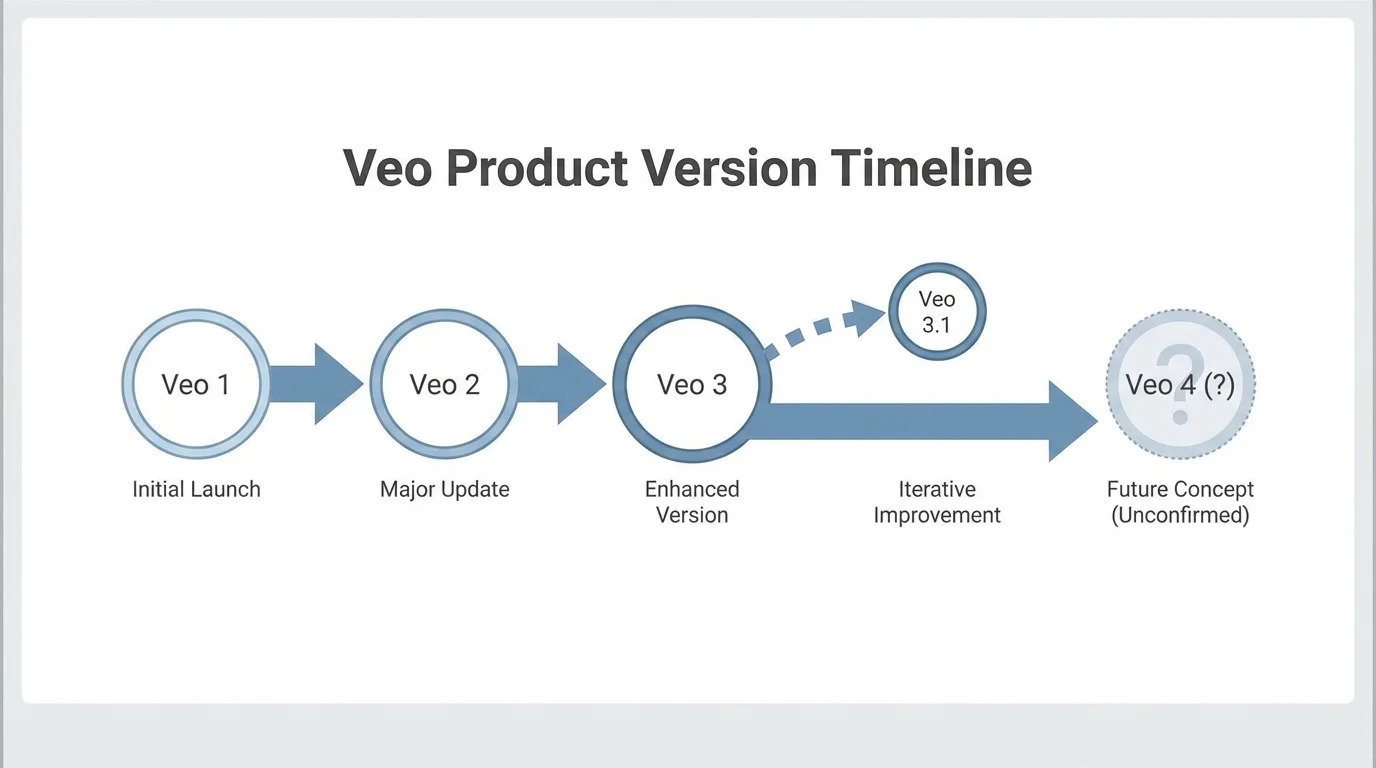
Before diving into Veo 4, it helps to understand where the series started. Veo, or Google Veo, is a text-to-video model developed by Google DeepMind, first announced in May 2024. As a generative AI model, it generates videos from user prompts. Each release has been a meaningful step forward:
The series includes Veo (announced in May 2024), Veo 2 (released in December 2024), and Veo 3 (released in May 2025). Google developed these models to compete with OpenAI’s Sora and Runway’s Gen-3. They generate videos from text prompts or images, with outputs ranging from 4 to 8 seconds depending on the version.
In December 2024, Google released Veo 2, available via VideoFX, with support for 4K-resolution video generation and improved physics modeling. In May 2025, Google released Veo 3, which not only generates videos but also creates synchronized audio, including dialogue, sound effects, and ambient noise to match the visuals.
Then came Veo 3.1, released in October 2025. By October 2025, Veo 3.1 was delivering 4K video with native synchronized audio, something many thought impossible months earlier. This rapid pace is exactly why everyone is asking about Veo 4.
So, When Is Veo 4 Coming Out?
Let’s be direct about this. There is no official release date for Veo 4 as of January 27, 2026. Google has not announced a Veo 4 model on official model pages or release notes, and those are the places that normally update first when a new generation is ready.
Google DeepMind has not officially announced Veo 4. All current information comes from public research trajectories, industry reporting, and the evolution of previous Veo models. That said, the release pattern tells a compelling story.
The Release Pattern: What History Tells Us
Veo 1 was introduced at Google I/O in May 2024. Veo 2 was announced in December 2024. Veo 3 was released in May 2025.
The pattern is consistent. Google has alternated between Google I/O (May) announcements and year-end launches (December). Based on this rhythm, the two most likely windows for Veo 4 are:
Window 1: Google I/O — May 19–20, 2026
Google I/O 2026 is scheduled for May 19–20, with livestreamed keynotes, sessions, and more. May 2026 would give Google a full year post-Veo 3.1 to develop meaningfully improved capabilities. It would also position Veo 4 as a major press moment to counter OpenAI’s competitive advances.
Google I/O 2026 will feature keynote addresses from Google leaders, forward-looking panel discussions, and product demos showcasing the next frontier of technology, kicking off on May 19 at 10 am PT.
Window 2: A Surprise Announcement
If internal testing reveals critical gaps or if competitors accelerate their own releases, Google might announce Veo 4 at a special event or via a surprise blog post. This is less likely but possible if competitive pressure intensifies.
Prediction markets reflect this uncertainty. Community forecasts give roughly 30% odds that Veo 4 launches before May 2026, rising to about 69% before June 2026, suggesting that most informed observers point to mid-2026 as the likely window.
What Will Veo 4 Actually Offer?
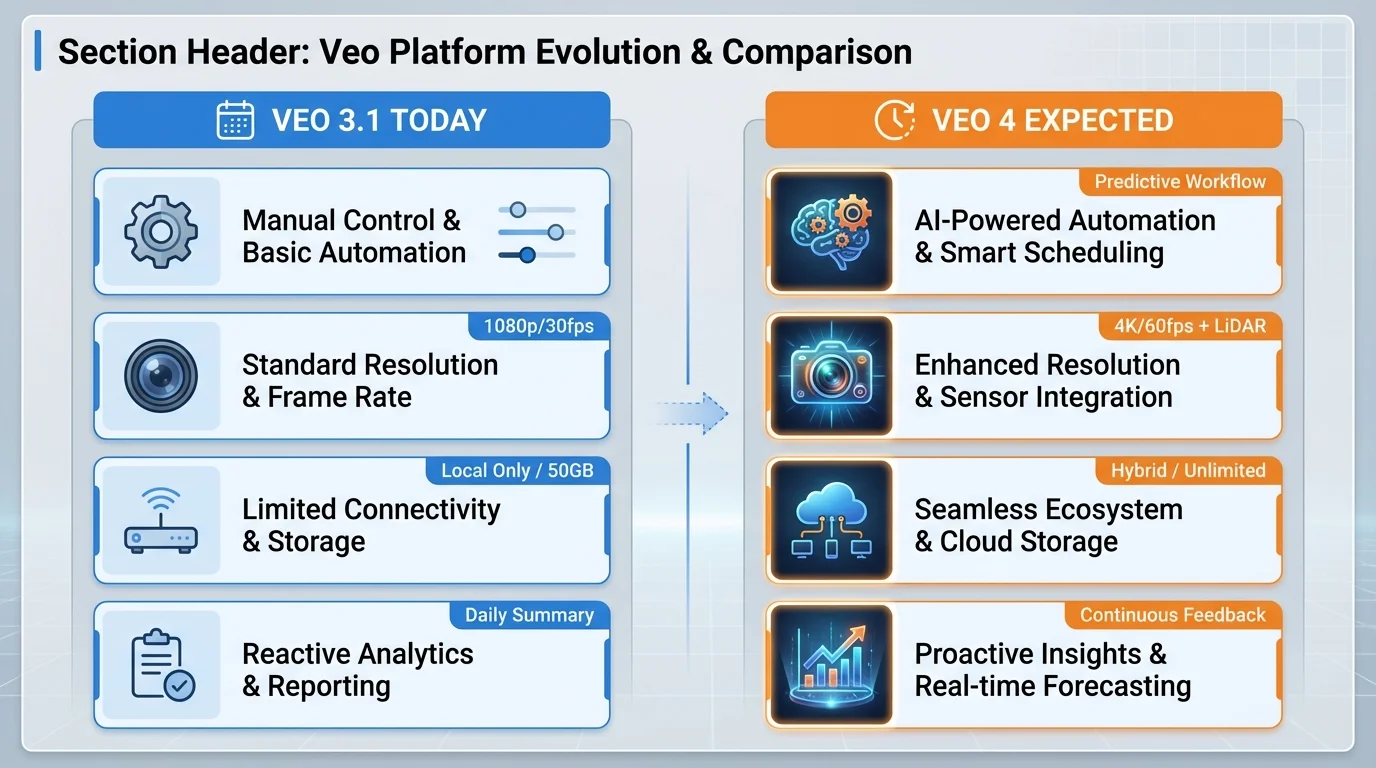
No official feature list exists. But based on documented model evolution, creator feedback, and the competitive landscape, here is what Veo 4 is widely expected to deliver.
1. Longer Video Clips (15–30 Seconds or More)
This is perhaps the most requested upgrade among creators. Veo 3.1 caps at 8 seconds per generation. The entire industry is pushing toward longer, coherent output. A Veo 4 could reasonably push to 15–30 seconds in a single pass while maintaining temporal consistency.
2. Native 4K Output
1080p is the current ceiling for most AI video models. 4K native generation, where every pixel is generated from scratch rather than upscaled, would be a significant differentiator. The compute cost would be substantial, but Google has the infrastructure to make it happen.
3. Better Character Consistency
This has been one of the most frustrating limitations of current AI video tools. Veo 3 sometimes struggles with keeping objects and backgrounds stable across frames. Characters might change their clothing colors, or furniture might shift slightly. Veo 4 should maintain perfect consistency throughout the entire video, an improvement that comes from better temporal understanding.
4. Personalized Avatars and Voice Cloning
Veo 4 might let you upload your photo and voice to create personalized videos. This feature would use your image as a reference to generate consistent character appearances throughout the video. Voice cloning could sync with the avatar’s mouth movements.
5. Advanced Camera Controls and Multi-Angle Generation
Veo 4 introduces more complex angles, better motion logic, and depth-aware transitions. These improvements matter for content creators building Snap Ads, TikTok Reels, and story-based video ads.
6. Better Multilingual Support
Veo 4 is expected to offer higher resolution, longer and more coherent sequences, stronger character consistency, better multilingual support, and higher-quality audio. It’s also expected to provide more robust camera control, editing tools, and workflow integrations.
How Veo 4 Fits Into the Competitive Landscape
The AI video generation market has changed dramatically in the past year. The AI video space has reached a critical inflection point. Every major competitor, Google, OpenAI, and Kuaishou, now supports native audio generation. Veo 3.1 leads in cinematic visual polish and prompt faithfulness. Sora 2 excels at physics-driven scenes and longer clips. Kling 2.6 excels in action sequences and motion control at competitive pricing.
This competitive pressure is actually good news for users. It means Google has strong incentives to push Veo 4 forward quickly. Each model has carved a distinct niche, and Veo 4’s success will depend on where Google can deliver the most meaningful innovation.
Where Will Veo 4 Be Available?
Based on how previous versions launched, Veo 4 will most likely roll out in stages. Expected access points include Google VideoFX, AI Test Kitchen, and enterprise platforms. Third-party APIs on platforms like Vertex AI are also expected, given Veo 3’s expansion.
Most Veo releases launch first to selected partners and platforms, then expand to wider public availability. For pricing, based on Veo 3 ($0.40/second plus subscription fees), expect higher costs for longer clips and premium features.
What Should You Do Right Now?
Waiting for Veo 4 shouldn’t mean standing still. Creators can prepare by using Veo 3.1 today, building character reference sheets, developing prompt libraries, working in 4K timelines, and testing story structures that will transfer directly into Veo 4 once it becomes available.
Conclusion
The honest answer to “when is Veo 4 coming out” is: probably mid-2026, most likely around Google I/O in May, but nothing is confirmed yet. What we do know is that every Veo release has been a genuine leap forward. From 8-second silent clips in 2024 to native audio, cinematic motion, and 4K output by 2025, the trajectory is impressive. Veo 4 has every reason to continue that pattern.
Veo 4 will be powerful. But the best AI tool for video generation is the one that’s there when you need it. Keep an eye on Google’s official channels, Google Cloud, DeepMind’s blog, and Google I/O for the first real announcement. When it comes, it will be worth knowing about.
Frequently Asked Questions (FAQs)
When is the official release date for Veo 4?
As of April 2026, Google has not announced an official release date for Veo 4. Based on the Veo release cycle with major launches at Google I/O and year-end events, the most likely window is Google I/O 2026 (May 19–20). Any specific dates you see online are community speculation, not confirmed facts.
What is Veo 4?
Veo 4 is the anticipated next-generation of Google DeepMind’s Veo AI video-generation model. It is expected to improve on Veo 3 and Veo 3.1 with longer video clips, native 4K output, better character consistency, personalized avatars, and advanced camera controls.
Will Veo 4 be free to use?
Unlikely to be entirely free. Based on Veo 3’s pricing model (around $0.40 per second of video, plus subscription tiers), Veo 4 will probably offer both subscription-based and pay-per-use access. Enterprise tiers through Google Cloud Vertex AI are also expected.
How is Veo 4 different from Veo 3?
Veo 3 introduced synchronized audio generation, bringing dialogue and ambient sound into AI video for the first time. Veo 4 is expected to go further, offering longer clip durations (15–30 seconds vs. 8 seconds), native 4K resolution, personalized avatar generation, and much stronger frame-to-frame consistency.
Is there a Veo 4 beta I can sign up for?
No public beta or waitlist has been announced. Watch Google’s official channels, the Google Cloud blog, DeepMind’s site, and Google I/O announcements for any early access programs.
How does Veo 4 compare to OpenAI’s Sora?
Both are top-tier AI video generation systems. Sora 2 (released September 2025) excels at physics-driven scenes and longer clip lengths. Veo 4 is expected to compete directly with Google’s strengths in audio integration and compute infrastructure, potentially giving it an edge in cinematic quality and multilingual support.
What platforms will support Veo 4?
Following the Veo 3 rollout, Veo 4 is expected to be available through Google VideoFX, AI Test Kitchen, Vertex AI (for developers), and select third-party platforms. Google typically opens access to partners first, then expands to the public.
Should I wait for Veo 4 or use Veo 3.1 now?
If you have active projects, use Veo 3.1 now. It already produces high-quality cinematic video with native audio at 1080p. Building your prompting skills and workflow today means you’ll be ready to hit the ground running the moment Veo 4 drops.









)
&description=&image=https://techwelo.com/wp-content/uploads/2026/04/google-veo-4-release-date-predictions-1024x572.webp)