If you have been paying attention to the SEO landscape over the past couple of years, you already know that something fundamental has shifted. Google is no longer just a list of blue links. It is increasingly an answer engine, one that pulls from AI-generated summaries, AI Overviews, and AI Mode results before a user ever clicks on a single organic result.
For businesses, marketers, and SEO professionals, this shift raises an uncomfortable question: if AI is answering queries before users even see your website, how do you know whether your brand is being mentioned, cited, or completely ignored? That is exactly the problem the Ziptie AI Search Performance Tool was built to solve.
In this complete guide, we are going to break down everything you need to know about Ziptie: what it is, how it works, why it matters for your business, what features set it apart, and how it compares to other AI search visibility tools on the market. Whether you are a solo SEO consultant, a large agency managing dozens of clients, or a brand trying to stay visible in an AI-first search world, this guide is your definitive resource.
What Is the Ziptie AI Search Performance Tool?
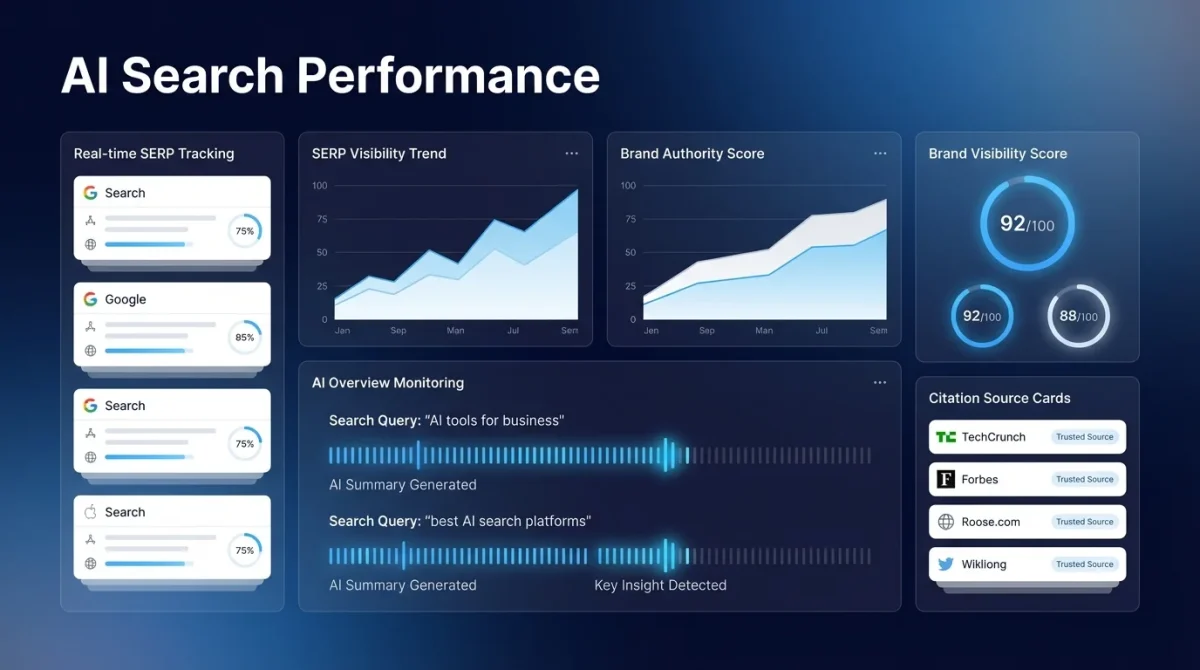
The Ziptie AI Search Performance Tool is a specialized SEO and search visibility platform designed to help businesses track, monitor, and optimize their presence inside AI-generated search results, including Google’s AI Overviews, Google AI Mode, and other AI-powered search surfaces.
Unlike traditional SEO rank trackers that only show you where you rank in standard organic results, Ziptie goes a layer deeper. It monitors whether your brand, content, or website is featured, cited, or referenced in AI-generated answers on the new search results front page.
While conventional rank trackers tell you where your blue link sits, Ziptie tells you whether AI is mentioning you at all and how often, in what context, and against which competitors.
How Ziptie Defines AI Search Visibility
AI search visibility is a concept that most traditional SEO tools have yet to catch up with. It refers to how prominently a brand, domain, or piece of content appears within AI-generated search responses, summaries, and overviews as opposed to standard ranked URL positions.
Ziptie defines this visibility across several dimensions:
- AI Overview presence: Is your content being cited inside Google’s AI Overviews?
- AI Mode rankings: When users switch to Google’s AI Mode, where does your brand appear in the conversational results?
- Brand mention frequency: How often is your brand name or domain referenced in AI-generated answers across tracked keywords?
- Citation quality: Is your content being used as a primary source or a supporting reference?
This multi-dimensional approach to visibility is what separates Ziptie from legacy rank-tracking tools built for a world that no longer quite exists.
The Difference Between Traditional Rank Tracking and AI Mode Rank Tracking
This distinction is worth a moment because it often confuses people new to this space.
Traditional rank-tracking tools, the kind that have been around since the early 2000s, work by querying a search engine for a given keyword and recording the position your URL appears in the organic results: position 1, position 7, page 2, that kind of data.
AI Mode rank tracking is fundamentally different. When a user searches in Google’s AI Mode or receives an AI Overview, the results are not a ranked list of URLs. They are a synthesized, conversational answer generated from multiple sources. Your “rank” in this context is not a number; it is a question of whether your content was selected as a source, how prominently it was cited, and whether your brand name appeared in the generated response.
Ziptie bridges this gap. It gives marketers a structured, trackable way to measure AI visibility using metrics that actually reflect how modern search works, not how it worked a decade ago.
Who Should Use an AI Search Performance Tool?
Ziptie is built for a wide range of users, but it delivers the most value to:
- SEO professionals who need to demonstrate ROI and justify strategy shifts in a world where AI is eating organic click-share.
- Digital marketing agencies manage visibility for multiple clients across different industries and geographies.
- In-house marketing teams at mid-to-large companies that need to protect brand visibility as AI rewrites search results.
- Content strategists want to understand which of their content assets are being picked up by AI search systems.
- PR and brand teams who care about how their company is being described and positioned inside AI-generated answers.
If your business depends on organic search traffic, and most do, then understanding your AI search visibility is no longer optional. It is a core part of modern SEO.
Why Use AI Search Optimization Tools for Your Business
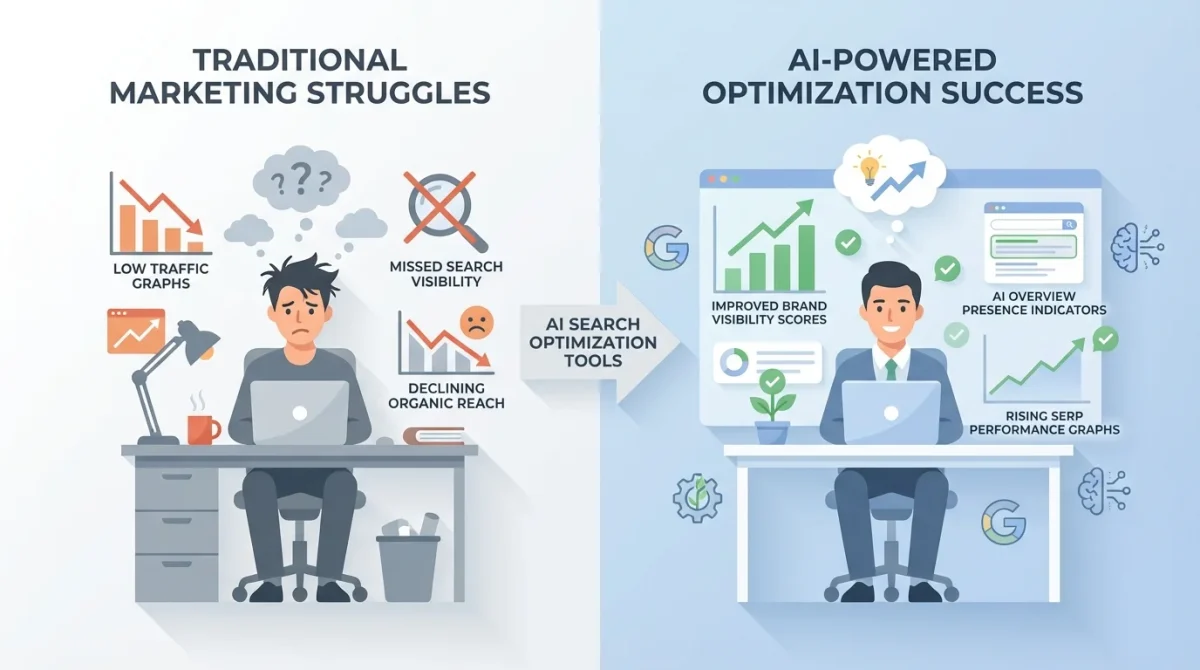
The case for investing in AI search optimization tools has never been stronger. And it is not just about keeping up with trends; there are concrete, measurable business reasons to care about this category of tooling right now.
The Rise of AI Overviews and What It Means for SEO
Google began rolling out AI Overviews (formerly known as Search Generative Experience, or SGE) more broadly in 2024. By 2026, they had become a standard feature of the search results page for a significant portion of queries in the United States and other major markets.
What AI Overviews do is dramatic: they generate a synthesized answer at the very top of the search results page above the ads, above the featured snippet, above everything else. Users can get a comprehensive answer without clicking a single link.
The SEO implications are significant. Studies tracking AI Overview rollouts showed notable drops in click-through rates for queries that included AI Overviews. For informational queries, particularly those that drive the top of the marketing funnel, the impact can be substantial.
But here is the counterintuitive opportunity: the sources that Google’s AI cites inside those overviews tend to receive a different kind of traffic, highly engaged, high-intent visitors who are using the AI answer as a starting point rather than a final destination. Being cited inside an AI Overview is a form of authority endorsement, and it can drive meaningful traffic and brand awareness even as raw click volume shifts.
This is why monitoring AI Overviews is not just a defensive play; it is an offensive SEO strategy.
How AI Search Optimization Tools Improve SERP Rankings
There is a common misconception that AI search visibility and traditional SERP rankings are separate universes. They are not. The two are deeply interconnected. AI search optimization tools like Ziptie improve SERP rankings in several concrete ways:
1. By identifying content gaps
When you can see which queries trigger AI Overviews and which sources are being cited, you can identify exactly what type of content Google’s AI considers authoritative for your target topics. You can then build or optimize content to match those standards.
2. By revealing semantic patterns
AI-generated answers tend to favor comprehensive, well-structured content that covers a topic from multiple angles. Analyzing the content cited in AI Overviews reveals the semantic depth you need to match or exceed.
3. By tracking competitor visibility
If your competitors consistently appear in AI Overviews for keywords where you are absent, that is a clear signal that your content strategy needs adjustment. Visibility data makes this competition legible.
4. By measuring the impact of optimizations
Every SEO change you make, a content update, a new article, a schema markup addition, can now be measured not just against traditional rankings, but against AI visibility metrics. This creates a more complete picture of what is working.
ROI of AI Visibility Optimization
This is the question every marketing director and CMO eventually asks, and it is a fair one.
The ROI calculation for AI visibility optimization tools depends on a few factors: how competitive your industry is, how much of your traffic currently comes from informational and mid-funnel queries, and how aggressively your competitors are moving in this direction.
What we can say with confidence is that the cost of ignoring AI search visibility is increasingly measurable. Brands that are absent from AI-generated answers on their core topics are effectively invisible to a growing segment of searchers, particularly research-heavy ones. These early-funnel users are most valuable for building long-term customer relationships.
For agencies, the ROI case is even clearer. Being able to show clients concrete AI visibility data, “your brand was cited in AI Overviews for 47 keywords this month, up from 12 last month,” is the kind of reporting that justifies retainers and builds lasting client relationships in a way that a position-6-to-position-4 movement never quite could.
Key Features of the Ziptie AI Search Performance Tool
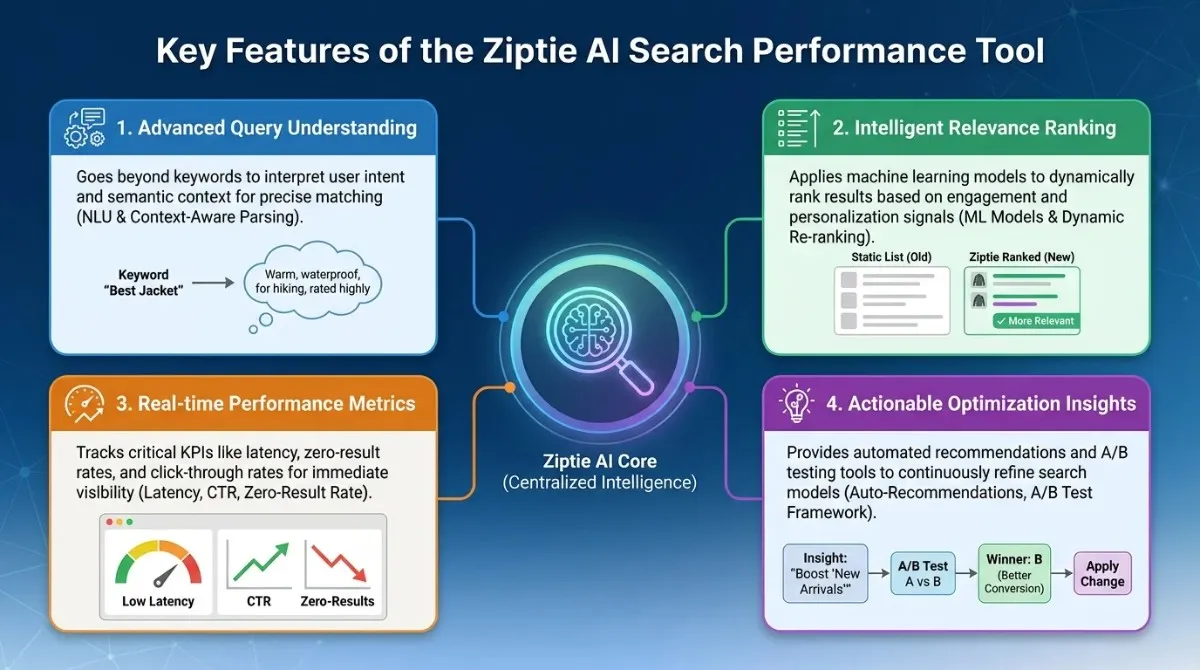
Now, let us get into the specifics. What does Ziptie actually do? Here is a detailed breakdown of the core feature set that makes it one of the leading AI visibility optimization tools available today.
AI Overview Tracking & Monitoring
The centerpiece of the Ziptie platform is its AI Overview tracking capability. This feature continuously monitors search results for your target keywords and records when and how AI Overviews appear, including which sources are cited, how your domain performs relative to competitors, and how AI Overview presence changes over time.
This kind of monitoring matters because AI Overviews are not static. Google’s AI systems update frequently, so a piece of content cited last week may not be cited this week. Conversely, a fresh content update or a new backlink profile can push your content into AI Overview citations that previously eluded you.
Ziptie’s tracking provides historical data to understand these patterns and act on them systematically rather than guess.
AI Mode Rank Tracking
Google’s AI Mode represents the next evolution of search, a fully conversational interface that generates detailed, multi-part answers to complex queries. As AI Mode becomes more widely used, the question of “where do I rank in AI Mode?” becomes just as important as traditional rank tracking.
Ziptie’s AI Mode rank tracking works by querying Google AI Mode for your target keywords and analyzing the structure of the responses, which brands are mentioned, which URLs are cited, how prominently your content features, and how this changes across geographic locations and query variations.
The output is a set of AI Mode visibility metrics that give you a trackable, comparable measure of your performance in this new search environment, just as a traditional rank tracker provides position data for organic results.
Brand Mention Tracking in AI-Generated Answers
One of the most valuable and often-overlooked features in Ziptie is its brand-mention monitoring across AI-generated answers.
When AI systems answer a query, they frequently mention brand names, products, and companies as examples, recommendations, or sources. If your brand is being mentioned positively and frequently inside these answers, that is enormously valuable, as it shapes perception at a crucial moment in the buyer journey. If your brand is absent or a competitor is mentioned where you should be, that is a competitive intelligence signal you need to act on.
Ziptie systematically tracks these mentions across your target keyword set, giving you a clear picture of how your brand is represented in AI-generated search results and how that representation compares to your competitors’.
Google AI Overview Checking & SERP Visibility Reports
Beyond continuous monitoring, Ziptie also provides on-demand Google AI Overview checks, allowing you to query specific keywords and immediately see whether an AI Overview appears, what it says, and whether your content is featured.
This is paired with comprehensive SERP visibility reports that bring together AI visibility data, traditional ranking data, and competitive benchmarks into a single coherent view. These reports are designed to be actionable, not just descriptive dashboards, but tools that help you identify what to prioritize next.
For SEO teams accustomed to pulling data from multiple tools and stitching it together in spreadsheets, this unified reporting capability is a significant time-saver.
Multi-Client AI Search Visibility Management (for Agencies)
For digital marketing agencies, Ziptie offers multi-client management capabilities that enable tracking AI search visibility at scale across a portfolio of clients.
This includes client-level dashboards, customizable reporting templates, keyword set management by client and campaign, and the ability to benchmark each client’s AI visibility against their specific competitive set rather than a generic industry average.
If you are managing AI search visibility for multiple clients, each with different industries, geographies, and competitive landscapes, this kind of structured multi-client tooling is not a nice-to-have. It is essential to deliver consistent, professional results without having your team drown in manual data collection.
Why Choose Ziptie Over Other AI Search Visibility Tools?
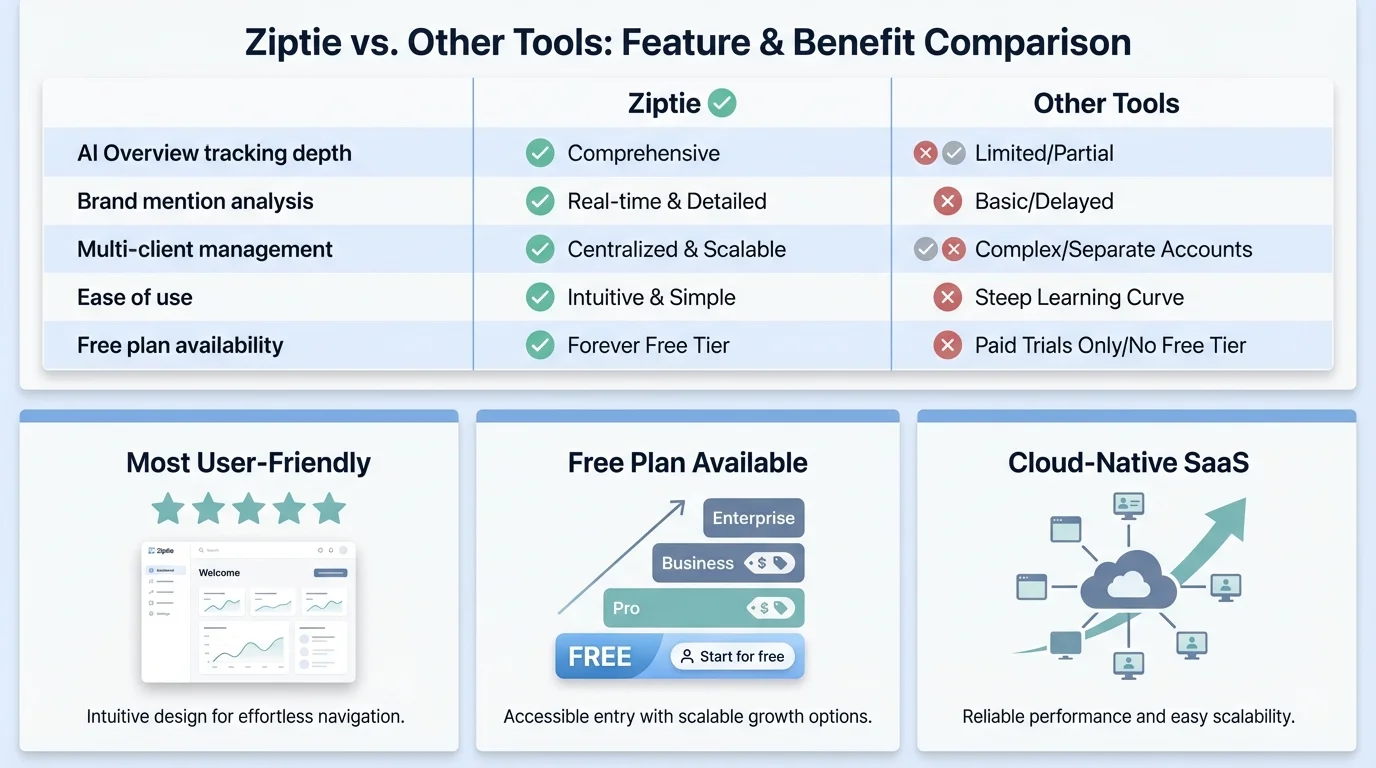
The market for AI search visibility tools has grown considerably over the past year or two, which means you now have real choices to make. Here is an honest look at why Ziptie stands out.
Ziptie vs. Other AI Mode SEO Tracking Tools
Most tools in this space fall into one of two categories: traditional rank trackers that have bolted on some AI Overview monitoring as a feature, or brand monitoring tools that have added some SERP tracking. Ziptie was purpose-built for AI search visibility from the ground up, and that architectural difference shows up in meaningful ways.
Traditional rank trackers with AI add-ons typically offer limited AI Overview data, often just a binary flag indicating whether an AI Overview appeared for a given keyword, with little detail about which sources were cited or how visibility has trended. Ziptie goes significantly deeper, offering citation-level analysis, brand-mention tracking, and comparative competitive data.
Brand monitoring tools that have added SERP tracking, on the other hand, tend to excel at tracking mentions across social media, news, and the web. Still, they lack the keyword-level search visibility data that SEO professionals need. Ziptie bridges this gap by combining search performance data with brand-mention analysis, specifically in AI-generated results.
The result is a tool that is more purpose-fit for the specific challenge of AI search visibility than either of those adjacent categories.
Ease of Use: The Most User-Friendly AI Search Optimization Tool
One consistent piece of feedback from users of AI search optimization tools is that many of them are technically capable but difficult to implement in practice. The interfaces are cluttered, the data is hard to interpret without deep SEO expertise, and generating client-ready reports requires significant manual effort.
Ziptie has invested heavily in usability. The platform is designed so that a marketing generalist, not just a seasoned technical SEO, can understand what the data means and what action to take. Keyword setup is guided, reporting is largely automated, and the dashboard surfaces the most important insights without requiring users to dig through layers of raw data.
For agencies, this usability advantage translates directly into time savings and the ability to delegate more reporting work to junior team members without sacrificing quality.
Pricing & Free Plan: Best Free AI Rank Tracker Option?
Cost is always a factor, especially for smaller agencies and in-house teams working with tight tool budgets. Ziptie offers tiered pricing that is designed to make AI search visibility accessible at different scales.
The free tier includes a meaningful set of features enough to get a genuine sense of your AI search visibility across a core keyword set and see the platform’s capabilities before committing to a paid plan. This makes it one of the more credible free AI rank-tracking options, compared to tools that offer “free” plans with severe limitations that are barely usable.
Paid plans scale based on the number of keywords tracked, the number of client accounts, and the depth of reporting features a sensible structure that allows agencies and enterprises to pay for the capacity they actually need.
If you are looking for a cheap AI overview rank-tracking option to get started, Ziptie’s entry-level plans offer genuine value without locking essential features behind expensive enterprise tiers.
SaaS & Cloud Capabilities for Scalable AI Visibility Management
Ziptie is built as a cloud-native SaaS platform, which means it scales cleanly whether you are tracking 50 keywords or 50,000. There is no software to install, no infrastructure to maintain, and the data is always up to date because the tracking runs continuously in the cloud.
For agencies managing multiple clients’ AI search visibility, this cloud architecture is particularly valuable. New clients can be onboarded quickly, keyword sets can be expanded without performance degradation, and the entire team works from the same data in real time, regardless of whether they are in the same office or distributed across time zones.
The SaaS model also means that as Ziptie adds new features, new AI search surfaces to track, new reporting capabilities, and new integrations, those improvements are available to all users immediately without any manual update process.
Best SEO Strategies for AI Visibility Using Ziptie
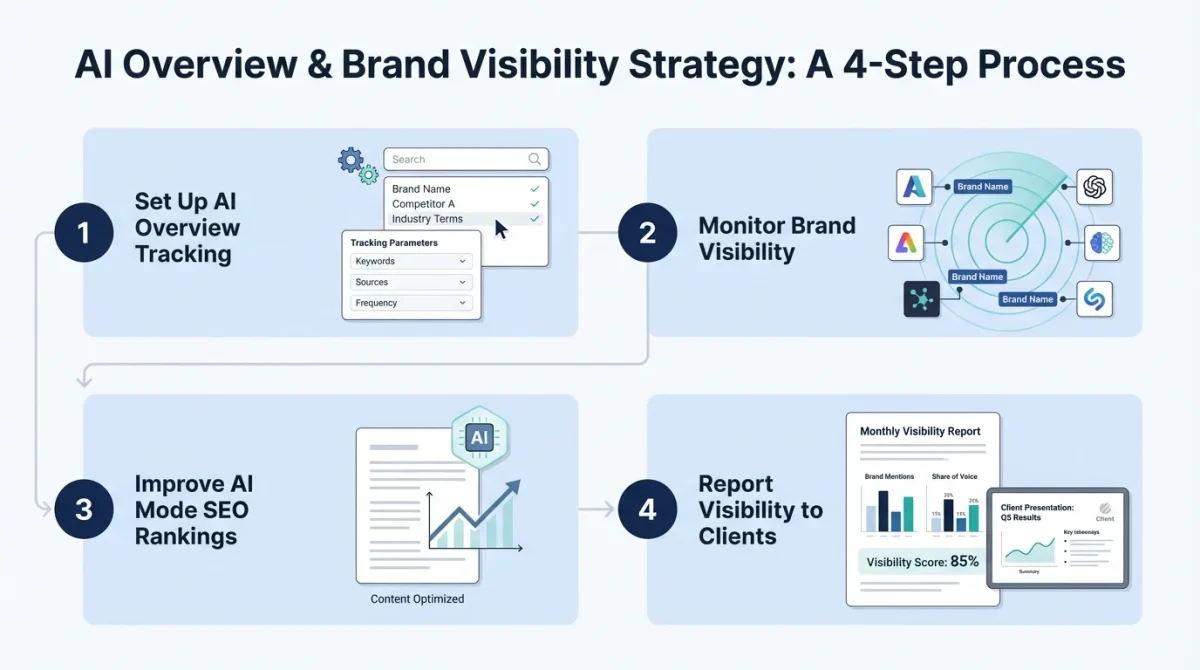
Having the right tool is only half the equation. Here is how to actually use Ziptie to drive measurable improvements in your AI search visibility.
How to Set Up AI Overview Tracking in Ziptie
Getting started with AI Overview tracking in Ziptie is straightforward, but doing it well requires some upfront thought about keyword selection.
The most effective approach is to start with your highest-priority informational keywords. In these queries, a potential customer is researching a problem or solution, and where AI Overviews are most likely to appear. These are typically broad, question-based queries at the top of the funnel.
Once you have identified your target keywords, set up tracking in Ziptie by entering them into the platform with the appropriate geographic targeting for your market. Ziptie will begin monitoring SERP results for these keywords and recording the appearance of AI Overview, citation sources, and visibility trends.
From there, establish a baseline by reviewing the data over the first two to four weeks. This baseline shows where you stand before any optimization work and provides a benchmark to measure against as you make changes.
Monitoring Brand Visibility Across AI Search Platforms
Brand visibility monitoring in Ziptie spans both AI Overview and AI Mode results, and the strategy for using this data effectively differs from traditional brand monitoring.
The key question you want to answer is not just “is my brand mentioned?” but “in what context is my brand mentioned?” An AI system mentioning your brand as a recommended solution for a high-intent query is extremely valuable. An AI system that mentions your brand only in the context of a historical overview, with no commercial intent, is less valuable.
Set up brand mention tracking in Ziptie with your primary brand name, key product names, and any branded search terms that matter to your business. Then, as data comes in, pay attention to the query types associated with mentions. Are you showing up in the research phase, the comparison phase, or the purchase-intent phase? This context shapes how you should respond strategically.
Using Ziptie Data to Improve Your AI Mode SEO Rankings
The most direct path from Ziptie data to improved AI Mode rankings runs through content optimization. Here is the practical workflow:
First, identify keywords where AI Mode is active, but your brand is not appearing. These are your priority target queries where an AI-driven answer is clearly being generated, but your content is not making the cut.
Second, analyze the content cited for those queries. What is the format? What is the depth? What entities and topics does it cover? This is your competitive benchmark.
Third, create or update content to match and exceed that standard. Focus on comprehensive coverage of the topic, a clear structure that AI systems can parse easily, authoritative sourcing and data, and direct answers to the core questions implied by the keyword.
Fourth, track the impact in Ziptie over the following weeks. AI visibility changes can occur more quickly than traditional ranking changes because AI systems continuously re-evaluate sources rather than waiting for periodic crawls and index cycles.
Reporting AI Search Visibility to Clients
For agencies, one of the most practical applications of Ziptie is to build AI search visibility into client reporting in a way that clients can understand and value.
The most effective approach is to frame AI visibility metrics in terms of outcomes that clients already care about: brand awareness, share of voice using AI, and competitive positioning. Rather than leading with technical metrics like “AI Overview citation rate,” translate the data into business language: “Your brand appeared in Google’s AI-generated answers for 63% of your tracked keywords this month, up from 41% last month. Your nearest competitor appeared in 38%.”
Ziptie’s reporting tools make this kind of client-friendly presentation achievable without requiring extensive manual work. Use the platform’s exportable reports as the foundation, then add brief narrative commentary that connects the data to the client’s specific business goals.
Over time, this kind of AI visibility reporting becomes one of the most compelling components of an agency’s value proposition because it is measuring something that matters in today’s search landscape and that most competitors are not yet tracking at all.
Final Thoughts
The shift from traditional organic search to AI-powered search is not a future possibility; it is an ongoing reality reshaping how brands get discovered, how content gets consumed, and how marketing budgets are justified.
The businesses and agencies that are building AI search visibility tracking into their core workflows right now are positioning themselves ahead of a curve that their competitors will eventually have no choice but to follow. The data advantage compounds over time: the longer you track AI visibility, the richer your historical dataset, the better your ability to identify patterns and optimize strategically.
The Ziptie AI Search Performance Tool is one of the most complete and accessible platforms available for this kind of tracking today. Whether you are just starting to explore AI search visibility or looking to replace a patchwork of tools with a unified platform, Ziptie is worth a serious look.
Start with the free tier, track your most important keywords, and see how your brand actually performs in the AI-generated answers that an increasing number of your potential customers see every day. The data will tell you everything you need to know about where to focus next.
Frequently Asked Questions (FAQs)
What is the best AI mode rank tracker tool in 2026?
The best AI Mode rank tracker in 2026 is one that is purpose-built for AI search environments rather than retrofitted from a traditional rank-tracking architecture. Ziptie is widely regarded as one of the leading options in this category for its comprehensive coverage of Google AI Overviews, Google AI Mode, and brand-mention tracking in AI-generated answers, all within a single platform.
When evaluating any AI Mode rank tracker, look for depth of AI Overview citation data (not just appearance/non-appearance), brand mention analysis, multi-client management capabilities, and the ability to track visibility trends over time rather than just point-in-time snapshots.
Which AI search optimization tools have the best ROI?
ROI in AI search optimization tools comes from two sources: the time they save in manual data collection and reporting, and the revenue impact of improved AI search visibility.
Tools that score highest on ROI tend to have strong automation (so your team spends less time gathering data and more time acting on it), actionable reporting (so insights translate quickly into strategy), and clear visibility metrics tied to business outcomes like traffic, leads, and brand awareness.
Ziptie scores well across all three dimensions, which is why it consistently ranks among the strongest AI search visibility tools in ROI, particularly for agencies that can spread the cost across multiple client accounts.
Are there free AI overviews and rank tracker tools available?
Yes, Ziptie offers a free tier that provides genuine AI Overview tracking functionality across a core set of keywords. It is one of the more useful free options in this category, as it provides users with enough data to understand their AI search visibility and to experience the platform’s capabilities before upgrading to a paid plan.
Keep in mind that free tiers across any tool category come with limitations, typically on the number of keywords tracked, the frequency of data updates, and access to advanced reporting features. For serious, ongoing visibility management, a paid plan will provide better coverage and depth.
How does Ziptie track brand mentions in AI-generated answers?
Ziptie tracks brand mentions in AI-generated answers by systematically querying AI search surfaces (Google AI Overviews, Google AI Mode) for your target keywords and parsing the generated responses for brand name mentions, domain citations, and contextual signals.
The platform records not just whether your brand was mentioned, but also in what context: as a primary recommendation, a cited source, a comparative mention, or a passing reference. This contextual data is what makes brand-mention tracking in Ziptie genuinely useful, rather than just a raw count of appearances.
What makes Ziptie different from other AI visibility checking tools?
Several factors set Ziptie apart from other tools in the AI visibility-checking category.
First, it was purpose-built for AI search visibility, not adapted from a traditional rank tracker or brand monitoring tool. This means the data models, tracking architecture, and reporting frameworks are all designed specifically for the unique characteristics of AI-generated search results.
Second, Ziptie combines AI Overview tracking, AI Mode rank tracking, and brand mention monitoring in a single platform. Most competing tools cover one or two of these dimensions, but not all three, which means users of those tools still have to piece together a complete picture from multiple data sources.
Third, the platform’s usability and reporting quality make it practical for agencies to use at scale across multiple clients, not just for power users who are comfortable interpreting raw data.
Finally, Ziptie’s pricing structure is accessible enough that businesses of all sizes can meaningfully engage with AI visibility tracking, rather than treating it as an enterprise-only luxury.