If you’ve been exploring technology-related education or career options, you’ve likely come across the term applied computer technology more than once. But what does it actually mean, and more importantly, what can you do with it?
Unlike pure computer science, which leans heavily on theory and mathematical abstraction, applied computer technology is all about putting technical knowledge to work in the real world. It’s the bridge between understanding how computers function and actually using that understanding to solve everyday problems in businesses, hospitals, schools, and beyond.
Before we dive in, it’s helpful to understand how applied computer technology fits within the broader landscape of computing fields. In this guide, we’ll break down exactly what applied computer technology is, how it differs from related fields, what careers it opens up, how it’s used across industries, and whether it’s the right path for you in 2026.
What Is Applied Computer Technology?
Applied computer technology refers to the practical use of computing skills, tools, and systems to address real-world challenges across different sectors. Rather than focusing solely on research or software theory, it emphasizes hands-on competency in setting up networks, supporting hardware and software, managing systems, troubleshooting technical issues, and deploying IT solutions.
Think of it as computer science with its sleeves rolled up. At the academic level, applied computer technology programs typically prepare students for roles in instructional technology services, IT support, network administration, systems maintenance, and computer operations. At the industry level, professionals in this field keep digital infrastructure running from small businesses relying on a single server to large enterprises managing cloud-based networks across multiple locations.
The word applied is key here. It signals a focus on doing rather than theorizing, making it one of the most employable and versatile fields in the technology sector.
Applied Computer Technology vs. Computer Science
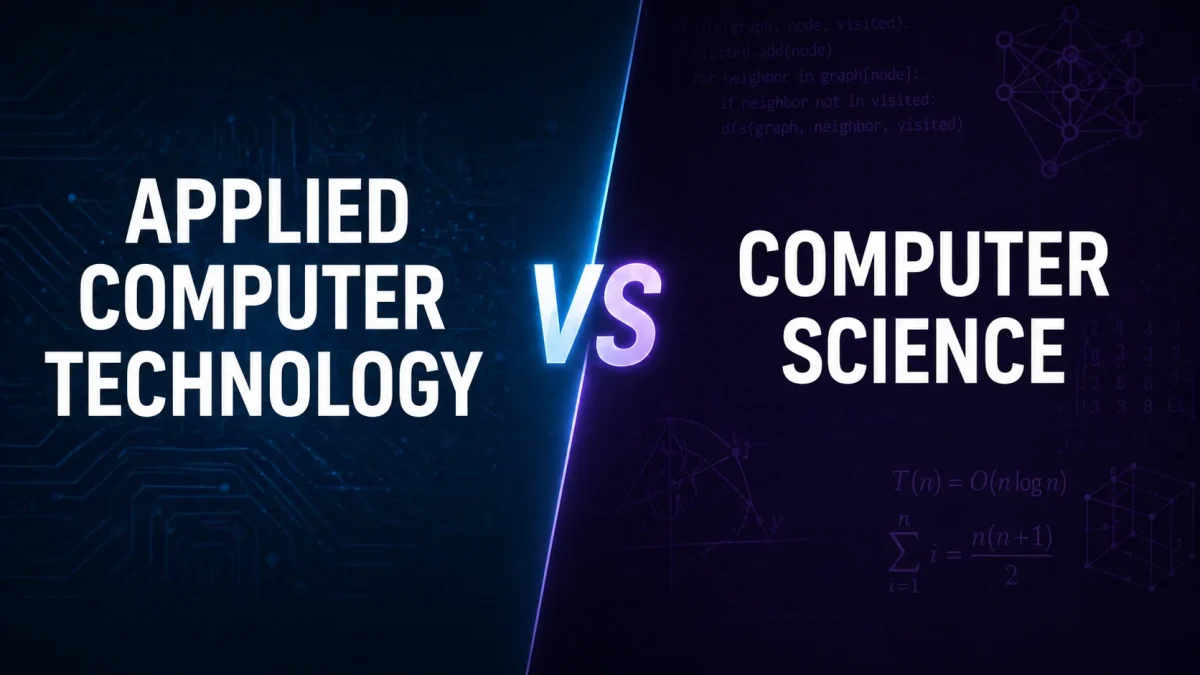
A common source of confusion is how applied computer technology compares to traditional computer science or information technology degrees. Here’s a simple breakdown:
Computer Science
Computer Science (CS) focuses on algorithms, programming languages, software engineering, and theoretical computation. It’s the foundation behind building entirely new technologies.
Information Technology
Information Technology (IT) is concerned with managing and supporting existing systems, networks, databases, hardware, and software infrastructure inside organizations.
Applied Computer Technology
Applied Computer Technology (ACT) sits at the intersection. It draws from both fields but prioritizes practical technical skills over deep theory. Students and professionals in ACT are trained to deploy, maintain, troubleshoot, and upgrade systems rather than invent them from scratch.
In short, a computer scientist might design a new database engine. An IT manager might decide which systems to use. An applied computer technology professional installs, configures, and maintains the database within an organization. All three are valuable, but ACT offers one of the fastest on-ramps into the workforce.
Core Areas Covered in Applied Computer Technology
Applied computer technology is not a single narrow skill; it’s a broad discipline that encompasses several interconnected areas:
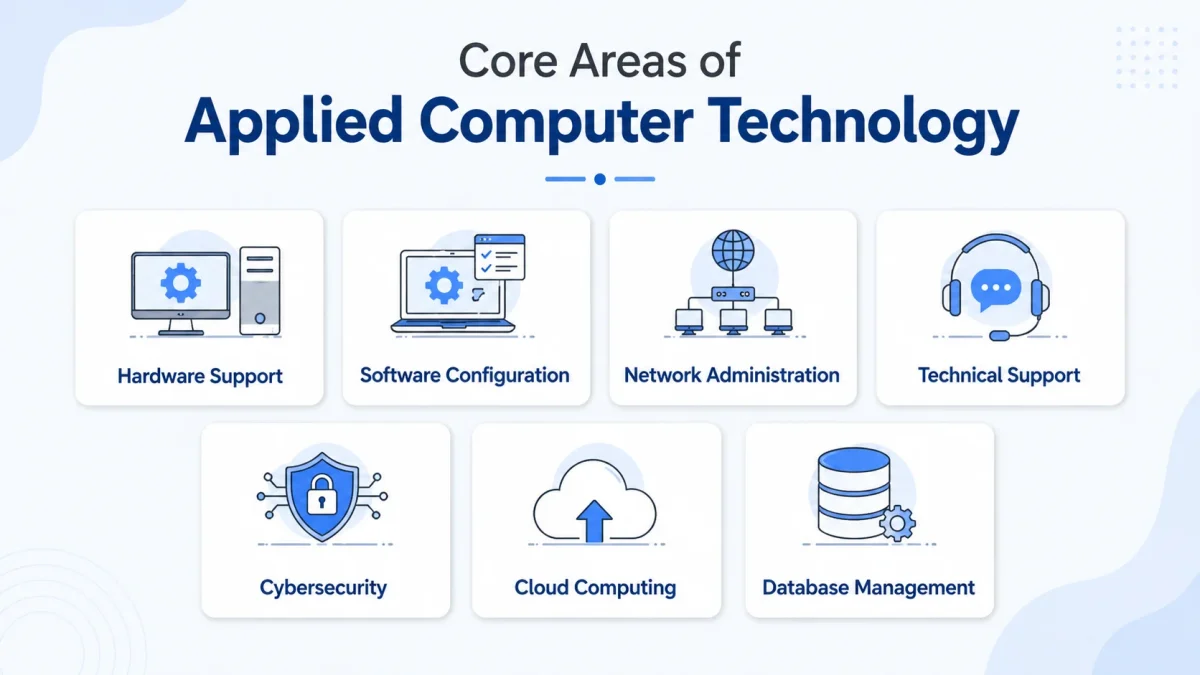
Hardware Support and Maintenance
This covers the physical side of computing: desktops or laptops, servers, printers, and peripheral devices. Professionals in this area install, repair, upgrade, and troubleshoot hardware components to keep systems functional.
Software Installation and Configuration
Installing operating systems, business applications, security software, and productivity tools is a core part of the role. ACT professionals ensure software is properly configured and compatible with the organization’s existing infrastructure.
Network Setup and Administration
From setting up routers and switches to managing local area networks (LANs) and wide area networks (WANs), networking skills are a central pillar of applied computer technology. This includes understanding TCP/IP, VPNs, firewalls, and wireless systems.
Technical Support and Help Desk Operations
Applied computer technology professionals are often the first point of contact when users encounter technical problems. Strong diagnostic and communication skills are just as important as technical ones here.
Cybersecurity Fundamentals
With cyber threats growing every year, ACT programs increasingly include training in security basics, data protection, access controls, phishing detection, and security patch application.
Cloud Computing and Virtualization
Modern workplaces rely heavily on cloud platforms like AWS, Microsoft Azure, and Google Cloud. ACT professionals today need a working knowledge of virtual environments, cloud storage, and remote infrastructure management.
Database Management
Basic database administration, setting up, querying, and maintaining databases, rounds out the skill set for many ACT professionals working within organizations that handle large volumes of data.
Real-World Uses of Applied Computer Technology
One of the most compelling aspects of this field is its widespread applicability across industries. Applied computer technology isn’t confined to the tech sector; it’s embedded in nearly every part of the modern economy.
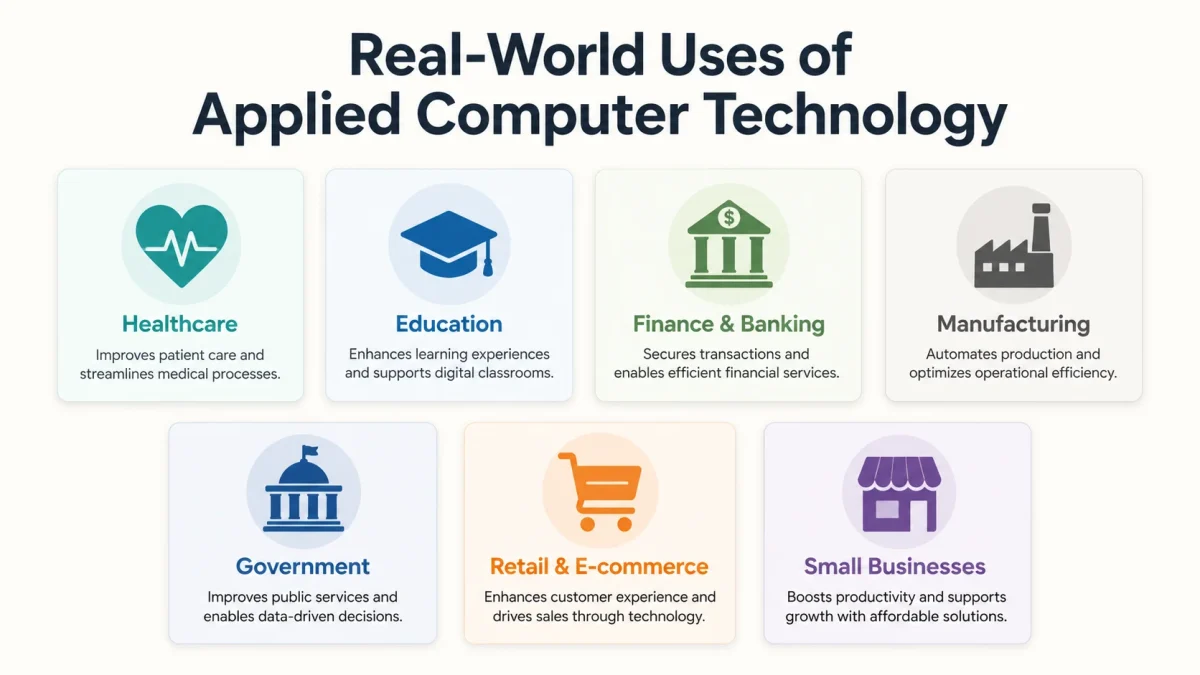
Healthcare
Hospitals and clinics rely on complex digital systems for patient records, diagnostic equipment, and communication networks. ACT professionals manage electronic health record (EHR) systems, maintain medical devices running embedded software, and ensure healthcare networks remain secure and compliant with data privacy regulations.
Education
Schools and universities need IT support to maintain computer labs, manage learning management systems (LMS), support remote learning infrastructure, and keep student data systems running. Applied computer technology graduates often fill roles as instructional technology specialists or campus IT coordinators.
Finance and Banking
Financial institutions use technology to process millions of transactions daily. ACT professionals in this space support trading terminals, maintain secure networks, assist with software deployments, and ensure that compliance-related systems function without interruption.
Manufacturing and Industry
Smart manufacturing increasingly depends on networked sensors, automated equipment, and Industrial Internet of Things systems. Applied computer technology professionals help integrate and maintain the technological backbone of modern factories.
Government and Public Sector
Local and federal agencies require IT support for everything from citizen-facing services to internal administrative systems. ACT-trained staff help manage government databases, secure public infrastructure, and maintain legacy systems that underpin public operations.
Retail and E-commerce
Point-of-sale (POS) systems, inventory management platforms, and customer data systems all need ongoing technical support. Retailers depend on ACT professionals to keep operations running smoothly, especially during high-volume periods.
Small and Medium Businesses
For smaller organizations that can’t afford a full IT department, applied computer technology professionals often serve as generalist technologists, handling everything from setting up office networks to troubleshooting daily issues and managing cybersecurity issues.
Career Paths in Applied Computer Technology
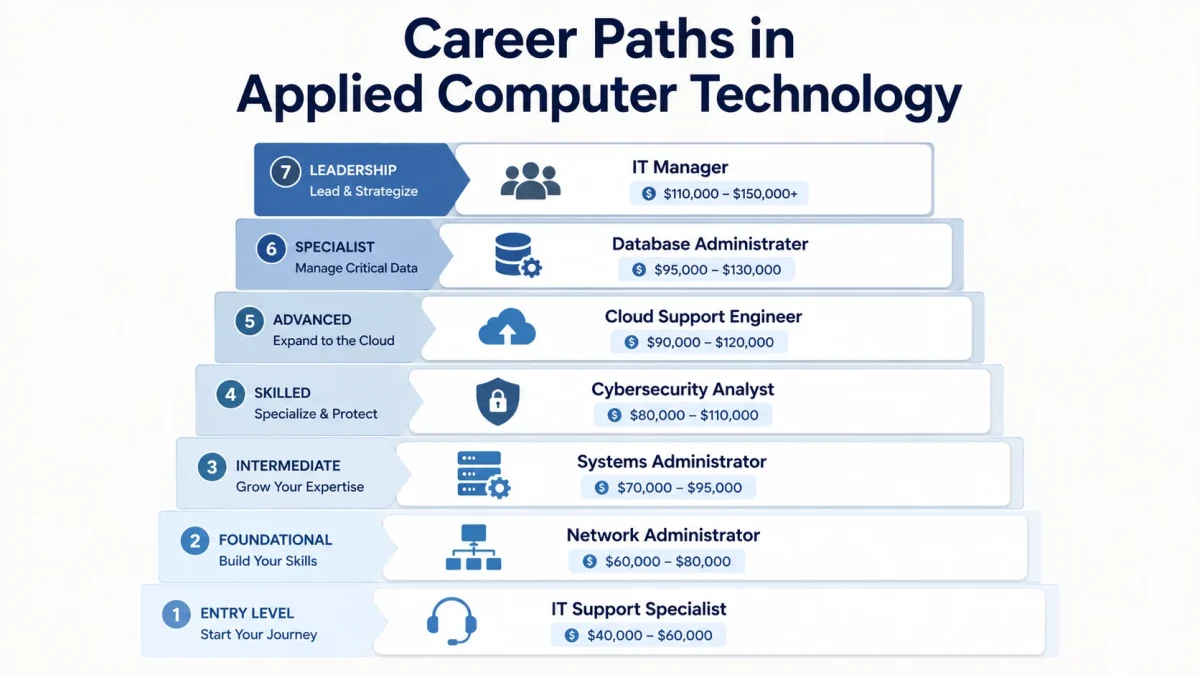
The career landscape for applied computer technology professionals is broad, well-compensated, and growing. According to the U.S. Bureau of Labor Statistics, the median annual wage for computer and information technology occupations was $105,990 in May 2024, significantly higher than the median wage for all U.S. occupations at $49,500. The BLS also projects that this field will generate approximately 317,700 job openings each year, on average, through 2034.
Here are the most common and in-demand career paths available to applied computer technology graduates:
IT Support Specialist / Help Desk Technician
Typical Entry-Level Salary: $40,000–$58,000/year
This is the most common entry point for ACT graduates. Help desk and IT support specialists assist users with technical problems, configure devices, install software, and escalate complex issues. For computer user support roles, employers often value coursework in areas like networking, server administration, and information security over a four-year degree, making this an accessible starting point.
Network Administrator
Typical Salary: $65,000–$90,000/year
Network administrators maintain the computer networks that organizations depend on, monitor performance daily, manage user access, configure routers and switches, and troubleshoot connectivity issues. These roles involve installing and maintaining computer networks and working with a wide variety of computer applications across diverse work environments.
Systems Administrator
Typical Salary: $70,000–$100,000/year
Systems administrators are responsible for an organization’s server infrastructure. They manage operating systems, configure system permissions, handle backups, and ensure uptime for critical business applications.
Cybersecurity Analyst
Typical Salary: $80,000–$130,000/year
One of the fastest-growing roles in technology, cybersecurity analysts protect networks and data from threats. Information security analysts are projected to see 29% employment growth from 2024 to 2034, with a median annual pay of $124,910, making this one of the most lucrative fields for ACT graduates specializing in security.
Cloud Support Engineer
Typical Salary: $85,000–$120,000/year
As organizations migrate to cloud infrastructure, cloud support engineers configure, monitor, and maintain cloud environments. This role combines networking, systems administration, and cloud platform expertise and is a strong fit for ACT professionals who upskill in AWS, Azure, or Google Cloud.
Database Administrator
Typical Salary: $75,000–$110,000/year
Database administrators manage and maintain the systems that store and organize an organization’s data. They handle performance tuning, backups, security, and database access management.
Computer Hardware Engineer
With additional education and experience, ACT professionals can move into hardware engineering roles. These professionals design parts for manufactured products that use processors and other components, such as household appliances, medical devices, and automobiles.
IT Manager / Computer and Information Systems Manager
For those who develop both technical and leadership skills, management is a natural progression. These professionals oversee the IT departments and coordinate technology-related activities within organizations, often earning six-figure salaries.
Education Pathways: What Degree Do You Need?
Applied computer technology is flexible in terms of educational entry points. Depending on the career goal, different levels of education make sense:
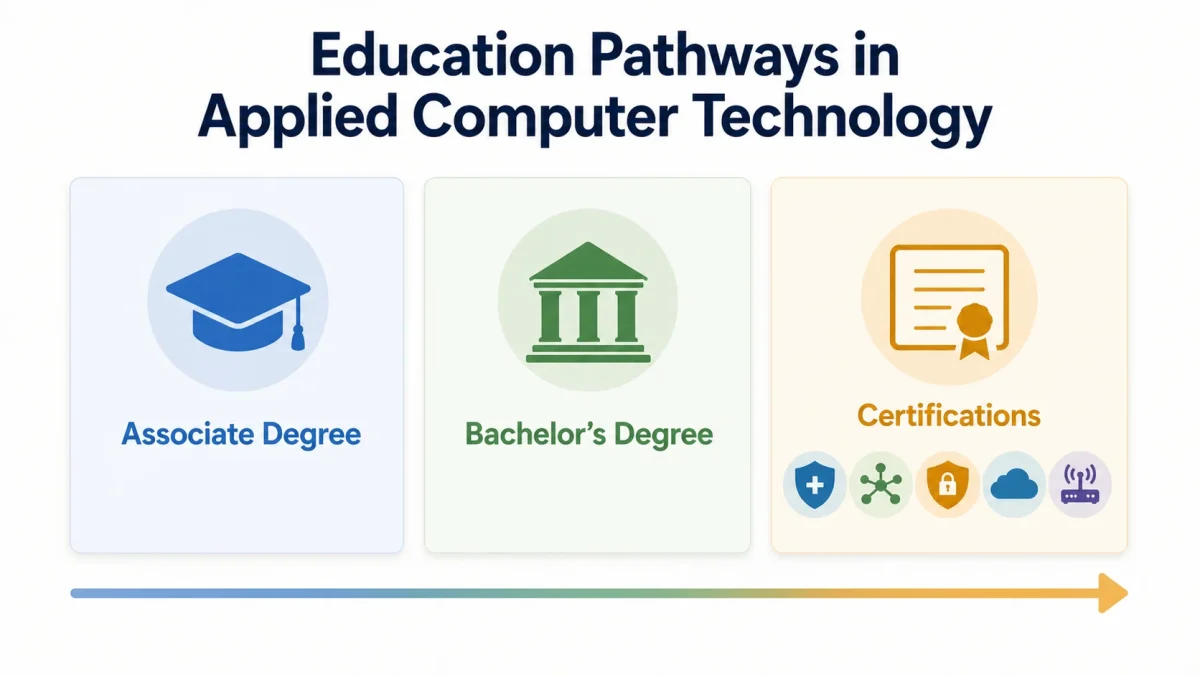
Associate Degree (AAS) in Applied Computer Technology
A two-year associate degree is the most direct path into the field. Programs like the AAS in Applied Computer Technology at RIT’s National Technical Institute for the Deaf lead to immediate entry-level positions in the computing industry, preparing graduates for careers in computer support, hardware/software maintenance, and network installation.
Bachelor’s Degree in Information Technology or Applied Computing
A four-year degree opens the door to more senior technical roles, management tracks, and higher salaries. It also provides a foundation for specialization in areas like cybersecurity, data analytics, or cloud architecture.
Industry Certifications
Certifications are highly valued in this field and can sometimes replace or supplement formal degrees. The most recognized include:
- CompTIA A+ — foundational hardware and software skills
- CompTIA Network+ — networking fundamentals
- CompTIA Security+ — cybersecurity basics
- Microsoft Certified: Azure Administrator — cloud infrastructure
- Cisco CCNA — networking at a professional level
Entry-level industry certifications like CompTIA A+, Network+, and Security+ can often be completed in weeks and qualify candidates for roles such as help desk technician, cybersecurity specialist, or systems administrator, making them a smart investment for those entering the field quickly.
Applied Computer Technology in the Age of AI
The rise of artificial intelligence doesn’t make applied computer technology obsolete; it makes it more important. AI tools need infrastructure, and that infrastructure needs people to maintain it.
In 2026, the nature of IT roles is changing as AI and automation take over more repetitive tasks, but this shift is creating new opportunities rather than eliminating them. The demand is shifting toward professionals who can work alongside AI systems to configure, monitor, and secure AI-powered infrastructure.
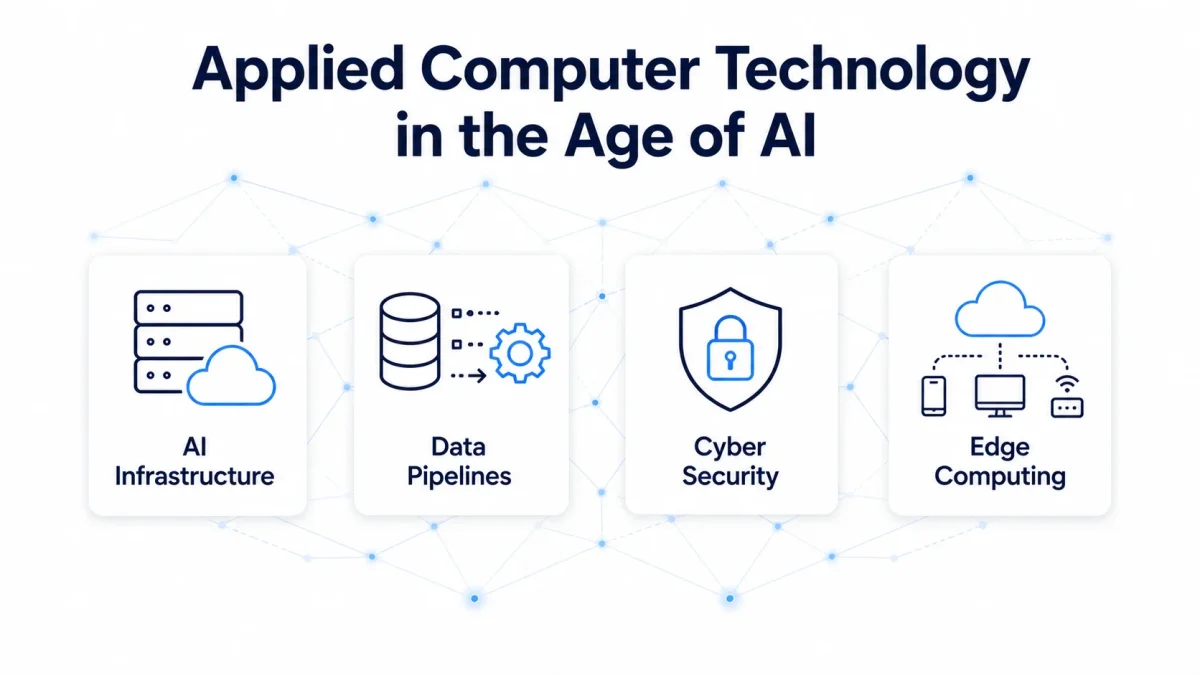
Key areas where ACT professionals will be needed in the AI era include:
- AI infrastructure support — maintaining the servers, GPUs, and network systems that power AI workloads
- Data pipeline management — ensuring clean, reliable data flows between systems
- Cybersecurity for AI systems — protecting AI models and the sensitive data they process
- Edge computing maintenance — managing devices and networks that process AI data locally rather than in centralized cloud environments
The professionals who thrive will be those who combine their foundational ACT skills with knowledge of emerging technologies like cloud computing, machine learning operations (MLOps), and zero-trust security frameworks.
Is Applied Computer Technology the Right Path for You?
Applied computer technology is a strong choice if you:
- Prefer hands-on problem-solving to theoretical research.
- Want to enter the workforce relatively quickly without a four-year degree.
- Are interested in a career with strong job stability and competitive pay
- Enjoy working across different industries and environments.
- Want a foundation that allows you to specialize later (cybersecurity, cloud, AI)
It may not be the best fit if your primary interest is building new software from the ground up, conducting computer science research, or pursuing a career in machine learning engineering. These paths typically require more advanced programming and mathematics.
That said, many successful software developers, cloud architects, and IT directors started their careers in applied computer technology roles and built on them.
Key Skills You’ll Need to Succeed
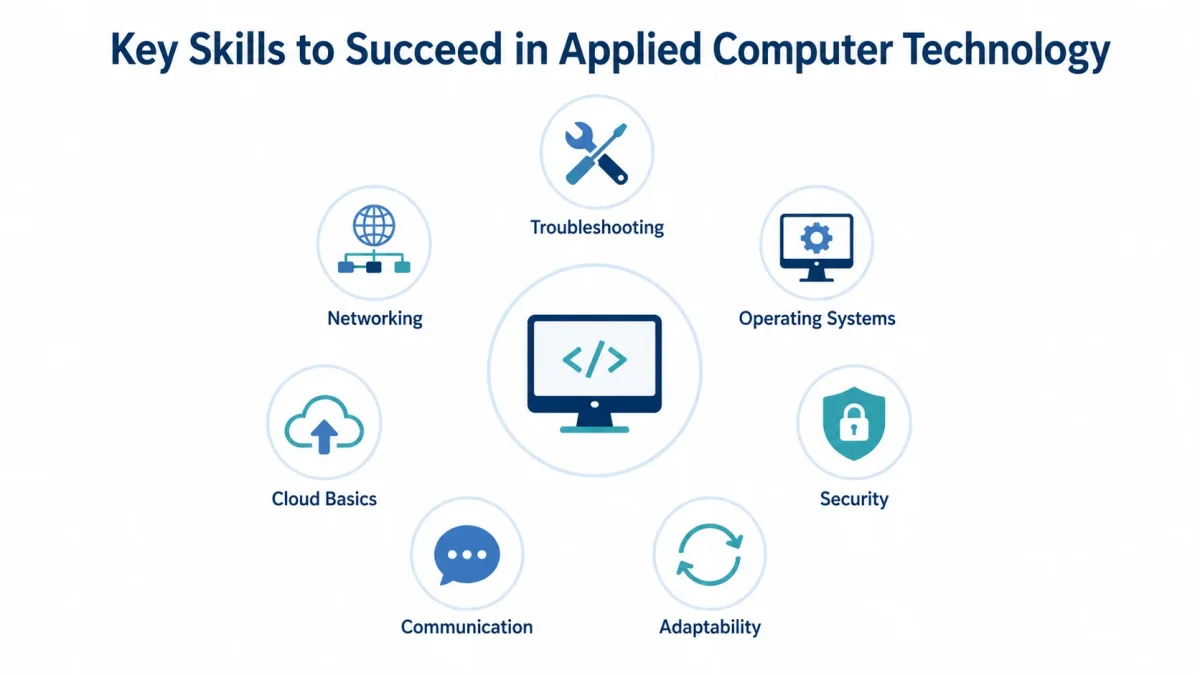
Whether you’re just starting or looking to advance in applied computer technology, the following skills will consistently open doors:
- Technical troubleshooting — diagnosing and resolving hardware, software, and network issues efficiently
- Networking fundamentals — TCP/IP, DNS, DHCP, VPNs, firewalls
- Operating systems — proficiency with Windows Server, Linux, and macOS environments
- Cloud basics — familiarity with at least one major cloud platform
- Security awareness — understanding of common threats and mitigation practices
- Communication skills — explaining technical concepts clearly to non-technical users
- Adaptability — the willingness to keep learning as technology evolves
Conclusion
Applied computer technology occupies a unique and essential position in today’s job market. It’s not about building the next operating system or writing machine learning algorithms from scratch; it’s about ensuring that the technology organizations depend on actually works, day in and day out.
For anyone looking to enter a stable, well-paid, and genuinely impactful career without necessarily spending four or more years in a traditional university program, applied computer technology offers one of the most direct and flexible pathways available.
In 2026, as AI tools, cloud platforms, and connected devices continue to multiply, the need for skilled professionals to install, configure, manage, and secure that technology will only grow. The question isn’t whether this field has a future; the question is whether you’re ready to be part of it.
Start with a foundational certification, build practical experience, and don’t underestimate how far hands-on technical expertise can take you in a world that runs on computers.
Frequently Asked Questions (FAQs)
Is applied computer technology a good career in 2026?
Absolutely. Employment in computer and information technology occupations is projected to grow much faster than average for all occupations from 2024 to 2034, with roughly 317,700 openings projected annually. Demand spans every industry, not just the tech sector.
What is the difference between applied computer technology and computer science?
Computer science is more theoretical and research-oriented, focused on algorithms, software development, and computing theory. Applied computer technology is practice-focused, centered on deploying, maintaining, and supporting technology systems in real-world organizations.
Can I get a job in applied computer technology without a degree?
Yes. Industry certifications like CompTIA A+, Network+, and Security+ are widely accepted by employers, especially for entry-level positions. Many professionals build successful careers through certifications combined with hands-on experience.
What industries hire applied computer technology professionals?
Virtually every industry, including healthcare, finance, education, government, retail, manufacturing, and more, needs IT support and computer systems management. The field offers unmatched industry diversity.
How does AI affect applied computer technology jobs?
Rather than replacing ACT professionals, AI is expanding the scope of their work. New roles are emerging in AI infrastructure support, data pipeline management, and AI system security, all of which draw on foundations in \applied computer technology.
What certifications are most valuable for applied computer technology?
CompTIA A+, Network+, and Security+ are considered foundational. For more advanced roles, certifications from Microsoft (Azure), Cisco (CCNA), and AWS are highly valued by employers.