
If you searched VO Technology and landed here feeling slightly confused, you are not alone. This two-letter prefix carries at least four completely different meanings depending on the industry you work in. A packaging engineer, a startup founder, a student, and a customer service director could all search the same keyword and need entirely different answers.
This guide untangles all of it. Whether you are exploring voice AI for your business, evaluating an IT outsourcing partner, researching sustainable plastics, or considering a vocational-technical career path, this is the only resource you need in 2026.
The 5 Types of VO Technology: A Quick Disambiguation
Before diving deep, here is a clear breakdown of the four distinct things people mean when they say VO technology:
| Type | Full Meaning | Who Needs It |
| Voice AI / VO Tech | Voice-enabled artificial intelligence systems | Businesses, developers, consumers |
| Various Outsourcing Technologies | IT outsourcing via global digital teams | Startups, SMEs, enterprises |
| VOing Technologies LLP | A specific IT consulting and web services company | Businesses seeking outsourced dev |
| VO+ Voiding Technology | Nano-voiding innovation in plastic manufacturing | Manufacturers, sustainability teams |
| VO-Tech (Vocational-Technical) | Hands-on career training in technical fields | Students, career changers |
VO Technology as Voice AI: What It Really Means in 2026
When most tech publications write about VO technology today, they mean Voice AI, the umbrella of technologies that allow machines to understand, process, and respond to human speech with human-like fluency.
This is no longer the clunky voice recognition of a decade ago. In 2026, voice AI has crossed from experimental novelty into mission-critical business infrastructure. The voice recognition market reached $18.39 billion in 2025 and is projected to hit $61.71 billion by 2031, with a compound annual growth rate of 22.38%. Even more telling: 87.5% of builders are actively building voice agents, not just researching them, according to the 2026 Voice Agent Report. That is not curiosity, that is commitment.
What changed? Primarily one thing: latency. The technology breakthrough that triggered the current wave was the elimination of the 3-second processing delay that long made voice bots unusable. Today’s systems respond in under 300 milliseconds within the range of natural human conversation rhythm.
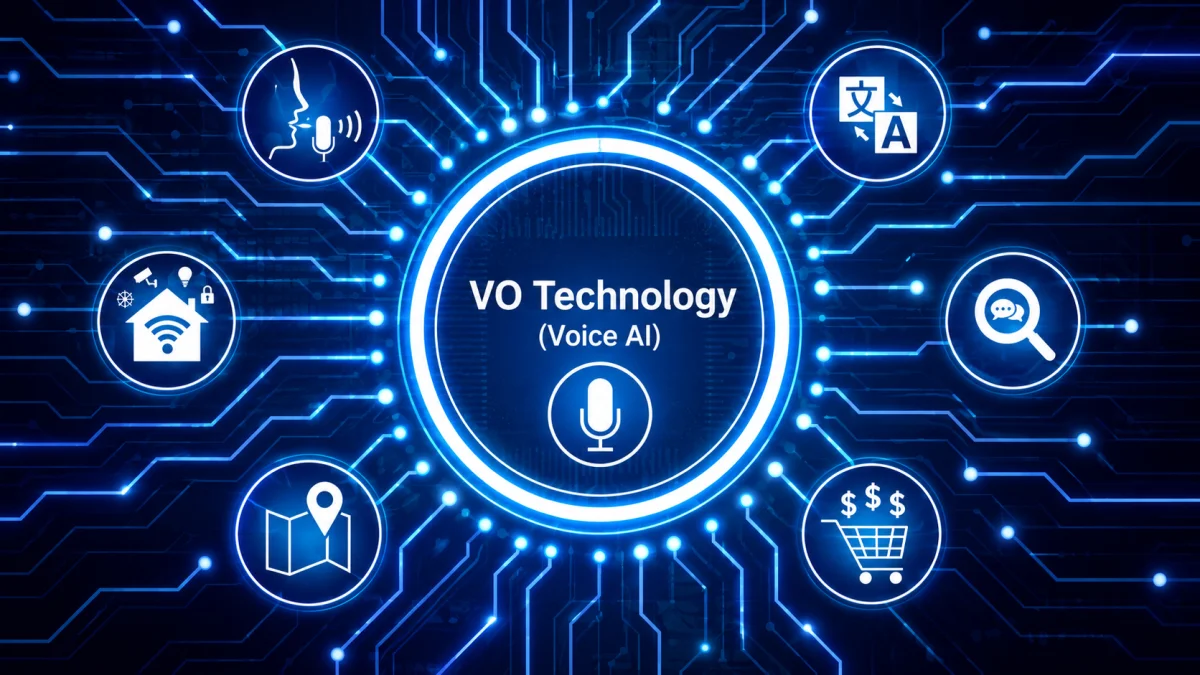
The Technical Architecture: How Voice AI Actually Understands You
Modern voice AI runs on a three-layer stack that processes your words in fractions of a second:
Automatic Speech Recognition (ASR)
ASR is the system’s ear. It converts acoustic sound waves of your voice into text. Today’s ASR models handle accents, background noise, and overlapping speakers with far greater accuracy than legacy systems. Real-time voice AI usage grew 4x in 2025, not because the technology became dramatically faster, but because it became reliable enough to run critical workflows.
Natural Language Understanding (NLU)
NLU is the brain. It doesn’t just read the words; it interprets the intent. When you say “I’m freezing,” a well-trained NLU layer understands that you want the thermostat adjusted, not a weather report. Large Language Models (LLMs) have replaced old keyword-mapping approaches with vector embeddings that grasp semantic relationships between concepts. This enables two capabilities competitors often overlook:
- Code-Switching: The system handles mid-sentence language switches, such as mixing English and Spanish, without losing context.
- Disfluency Handling: Umms, self-corrections, and false starts are filtered out gracefully rather than causing the request to crash.
Neural Text-to-Speech (TTS)
TTS is the voice your users actually hear. The 2026 standard goes beyond generating words; it replicates prosody, the rhythm, pitch, and emotional intonation that make a voice sound human rather than robotic. Companies like Rime are leading this charge: Rime now powers 100 million+ phone conversations monthly, differentiating through a proprietary dataset of real conversations with everyday people, not audiobook narrators or podcast hosts.
Legacy vs. Modern Voice AI: A Clear Comparison
| Feature | Legacy Voice (2018–2022) | Modern VO Tech (2026) |
| Response Latency | 1.5 – 3.0 seconds | Under 300 milliseconds |
| Context Window | Single-turn | Multi-turn, conversation memory |
| Processing | 100% cloud | Hybrid edge + cloud |
| Intelligence | Rule-based scripts | Generative LLM-driven reasoning |
| Language Support | 1–3 languages per deployment | 20+ languages with dialect recognition |
VO Technology in Business: Industry Disruptions and Real ROI Numbers
The business case for voice AI is no longer theoretical. Here is where it is delivering measurable results in 2026:

Customer Service: The Contact Center Transformation
Contact centers are seeing a 35% reduction in call handling time, a 30% increase in customer satisfaction, and queue times reduced by up to 50%.
The financial math is staggering. Companies adopting autonomous voice agents are seeing up to a 75% reduction in operational costs per call, bringing the average interaction cost from $7–$12 per human agent interaction down to roughly $0.40 per AI-handled session. For any business running a contact center at scale, that arithmetic is impossible to ignore.
Voice Commerce: A $194 Billion Market
Voice-based shopping is projected to exceed $194 billion globally in 2026. Voice-enabled reordering in-car purchasing and friction-free checkout are shifting retail behavior faster than most brands are prepared for. Leading retail companies are leveraging voice AI for order tracking, returns processing, and personalized shopping assistance, with 71% of consumers already using voice assistants to research products before purchasing.
The Multimodal Leap
By 2026, 40% of AI models will blend different data modalities, enabling voice systems to seamlessly integrate with visual, text, and video inputs, transforming voice from an isolated channel into a unified interface that connects all customer touchpoints.
In practice, this means a single customer interaction can start with a voice call, hand off to a visual document request, and complete via a text confirmation, all without losing conversation context.
Various Outsourcing (VO) Technology: The Remote-First IT Model
The second major meaning of VO technology is Various Outsourcing (VO), a strategic model where businesses use digital platforms, global talent networks, and automation to offload non-core technical operations.
This is not the offshore call center model of the 2000s. Modern VO technology outsourcing means a startup in London can spin up a dedicated AI development squad in weeks without a single office lease or HR headcount. It means access to niche skills, Rust developers, AI prompt engineers, and cloud architects on demand.
Why businesses are moving toward VO solutions
- Speed to Market: Products that would take 12 months with a traditional in-house team can launch in 3 months with the right outsourcing partner.
- Agility: You can restructure your entire tech stack without mass layoffs or lengthy recruitment cycles.
- Cost Efficiency: Significant reductions in overhead office infrastructure, benefits, and training without sacrificing output quality.
- Access to Global Talent: Top engineering talent is no longer geographically locked.
The Honest Limitations
VO outsourcing is not without friction. Time zone gaps create coordination overhead when your partner is 8–10 hours ahead. Knowledge transfer during onboarding can be slower than with in-house teams. And communication gaps, especially around technical specifications, remain the number one reason outsourced projects drift from their original scope.
The businesses that succeed with various outsourcing technologies treat it as a partnership, not a transaction. Clear documentation, asynchronous-first communication culture, and measurable sprint goals are non-negotiable.
VOing Technologies LLP: Services, Strengths & Honest Review
VOing Technologies LLP is a Limited Liability Partnership operating in the IT careers consulting and web services space. It represents a new-generation outsourcing firm, one built around delivering end-to-end digital solutions rather than simply providing headcount.
Core Service Areas
- Custom CMS Development: Building and customizing content management platforms, including WordPress and headless CMS architectures.
- AI Orchestration: Deploying and managing machine learning pipelines for customer behavior prediction and automation.
- API Integrations: Connecting third-party tools and platforms into unified digital ecosystems.
- Web Maintenance & Performance: Ensuring uptime, security patching, and load performance across client websites.
What the Reviews Say
The pattern across user feedback on VOing Technologies tends to split into two camps. Clients who come in with clearly scoped projects, defined deliverables, documented technical requirements, and realistic timelines report high satisfaction, particularly with cost-efficiency and access to specialized skill sets, such as advanced AI development.
Clients who experience friction tend to have underestimated the importance of upfront communication protocols. Remote collaboration with teams across different time zones demands more intentional project management than most clients anticipate.
VO+ Voiding Technology: The Plastic Innovation
One of the most technically fascinating uses of VO technology comes from an entirely different industry: materials science.
VO+ is an extensively patented voiding technology developed by VOID Technologies. It engineers nano- and micro-scale air pockets directly into plastic polymers during the extrusion and stretching process. The result: plastic products that are lighter, structurally stronger, and use less raw material measurably.
How It Works (Simply Explained)
VO+ is supplied as a masterbatch resin pellet to plastic film manufacturers. During a standard extrusion process, the VO+ masterbatch is blended with a primary polymer, such as polyethylene. As the material is stretched through a process called machine-direction orientation (MDO), the VO+ additives physically separate from the surrounding polymer, creating microscopic voids throughout the material.
Those tiny air pockets are the entire point. They replace plastic with air-reducing material, reducing material use and weight, and the associated carbon footprint, without sacrificing the mechanical performance brands require.
Where It’s Applied Today
VO+ is most mature in polyethylene (PE) film and packaging. Applications include flexible food packaging, e-commerce mailers, agricultural films, shrink sleeves, and consumer product packaging. Given the regulatory pressure on single-use plastics across Europe and North America, this technology sits at the intersection of profitability and genuine environmental impact.
VO-Tech (Vocational-Technical) Education
The original VO Vocational-Technical education often gets overlooked in tech conversations. It shouldn’t.
VO-Tech schools have evolved well beyond their traditional reputation for car mechanics and carpentry. In 2026, they are high-demand training grounds for careers that sit at the intersection of hands-on skill and advanced technology:
- Cybersecurity Analysts (threat monitoring, penetration testing)
- Robotic Maintenance Engineers (factory automation systems)
- Renewable Energy Technicians (solar, wind, battery storage systems)
- Network Infrastructure Technicians (fiber, 5G, edge computing hardware)
The demand driver is the growing number of middle-skill jobs that require more than a high school diploma but less than a four-year university degree. As automation handles routine cognitive work, the premium is shifting to people who can physically configure, maintain, and repair the intelligent systems running our economy.
For students and career changers, a VO-Tech credential in a high-demand technical area often offers a faster, lower-debt path to a stable career than a traditional degree. In 2026, that is not a consolation prize; it is a strategic advantage.
Voice Biometrics, Security, and the Deepfake Threat
As voice AI becomes embedded in banking, healthcare, and enterprise authentication, security has become the defining conversation. The risk is real and growing fast.
Voice deepfake fraud attempts rose by over 600% in 2025. AI voice-cloning tools can now replicate a person’s vocal characteristics from as little as a few seconds of audio, making traditional voice authentication increasingly vulnerable.
Two Authentication Approaches
Active Voice Biometrics requires users to speak a specific passphrase. The system verifies the voiceprint against a stored template. The weakness: a convincing deepfake recording of that passphrase can potentially defeat the system.
Passive Voice Biometrics operate continuously in the background, analyzing the unique physical characteristics of a user’s vocal tract, pitch, cadence, and breathing patterns throughout a conversation without requiring any specific phrase. This is harder to spoof because it monitors behavioral consistency over time, not just a single isolated sample.
The emerging gold standard is Liveness Detection systems that measure microscopic acoustic properties, such as breathiness, air-pressure dynamics, and micro-pauses, that synthetic voice models cannot currently replicate. In 2026, security is a non-negotiable requirement alongside accuracy and latency. Voice biometrics, liveness detection, and audit trails are baseline expectations, not premium features.
The Vishing Threat
Bad actors are using AI to mimic a CEO’s voice to authorize fraudulent wire transfers, a threat known as vishing (voice phishing), making biometric security and multi-factor authentication for voice now standard requirements for business communication systems.
The Environmental Cost of Voice AI
Every voice query has an energy cost. A single logic-intensive voice request to a cloud-based generative AI model can consume up to 0.24 watt-hours of electricity. Multiply that by billions of daily interactions, and AI data centers become a significant climate consideration.
The industry’s structural response to this problem is Edge AI, which moves processing from distant data centers to the device itself (your phone, smart speaker, or laptop). On-device processing delivers two simultaneous benefits: lower energy consumption and stronger user privacy, since audio data never leaves the local device.
On-device AI adoption is accelerating in 2026 as domain-tuned models cut errors by up to 70%, while pressure from deepfake fraud makes local verification essential.
For enterprises, the calculus is shifting: cloud AI delivers scale and model power; edge AI delivers speed, privacy, and sustainability. The winning architecture in 2026 is a hybrid routing approach: simple, high-frequency queries to edge processing, and complex multi-step tasks to cloud intelligence.
Which VO Technology Is Right for You? A Practical Decision Guide
Given that VO technology means five different things, here is a simple framework for finding the right answer:
You need Voice AI if…
- You run a contact center and want to reduce costs while maintaining or improving customer experience.
- You are building a consumer app or enterprise product that requires voice interaction.
- You want to automate appointment booking, customer support triage, or voice-based transactions.
You need Various Outsourcing Technology if…
- You are a startup or SME that needs technical capability faster than you can hire for it.
- You want access to specialized skills (AI development, cloud architecture, niche frameworks) without long-term headcount commitments.
- You are scaling internationally and need teams across time zones.
You should look at VOing Technologies LLP if…
- You specifically need custom CMS development, AI module integration, or ongoing web platform maintenance.
- You have well-documented project requirements and can effectively manage a distributed team.
VO+ Voiding Technology matters to you if…
- You are in plastic film manufacturing, flexible packaging, or consumer goods production.
- Sustainability metrics are a strategic priority for your brand or supply chain.
VO-Tech education is your path if…
- You or someone you know is entering the workforce or pivoting careers.
- You want a faster, more practical route to a technology career than a 4-year degree.
Conclusion
The reason VO technology generates so much search confusion is the same reason it represents so much opportunity. It is a term that sits at the crossroads of artificial intelligence, global business strategy, sustainable manufacturing, and workforce development.
In 2026, voice AI is rewriting the economics of customer service, healthcare, and retail at a pace that rewards early movers. Various outsourcing technologies are enabling startups to compete with enterprises without matching their headcount. VO+ voiding technology is giving manufacturers a credible, patented path to sustainability. And VO-Tech education is quietly producing the technical workforce that keeps it all running.
Whatever version of VO technology brought you here, the next step is the same: identify which application belongs to your world, understand it deeply, and move decisively. The businesses and individuals winning in 2026 are the ones who stopped waiting for the landscape to settle and started building within it.
Frequently Asked Questions (FAQs)
What is the most common meaning of VO technology today?
In the tech and business context, it most frequently refers to Voice AI systems that enable machines to understand and respond to spoken human language. In an IT services context, it often stands for “Various Outsourcing Technologies.”
Can voice AI detect emotions?
Yes. Emotional AI is increasingly standard in customer-facing deployments. Systems analyze tonal frequency, speech rate, and micro-pauses to detect frustration, urgency, or confusion, then route interactions accordingly, significantly reducing human agent escalations.
Is voice technology accessible for people with speech impediments?
Modern voice AI has made meaningful progress in recognizing atypical speech. Models trained on diverse audio datasets, including those with speakers who stutter, have dysarthria, or strong regional accents, are significantly more inclusive than systems from even 3 years ago.
Are VOing Technologies reviews generally positive?
Reviews tend to be positive for clients with well-scoped projects and strong internal communication practices. The most common pain points are time zone management and initial knowledge transfer, both of which are challenges across the outsourcing sector.
What is VO+ Voiding Technology used for?
VO+ is used in plastic film and packaging manufacturing to engineer nanoscale air pockets into materials, producing lighter products that use less raw plastic, with applications in food packaging, e-commerce mailers, agricultural films, and more.
Is VO-Tech still a good career path?
Absolutely. With automation handling routine cognitive work, hands-on technical skills in areas such as cybersecurity, robotics maintenance, and renewable energy systems are in increasing demand. VO-Tech credentials offer a faster, lower-cost route to these careers than traditional university degrees.
How secure is voice biometric authentication?
Passive voice biometrics, which analyze unique vocal characteristics continuously during an interaction, are significantly more secure than active passphrases. Liveness detection, which measures properties that synthetic voice models cannot replicate, represents the current state of the art in voice security.