
You studied hard, earned your degree, and maybe even picked up a few certifications along the way. But now you’re staring at a job board, wondering: Which information technology jobs actually pay what I deserve? With AI reshaping industries overnight, cloud adoption accelerating across every sector, and cyberattacks costing businesses billions each year, the IT landscape in 2026 has split into two very distinct worlds: roles that are stagnating, and roles where employers are practically competing to outbid each other.
This guide is for the second group. Whether you’re a fresh graduate mapping out your career or a seasoned professional considering a pivot, understanding where the real money sits in IT is no longer a luxury; it’s a survival strategy. The good news? The data right now is overwhelmingly in your favor.
The U.S. Bureau of Labor Statistics reports that the average IT professional now earns $104,420, and that’s just the baseline. Specialized roles in AI, cloud, and cybersecurity are pulling salaries into the $150,000–$400,000+ range, with total compensation packages at top tech firms shattering those figures even further.
Here’s a full breakdown of the 10 highest-paying information technology jobs in 2026, complete with real salary figures, the skills employers are paying a premium for, and practical career advice for each role.
Why 2026 Is a Breakthrough Year for IT Salaries
Before we dive into the list, it’s worth understanding why these salaries are at an all-time high.
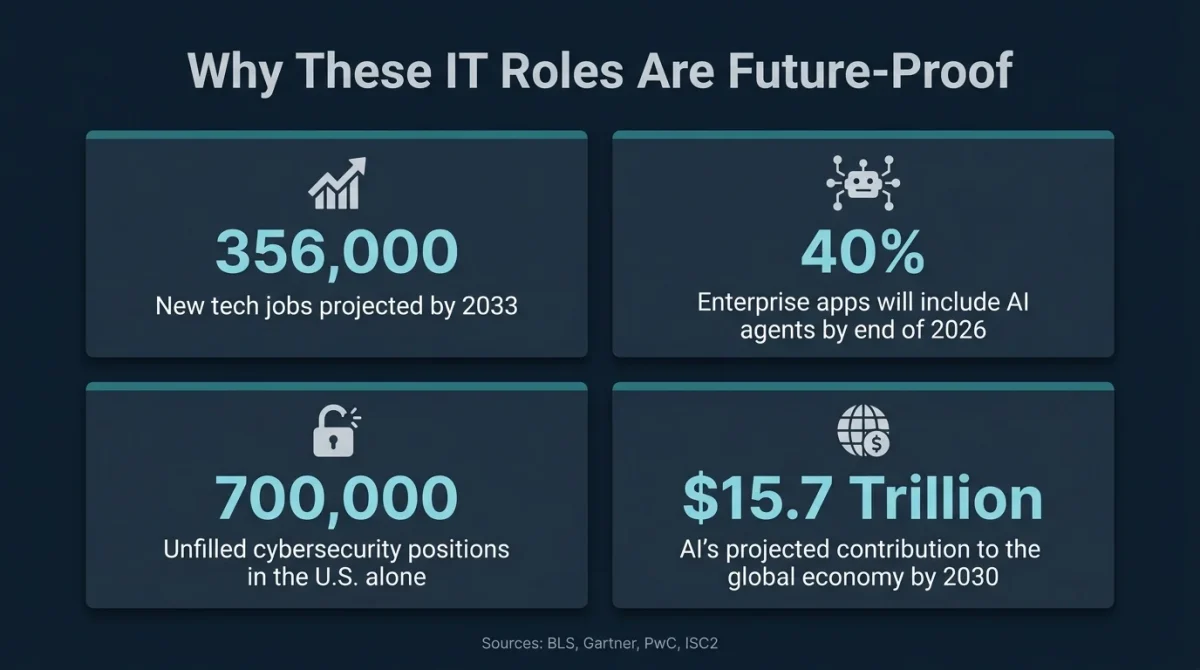
The tech hiring market in 2026 is not what layoff headlines suggest. Baseline and legacy roles are cooling. But for specialized talent, the picture looks entirely different. In a 2025 survey, 76% of IT employers struggled to find the tech talent they needed. There are an estimated 700,000 unfilled cybersecurity positions in the U.S. alone.
According to Robert Half’s 2026 Salary Guide, IT salaries are projected to rise 1.6% on average overall, but that figure masks the real story. For professionals with deep expertise in AI, cloud computing, data science, and cybersecurity, employers are willing to pay 10–30% premiums above market rates, and they’re sweetening offers with equity, bonuses, and flexible arrangements just to win the talent war.
Tech roles are also projected to add 356,000 new jobs by 2033, meaning the window of opportunity isn’t closing, it’s widening. The professionals who invest in the right skills today are positioning themselves for a decade of exceptional earning potential.
Top 10 Highest-Paying Information Technology Jobs in 2026
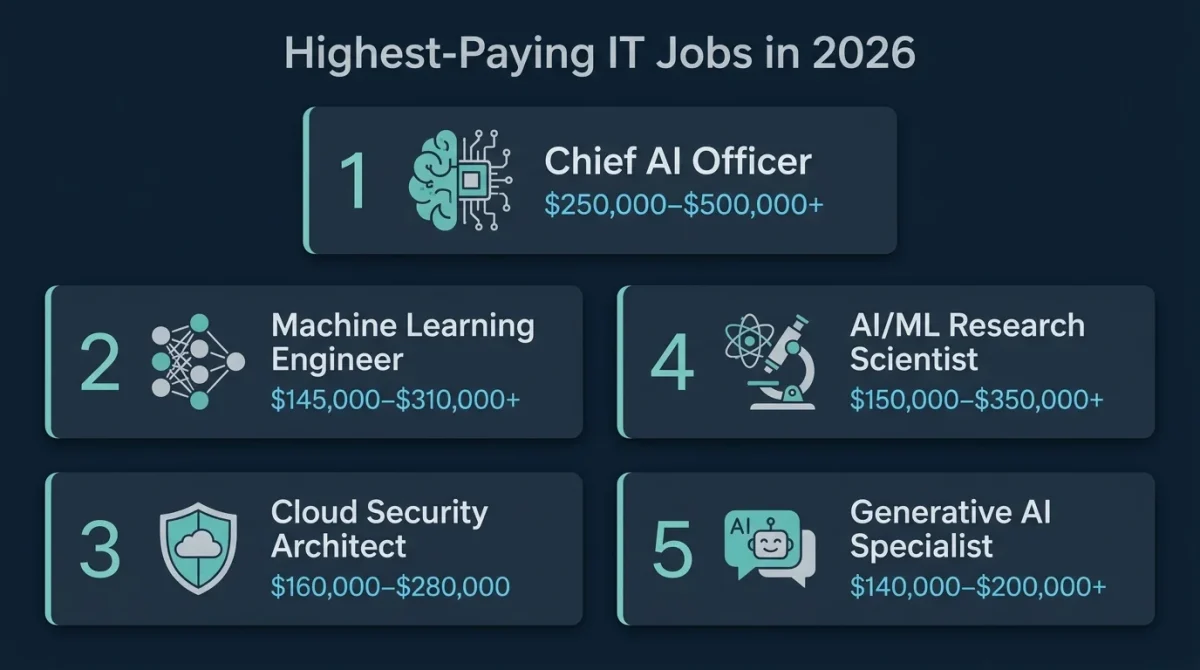
1. Chief AI Officer (CAIO)
A few years ago, this title barely existed. Today, it sits at the C-suite table alongside the CEO and CTO. The Chief AI Officer is responsible for defining an organization’s entire AI strategy, deciding which initiatives to fund, ensuring ethical AI deployment, managing cross-functional teams, and directly reporting to the board on how AI drives competitive advantage.
This role is unique because it lives at the intersection of technical vision and business leadership. A CAIO needs to understand transformer architectures and also be able to present ROI to a boardroom that doesn’t know what a neural network is.
What Makes This Role Pay So Well
The CAIO directly controls one of the most strategically critical functions in any modern enterprise. A wrong AI investment can cost tens of millions. The right one can reshape an entire industry. That level of accountability commands extraordinary compensation.
Key Skills Required
- AI governance frameworks and responsible AI deployment
- Enterprise architecture and large-scale system design
- Risk management and regulatory compliance (GDPR, EU AI Act, FDA for healthcare AI)
- Stakeholder communication at the executive and board level
- Deep familiarity with LLMs, agentic AI, and ML pipelines
Salary Range: $250,000 – $500,000+
Career Path: VP of AI / AI Director → Chief AI Officer
2. Machine Learning Engineer
Machine Learning Engineers are the architects of intelligent systems. They design model pipelines, build training infrastructure, optimize model performance for production environments, and ensure that AI systems behave reliably at scale. In 2026, their role has sharpened the market significantly, now clearly separating ML Engineers (who focus on model architecture and MLOps) from Applied AI Engineers (who focus on LLM integration and product features).
According to MRJ Recruitment’s 2026 benchmark data, the national senior median salary for ML Engineers is $230,625, with Zone 1 professionals in NYC and San Francisco earning $270,000 in base pay alone. Total compensation packages at major tech companies routinely exceed $400,000 when equity is included.
Which specialty commands the highest premium right now? LLM fine-tuning. Professionals who can take a foundation model and customize it for a specific business use case using techniques such as LoRA, QLoRA, and RLHF are in the highest-demand bracket across all of applied AI.
Key Skills Required
- Python (appears in nearly 100% of ML job postings)
- TensorFlow, PyTorch, JAX
- MLOps and model deployment pipelines
- LLM fine-tuning: LoRA, QLoRA, RLHF, instruction tuning
- RAG (Retrieval-Augmented Generation) architecture
- Vector databases: Pinecone, Weaviate, Chroma
- Cloud AI services: AWS SageMaker, Azure ML, Google Vertex AI
Salary Range: $145,000 – $310,000+ (Total comp can exceed $400,000 at FAANG)
Career Path: Data Scientist / Software Engineer → ML Engineer → Senior ML Engineer → Staff Engineer → ML Architect
3. Cloud Security Architect
The explosion of cloud adoption has created a massive security blind spot, and organizations are paying dearly to fill it. Cloud Security Architects design and enforce security frameworks, policies, and controls to protect cloud-native infrastructure across AWS, Azure, and GCP. They implement zero-trust architectures, manage identity and access at scale, and ensure compliance with increasingly stringent regulatory frameworks.
Cybersecurity talent shortages are driving up salaries by 10–15% for mid-level roles, but highly specialized positions like Cloud Security Architects command even steeper premiums due to niche expertise. The ISC2 workforce study found that 36% of organizations cite cloud security as a critical skill gap, a statistic that directly translates into exceptional compensation for qualified professionals.
Key Skills Required
- Cloud-native security: AWS Security Hub, Azure Defender, GCP Security Command Center
- Zero Trust Network Access (ZTNA) architecture
- SIEM platforms and threat detection
- IAM (Identity and Access Management)
- Compliance frameworks: SOC 2, ISO 27001, NIST CSF, FedRAMP
- DevSecOps integration and shift-left security practices
Salary Range: $160,000 – $280,000
Career Path: Cybersecurity Analyst → Cloud Security Engineer → Cloud Security Architect
4. AI/ML Research Scientist
Research Scientists sit at the frontier of AI. They don’t just deploy existing models; they advance the state of the art. At organizations like Google DeepMind, OpenAI, Meta AI, and Anthropic, Research Scientists design entirely new architectures, develop novel training methodologies, and publish findings that shape the field as a whole.
This is one of the most academically rigorous information technology jobs on this list. Most Research Scientist positions at top labs require a PhD, and publications in venues such as NeurIPS, ICML, and ICLR carry significant weight. The barrier to entry is high, but so is the ceiling. Total compensation at Frontier AI Labs can exceed $500,000 for senior researchers, including equity that could prove transformative.
Key Skills Required
- Deep expertise in machine learning theory and statistical modeling
- Research publication record (peer-reviewed venues preferred)
- Proficiency in Python, PyTorch, JAX
- Familiarity with distributed training on GPU clusters
- Experience with specific research areas: NLP, computer vision, reinforcement learning, multimodal AI
Salary Range: $150,000 – $350,000+ (with equity at Frontier Labs)
Career Path: PhD Research → Postdoc / Residency → Research Scientist → Senior Research Scientist → Principal Researcher
5. Generative AI Specialist / LLM Engineer
This role didn’t exist at scale three years ago. Today, it’s one of the most sought-after specializations in the entire IT job market. Generative AI Specialists work exclusively with large language models, the technology powering tools like ChatGPT, Claude, and Gemini. Their work includes applying Retrieval-Augmented Generation to connect LLMs to business knowledge bases, fine-tuning models for domain-specific applications, building conversational AI pipelines, and developing prompt optimization strategies at scale.
Analytics Vidhya research puts the average annual salary for generative AI specialists at $174,727, with top performers exceeding $300,000. The fact that this role didn’t formally exist until recently, yet already commands these compensation levels, tells you everything you need to know about how fast the market has moved.
Key Skills Required
- Deep understanding of transformer architectures
- Fine-tuning LLMs: GPT, LLaMA, Mistral, BERT
- RAG implementation and semantic search
- Vector databases and embedding models
- Prompt engineering and evaluation frameworks
- Python, LangChain, LlamaIndex, Hugging Face APIs
Salary Range: $140,000 – $200,000+ (top performers exceed $300,000)
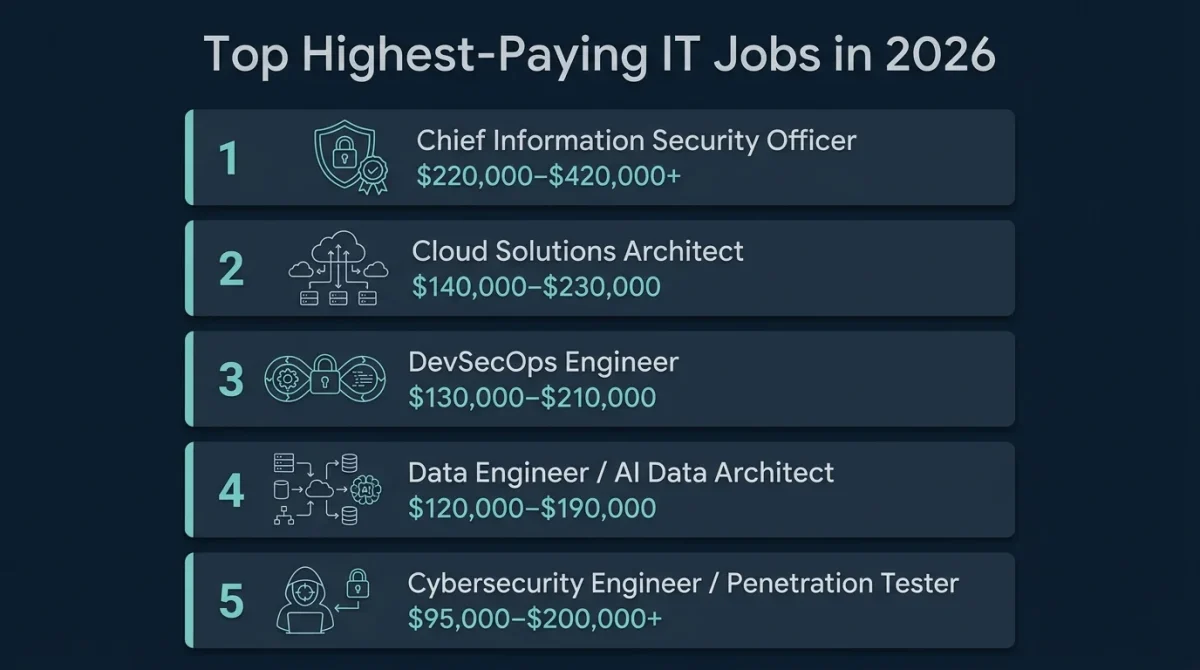
6. Chief Information Security Officer (CISO)
The CISO is the highest-ranking cybersecurity role in any organization. They own the entire information security strategy, manage security teams, report to the board, ensure regulatory compliance, and are ultimately accountable when something goes wrong. In 2026, that responsibility has never been more consequential. A surge in cyberattacks has driven over $16.6 billion in losses across businesses, making experienced CISOs among the most valued executives in any industry.
Cybersecurity salaries range from $55,000 for entry-level technicians to $420,000+ for CISOs at large enterprises, with total compensation at major organizations exceeding $500,000 when equity and bonuses are included. The path is long, typically requiring 15–20 years of progressive security experience, but the financial destination is exceptional.
Key Skills Required
- Executive communication and board-level reporting
- Enterprise risk management and regulatory compliance
- Incident response and crisis management
- Security architecture across hybrid and multi-cloud environments
- AI security governance (emerging requirement)
- Team leadership and budget management
Salary Range: $220,000 – $420,000+ (total comp at large enterprises exceeds $500,000)
Career Path: Security Analyst → Security Manager → Director of Security → VP of Security → CISO
7. Cloud Solutions Architect
Every company is racing to move its infrastructure to the cloud, and Cloud Solutions Architects are the professionals who make it possible. They design end-to-end cloud environments, select the right services for business requirements, optimize costs, ensure scalability, and guide organizations through complex digital transformation journeys. In 2026, multi-cloud and hybrid cloud expertise has become particularly valuable as businesses seek to avoid vendor lock-in.
Cloud roles are consistently among the highest-paying information technology jobs because demand massively outpaces supply. The BLS projects strong, sustained growth for cloud-related roles through 2033, and employers are actively offering certifications, signing bonuses, and remote flexibility to win top talent.
Key Skills Required
- Deep expertise in at least one major cloud platform: AWS, Azure, or GCP
- Infrastructure as Code (IaC): Terraform, CloudFormation, Bicep
- Microservices architecture and container orchestration (Kubernetes, Docker)
- Cost optimization and FinOps principles
- Cloud networking, VPC design, and hybrid connectivity
- Security and compliance in cloud environments
Salary Range: $140,000 – $230,000
Career Path: Cloud Engineer → Senior Cloud Engineer → Solutions Architect → Principal Architect
8. DevSecOps Engineer
DevSecOps Engineers represent the convergence of three critical disciplines: development, security, and operations. They embed security practices directly into the CI/CD pipeline, automate security testing, manage vulnerability remediation, and ensure that software ships fast and safely. In a market where breaches can cost hundreds of millions and regulatory penalties are escalating, organizations that once treated security as an afterthought are now making DevSecOps a foundational part of their engineering culture.
Highly specialized positions, such as DevSecOps Engineers, command premium compensation due to their niche expertise at the intersection of security and engineering. The role is particularly in demand at financial services firms, healthcare organizations, and defense contractors, where security failures carry both regulatory and reputational consequences.
Key Skills Required
- CI/CD pipeline management: Jenkins, GitHub Actions, GitLab CI
- Container security: Kubernetes security, image scanning (Trivy, Snyk)
- SAST/DAST tools and automated security testing
- Infrastructure as Code security scanning
- Secrets management: HashiCorp Vault, AWS Secrets Manager
- Compliance automation: SOC 2, PCI-DSS, HIPAA
Salary Range: $130,000 – $210,000
Career Path: Software Developer or Security Analyst → DevOps Engineer → DevSecOps Engineer → Principal DevSecOps Architect
9. Data Engineer / AI Data Architect
Here’s a truth that often gets buried in the AI hype: every AI system is only as good as the data feeding it. Data Engineers and AI Data Architects build and maintain the pipelines, warehouses, lakes, and lakehouses that enable AI. Without them, the ML models that power generative AI, recommendation systems, and fraud detection would have nothing to learn from.
In 2026, the role has evolved significantly. The modern Data Engineer isn’t just moving data from A to B; they’re designing real-time streaming architectures, implementing data quality frameworks, and building the infrastructure that allows AI models to train and serve predictions reliably. Data engineers who can ensure data integrity, security, and accessibility for AI workloads are at the very top of hiring lists.
Key Skills Required
- Data pipeline development: Apache Spark, Kafka, Airflow, dbt
- Cloud data warehouses: Snowflake, BigQuery, Azure Synapse, Redshift
- Real-time streaming architectures
- Data governance and quality frameworks
- Python and SQL (non-negotiable)
- MLOps data pipelines and feature stores
Salary Range: $120,000 – $190,000
Career Path: Data Analyst → Data Engineer → Senior Data Engineer → Data Architect → AI Data Architect
10. Cybersecurity Engineer / Penetration Tester
While the CISO role commands the largest packages at the executive level, Cybersecurity Engineers and Penetration Testers represent the highest-density, high-paying segment of the IT market, meaning there are vastly more of these roles available than C-suite positions. With 700,000 unfilled cybersecurity positions in the U.S. alone and millions more globally, qualified professionals have exceptional negotiating leverage.
Penetration testers who simulate attacks to find vulnerabilities before real adversaries do are among the most specialized and highest-paid practitioners in cybersecurity. Organizations facing sophisticated, AI-powered threats are increasing their red team and offensive security budgets significantly in 2026.
Key Skills Required
- Network penetration testing and vulnerability assessment
- Web application security: OWASP Top 10, API security
- Cloud penetration testing (AWS, Azure, GCP)
- Scripting: Python, Bash, PowerShell
- Exploit development and reverse engineering (for senior roles)
- Tools: Metasploit, Burp Suite, Nmap, Cobalt Strike
- AI-powered threat detection and response (emerging requirement)
Salary Range: $95,000 – $175,000 (senior and specialized roles reach $200,000+)
Career Path: Security Analyst → Penetration Tester → Senior Security Engineer → Red Team Lead
Skills That Command the Highest Premiums in 2026
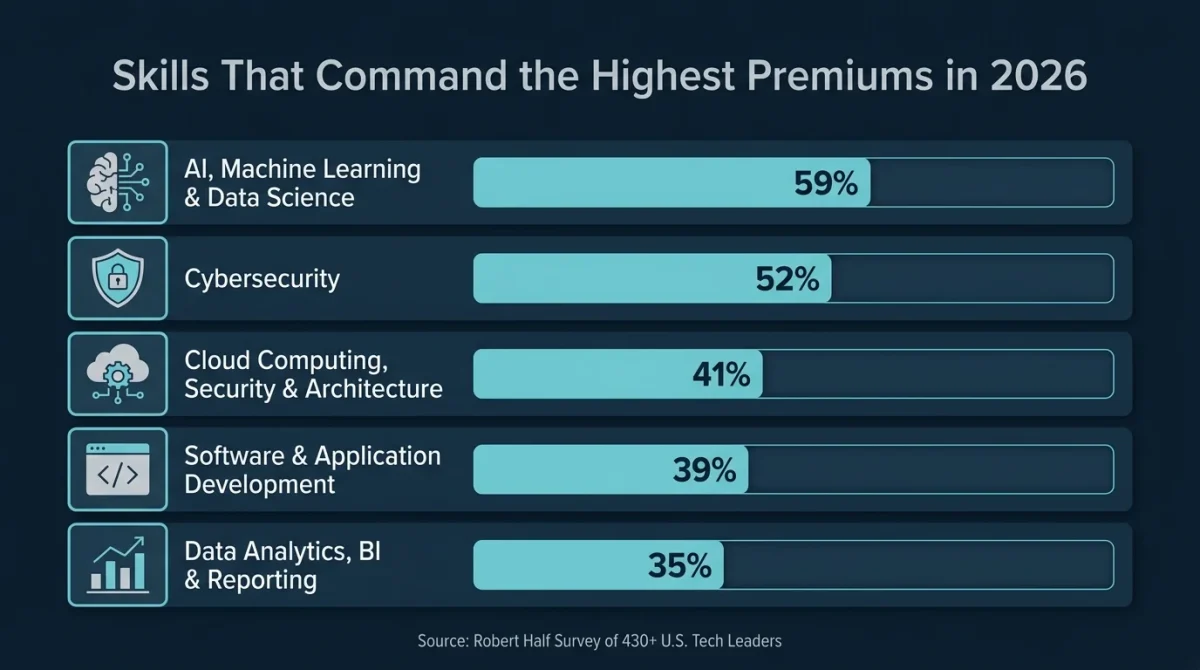
Across these information technology jobs, certain skills consistently serve as salary multipliers regardless of the specific role. According to Robert Half’s survey of more than 430 technology leaders in the U.S., the top skills leaders are willing to pay more for in 2026 are:
- AI, machine learning, and data science — cited by 59% of tech leaders
- Cybersecurity — cited by 52%
- Cloud computing, security, and architecture — cited by 41%
- Software and applications development — cited by 39%
- Data analytics, BI, and reporting — cited by 35%
The most valuable professionals in 2026 aren’t necessarily the ones who know the most about one thing, but they’re the ones who can bridge disciplines. An ML Engineer who understands cloud security. A DevSecOps Engineer who speaks executive language. A Cloud Architect who can mentor a junior AI team. These hybrid profiles consistently command 20–30% premiums above single-discipline specialists.
Highest-Paying IT Jobs: Salary Comparison
| Rank | Role | Salary Range (USD) |
| 1 | Chief AI Officer | $250,000 – $500,000+ |
| 2 | Machine Learning Engineer | $145,000 – $310,000+ |
| 3 | Cloud Security Architect | $160,000 – $280,000 |
| 4 | AI/ML Research Scientist | $150,000 – $350,000+ |
| 5 | Generative AI Specialist / LLM Engineer | $140,000 – $200,000+ |
| 6 | Chief Information Security Officer | $220,000 – $420,000+ |
| 7 | Cloud Solutions Architect | $140,000 – $230,000 |
| 8 | DevSecOps Engineer | $130,000 – $210,000 |
| 9 | Data Engineer / AI Data Architect | $120,000 – $190,000 |
| 10 | Cybersecurity Engineer / Penetration Tester | $95,000 – $200,000+ |
How to Position Yourself for These Roles in 2026
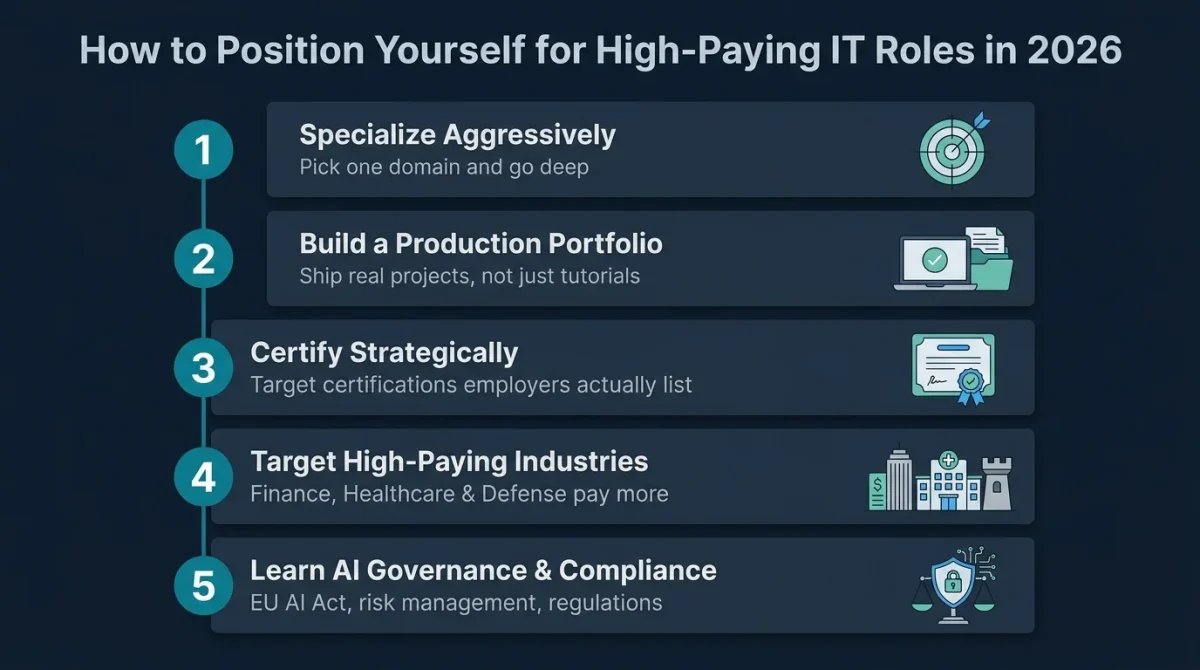
Specialize Aggressively — Generalists Are Losing Ground Fast
The days of landing a top-tier salary by being a well-rounded IT professional services provider are behind us. The 2026 market rewards depth. Pick the one or two areas that align with your strengths and go deep, not just through courses, but through real production experience.
Build a Portfolio That Proves Production Experience
For AI roles, especially, a GitHub portfolio with deployed production systems, not just tutorials, is more persuasive than a degree. Ship something real. Companies hiring for generative AI and ML roles want proof that you can take a model from prototype to production.
Certify Strategically — Not Randomly
Not all certifications pay equally. AWS Certified Solutions Architect Professional adds $10,000–$15,000. CISSP adds a 22% salary boost. CCSP in cloud security adds up to 25%. Research which certifications your target employers list most in job postings, and prioritize those. Don’t collect certificates; acquire the ones that pay.
Target the Right Industries
Financial services, healthcare, and defense consistently pay above-average IT salaries because the consequence of failure, a data breach, a compliance violation, or a flawed AI decision, is catastrophic and measurable in dollars. If you have the same skills as a peer but one of you works in tech and the other in banking or healthcare, the compensation gap can be $20,000–$40,000 annually.
Stay Current on AI Governance and Compliance
As AI regulation accelerates globally, the EU AI Act, U.S. executive orders, and state-level legislation, professionals who understand the intersection of AI, legal compliance, and risk management are becoming extraordinarily valuable. This is particularly true for CISO, CAIO, and Cloud Security Architect roles.
The Long View: Why These Roles Are Future-Proof
One of the biggest concerns any IT professional has when investing in a new specialization is: Will this skill matter in five years? For the roles on this list, the answer is yes and here’s why.
AI, cloud, and cybersecurity are not trends. They are permanent features of modern business infrastructure. Every organization, from a regional bank to a global manufacturing firm, is now dependent on cloud infrastructure, AI-driven automation, and cybersecurity defenses. The BLS projects that tech roles will add 356,000 jobs by 2033, and the talent shortage driving current salary premiums shows no sign of resolving quickly.
In fact, the emergence of agentic AI, where AI systems operate autonomously on complex tasks, is already creating entirely new categories of high-paying information technology jobs that barely existed in 2024. Gartner predicts that 40% of enterprise applications will include task-specific AI agents by the end of 2026, up from less than 5% in 2025. The engineers and architects who understand how to build, deploy, and secure these agentic systems will be among the highest-compensated IT professionals of the decade.
Final Thoughts
The information technology job market in 2026 is not the same market it was even two years ago. AI has restructured compensation hierarchies, cloud has become the default infrastructure for every serious business, and cybersecurity has graduated from IT department concern to board-level priority.
The 10 roles covered in this guide represent the convergence of these forces, positions where supply is short, demand is fierce, and employers are paying well above market to secure the talent they need. Whether you’re targeting a six-figure step up within your current discipline or considering a strategic career pivot, the data is clear: investing in AI, cloud, applied computer technology and cybersecurity expertise in 2026 is one of the highest-return career decisions you can make.
Start with one specialization. Go deep. Get certified strategically. Build real things. And let the market’s extraordinary demand for talent do the rest.
Frequently Asked Questions (FAQs)
What are the highest-paying IT jobs in 2026?
The highest-paying IT jobs in 2026 are primarily concentrated in artificial intelligence, cloud computing, and cybersecurity. Roles like AI Engineer, Machine Learning Engineer, Cloud Architect, Cybersecurity Engineer, and Data Scientist consistently rank at the top due to high demand and specialized skill requirements.
Why are AI and machine learning roles so highly paid?
AI and machine learning professionals are in high demand because businesses rely on automation, predictive analytics, and intelligent systems. These roles require advanced skills in algorithms, data modeling, and programming, making them both scarce and valuable.
What is the average salary of an AI Engineer in 2026?
While salaries vary by region and experience, AI Engineers in 2026 can earn between $120,000 and $200,000 annually, with senior professionals and specialists earning significantly more.
Are cloud computing jobs still in demand in 2026?
Yes, cloud computing remains one of the most in-demand IT fields. As companies continue to migrate to cloud platforms, roles such as Cloud Architect and Cloud Engineer offer strong job security and high salaries.
How much do cybersecurity professionals earn?
Cybersecurity roles, such as Security Engineers and Ethical Hackers, typically earn between $100,000 and $180,000+ annually, depending on expertise, certifications, and experience.
What skills are required for high-paying IT jobs?
Key skills include:
- Programming (Python, Java, Go)
- Cloud platforms (AWS, Azure, Google Cloud)
- Data analysis and machine learning
- Cybersecurity practices
- DevOps and automation tools
Soft skills like problem-solving and communication are also critical.
Do you need a degree to get a high-paying IT job?
A degree can help, but it’s not always mandatory. Many employers prioritize practical skills, certifications, and real-world experience over formal education.
Which certifications can boost IT salaries?
Popular certifications include:
- AWS Certified Solutions Architect
- Google Professional Cloud Architect
- Certified Information Systems Security Professional (CISSP)
- Microsoft Azure certifications
These credentials can significantly increase earning potential.
Is experience more important than skills in IT careers?
Both matter, but skills often take priority, especially in fast-evolving fields like AI and cloud computing. Demonstrating real-world projects and problem-solving ability can outweigh years of experience.
Are remote high-paying IT jobs common in 2026?
Yes, remote work is widely available in IT, especially for roles in AI, software development, cloud engineering, and cybersecurity. Many companies offer global opportunities with competitive salaries.