A cybersecurity policy is a formal document that defines how your organization protects its data, systems, and people. In 2026, every organization — from a five-person startup to a Fortune 500 company — needs one. This guide gives you the full picture: what to include, ready-to-use templates, the best frameworks to align with, and the new threats your policy must address right now. Skip to any section using the headings below. A cyberattack happens every 39 seconds somewhere in the world.
That number is jarring. But here is what makes it worse: most of those attacks succeed not because the hackers were brilliant, but because the target lacked a clear cybersecurity policy. No rules. No documented process. No accountability. If your organization does not have a written cybersecurity policy in 2026, you are not just unprepared — you are exposed.
This guide is not a dictionary definition. It is a practical, step-by-step resource that walks you through building, updating, or auditing a cybersecurity policy that actually works. Whether you are an IT manager, a small business owner, or a compliance officer, you will find exactly what you need here.
What Is a Cybersecurity Policy?
A cybersecurity policy is a set of rules, guidelines, and procedures that govern how an organization manages and protects its digital assets, sensitive data, and IT infrastructure.
Think of it as your organization’s security rulebook. It tells employees what they can and cannot do. It tells IT teams which controls to implement. And it tells leadership how cybersecurity aligns with business goals. But here is what most articles miss: a cybersecurity policy is not a static document you file away and forget. It is a living framework that must evolve as threats evolve.
In 2026, that matters more than ever. Attackers are now using AI to identify vulnerabilities faster than security teams can patch them. According to the IBM 2026 X-Force Threat Intelligence Index, the exploitation of vulnerabilities became the leading cause of cyberattacks in 2025, accounting for 40% of all observed incidents — and AI tools are helping attackers accelerate that pace dramatically.
A well-written cybersecurity policy directly addresses this reality. It closes the gap between what your organization intends to do and what actually happens on the ground.
Read more: Cybersecurity Stack
The 2026 Threat Landscape: Why Your Policy Needs Updating Now
Before you write or revise your policy, you need to understand the environment in which it will operate. The threat landscape in 2026 looks significantly different from what it was even two years ago.
AI-powered attacks are the new normal
Attackers are using large language models to generate polymorphic malware — malicious code that rewrites itself on every execution to evade signature-based detection. During 2025, over 70% of major breaches involved this type of adaptive malware. Your policy needs to account for detection strategies beyond traditional antivirus.
Identity-based intrusions are surging
Experts from PwC and U.S. Cyber Command predict that in 2026, more attackers will “walk in through the front door” using stolen or compromised credentials rather than exploiting technical vulnerabilities. The World Economic Forum’s Global Cybersecurity Outlook 2026 found that nearly three-quarters of respondents (73%) reported someone in their network was personally affected by cyber-enabled fraud in 2025, with phishing, vishing, and smishing being the most common methods.
AI agents are creating new blind spots
Organizations are deploying autonomous AI agents at scale in 2026. But research from Cybersecurity Insiders found that 32% of organizations have no visibility into what their AI agents are actually doing on their networks. A SOC analyst might trace an anomalous privilege change to a service account created by an agent — with no alert ever firing because no detection rule existed for agent-initiated behavior. Your cybersecurity policy must now explicitly address AI agent governance.
Third-party risk remains massive
Sixty percent of breaches in critical infrastructure occur through third-party vendor access vectors. Your policy cannot just cover internal employees. It must extend to every partner, contractor, and supplier with access to the system. Understanding these threats is not optional context — it is the foundation of a relevant, effective cybersecurity policy.

The 9 Core Components of a Strong Cybersecurity Policy
Not all cybersecurity policies are created equal. The best ones cover these nine essential components. Each one serves a specific purpose and addresses a specific category of risk.
1. Purpose and Scope
This section answers two questions: why this policy exists and who it applies to. Be explicit. The scope should name every group covered — full-time employees, remote workers, contractors, third-party vendors, and even automated AI systems. A policy that does not clearly define its own scope will fail at enforcement.
2. Acceptable Use Policy (AUP)
This governs how employees may use company devices, networks, and data. It covers personal use of company equipment, approved software, cloud storage policies, and remote access rules. In 2026, the AUP must also address the use of AI tools. Employees are using consumer AI tools, such as chatbots, to handle sensitive work. Your policy needs to define which AI tools are approved, what data cannot be entered into them, and what consequences apply for violations.
3. Access Control Policy
This defines who can access what, and under what conditions. The principle of least privilege is foundational: every user, system, and application should have access to only what they need to do their job — nothing more. According to the NIST Cybersecurity Framework, organizations with well-defined access control policies experience significantly fewer security incidents than those without formal policies.
Key elements to include: multi-factor authentication (MFA) requirements, role-based access controls (RBAC), privileged access management (PAM) for administrator accounts, and a defined process for revoking access when employees leave.
4. Data Classification and Protection Policy
Not all data carries the same risk. This section establishes a classification system — typically Public, Internal, Confidential, and Restricted — and defines how each category must be handled, stored, transmitted, and disposed of.
Include encryption requirements by data class. For example, Restricted data (such as personal health information or financial records) should require encryption at rest and in transit, with strict access logging.
Read more: Cyber Insurance Requirements
5. Incident Response Plan (IRP)
This is one of the most critical components — and one of the most commonly missing from smaller organizations’ policies.
An incident response plan defines exactly what your team does when a breach occurs. It covers four phases: detection, containment, eradication, and recovery. It names specific roles and responsibilities. And it establishes communication protocols — who to notify, when, and how.
Organizations that align with the NIST CSF framework report 65% faster incident response times and 42% lower security-related costs than those that use ad hoc approaches. Those numbers reflect the real-world value of having a documented IRP before a crisis hits.
Your IRP should also include a post-incident review process. Every breach is a learning opportunity. Documenting what happened and how you responded makes your organization measurably stronger.
6. Employee Training and Awareness Policy
Technology alone cannot secure an organization. Human error remains one of the leading causes of successful cyberattacks.
This section defines your security awareness training program: how often training occurs (at minimum, annually; quarterly is better), which topics are covered, how compliance is tracked, and what consequences apply for repeated policy violations.
In 2026, training must go beyond “don’t click suspicious links.” It should cover deepfake-based social engineering, AI-generated phishing emails, and secure handling of AI tools. Real-world simulated phishing campaigns are a proven best practice for reinforcing awareness.
7. Network Security Policy
This covers the technical controls protecting your network infrastructure: firewalls, intrusion detection and prevention systems (IDS/IPS), virtual private networks (VPNs) for remote access, network segmentation, and wireless security standards.
In 2026, add explicit guidance on cloud security posture management (CSPM) and AI security posture management (AI-SPM). These tools are becoming essential as AI workloads and data volumes grow rapidly. Organizations that cannot see their AI models and data flows cannot secure them.
8. Third-Party and Vendor Risk Management Policy
Every vendor with access to your systems is a potential attack vector. This section defines how you assess, onboard, monitor, and offboard third-party suppliers.
Minimum standards should include: security questionnaires prior to onboarding, contractual security requirements (including breach-notification timelines), periodic security reviews, and procedures for immediate revocation of access.
9. Compliance and Regulatory Alignment
This section maps your cybersecurity controls to the specific regulations and frameworks that apply to your organization. This is not optional — it is how you demonstrate accountability to regulators, auditors, and customers.
Read more: SOC Tools
Cybersecurity Policy Template: A Ready-to-Use Structure
Below is a clean template structure you can adapt for your organization. Fill in the bracketed sections with your specific details.

[ORGANIZATION NAME] CYBERSECURITY POLICY Version: 1.0 | Effective Date: [DATE] | Review Date: [DATE + 12 months]Policy Owner: [CISO / IT Director / Security Manager]Approved by: [Executive Sponsor]
- PURPOSE: This policy establishes the cybersecurity principles and minimum standards that [Organization Name] applies to protect its information assets, systems, and data from unauthorized access, disclosure, alteration, or destruction.
- SCOPE This policy applies to all employees, contractors, vendors, and third parties who access [Organization Name] systems, networks, or data — regardless of location or device ownership.
- ROLES AND RESPONSIBILITIES
- Executive Leadership: Approves and funds cybersecurity initiatives; accountable for policy compliance at the organizational level.
- IT/Security Team: Implements and monitors technical controls; maintains and tests incident response capability.
- All Employees: Complete required security training; comply with acceptable use and data handling policies; report suspected security incidents immediately.
- ACCEPTABLE USE
- Company devices are for business use. Limited personal use is permitted, provided it does not pose a security risk or violate this policy.
- Employees must not install unauthorized software, share credentials, or use unapproved cloud storage for company data.
- Use of consumer AI tools (e.g., public chatbots) for work tasks is prohibited unless the tool is explicitly approved. Confidential or Restricted data must never be entered into unapproved AI systems.
- ACCESS CONTROL
- All user accounts require unique credentials. Password sharing is prohibited.
- Multi-factor authentication (MFA) is mandatory for all remote access, email, and any system containing Confidential or Restricted data.
- Access rights are granted on a least-privilege basis and reviewed quarterly.
- Access is revoked within 24 hours of an employee’s departure or a role change.
- INCIDENT RESPONSE: All suspected security incidents must be reported immediately to [[email protected] / IT Help Desk]. The incident response team will follow the documented IRP, which covers: Detection → Containment → Eradication → Recovery → Post-Incident Review.
- TRAINING: All employees complete mandatory cybersecurity awareness training within 30 days of hire and annually thereafter. Phishing simulation exercises are conducted [quarterly/bi-annually].
- REVIEW AND UPDATES: This policy is reviewed annually or following any significant security incident, change in regulation, or material change to the organization’s IT environment.
Which Cybersecurity Framework Should You Align With?
Frameworks give your policy structure, credibility, and a roadmap for continuous improvement. Here are the four most widely adopted options in 2026, with clear guidance on which fits your situation.
NIST CSF 2.0 (Best for Most Organizations)
The National Institute of Standards and Technology Cybersecurity Framework is the most widely adopted framework globally. Version 2.0, released in 2024, added a critical new function: Govern. This function specifically embeds cybersecurity into enterprise risk management on an ongoing basis — a direct response to regulatory pressure for continuous, evidence-based compliance rather than annual audits.
NIST CSF is built around six core functions: Identify, Protect, Detect, Respond, Recover, and now Govern. It is flexible, scalable, and applicable across industries. CISA consistently recommends it for all critical infrastructure sectors, and it is the framework of choice for organizations seeking to align with federal procurement requirements.
ISO/IEC 27001 (Best for Global Credibility)
ISO 27001 is the international standard for information security management systems (ISMS). Achieving certification demonstrates to customers, partners, and regulators that your security practices meet a globally recognized standard. It integrates tightly with the NIST CSF — many organizations use ISO 27001 as the certification layer on top of NIST-aligned controls.
SOC 2 (Best for SaaS and Service Providers)
SOC 2 is not technically a framework — it is an audit standard developed by the American Institute of CPAs (AICPA). But it has become the de facto cybersecurity requirement for SaaS companies and cloud service providers. SOC 2 Type II certification demonstrates that your security controls not only exist but also have operated effectively over time.
NIS2 / DORA (Best for EU-Regulated Organizations)
The EU’s NIS2 Directive and the Digital Operational Resilience Act (DORA) came into full effect in 2024–2025 and now carry significant financial penalties for non-compliance. NIS2 requires continuous supply chain risk management and executive accountability reviews. DORA, which targets financial services organizations, requires ongoing vendor monitoring and a live Register of Information.
The common thread across all these frameworks is a shift toward continuous, evidence-based compliance. Regulators no longer accept point-in-time certifications. Your cybersecurity policy must reflect this — build in ongoing monitoring, regular reviews, and documented evidence of compliance at every step.
Read more: Cybersecurity Framework

7 Cybersecurity Policy Mistakes That Make Organizations Vulnerable
Most policy failures do not result from organizations ignoring cybersecurity. They happen because policies have subtle gaps that attackers exploit. Here are the seven most common — and how to fix them.
Mistake 1: Writing the policy for auditors, not employees
Policies full of legal jargon and compliance-speak do not change behavior. Employees who cannot understand the policy will not follow it. Write it in plain language. Use examples. Make it human.
Mistake 2: Ignoring remote and hybrid work realities
A policy written for office-only environments in 2019 does not cover the realities of home networks, personal devices, and cloud collaboration tools. Update your AUP and network security sections to address remote work risks explicitly.
Mistake 3: No AI usage policy
This is the fastest-growing gap in 2026. Employees are using AI tools for work tasks without realizing they may be sharing confidential data with third-party systems. Your policy needs an explicit AI tool governance section before a breach forces the issue.
Mistake 4: Access never gets revoked
Orphaned accounts — active credentials belonging to employees who left months ago — are a primary target for attackers. IBM research found that missing authentication controls were a major driver of the 44% increase in attacks exploiting public-facing applications. Implement and enforce a formal offboarding process.
Mistake 5: Vendors are treated like trusted insiders
Third-party vendors with broad system access represent a serious risk. Define minimum security requirements for all vendors and include contractual cybersecurity obligations in every supplier agreement.
Mistake 6: The policy is reviewed once and forgotten
Threat landscapes change. Regulations change. Your organization changes. A cybersecurity policy that is not reviewed annually is already outdated. Schedule it. Own it.
Mistake 7: No one is accountable
A policy without named owners is a policy without enforcement. Assign a specific person or team to every policy component. Without accountability, even a well-written policy will erode over time.
Read more: Is Cybersecurity Hard?
How to Implement Your Cybersecurity Policy: A Step-by-Step Roadmap
Having a written policy is only half the work. Implementation is where most organizations stumble. Follow this roadmap to move from document to operational reality.
Step 1: Conduct a risk assessment
Before writing or revising your policy, understand your actual threat exposure. Identify your most valuable assets, your most likely attack vectors, and your current control gaps. This is not a one-time task — build it into your annual review cycle.
Step 2: Get executive buy-in
Employees ignore cybersecurity policy without leadership support. Present the business case — frame risks in financial and reputational terms, not technical jargon. Executive sponsorship is non-negotiable for effective policy enforcement.
Step 3: Build cross-functional input
Involve HR, Legal, IT, and department heads in the drafting process. Their insights ensure the policy is both enforceable and operationally realistic. A policy drafted in isolation by the IT team will miss critical edge cases that other departments surface immediately.
Step 4: Communicate, train, and document
Roll out the policy with purpose. Do not just email a PDF. Conduct live training sessions. Use simulations. Document completion. Make acknowledgment a formal, recorded step for every employee.
Step 5: Implement supporting technical controls
Policy defines what should happen. Technology enforces it. Align your technical stack with your policy commitments: MFA, endpoint detection and response (EDR), data loss prevention (DLP), privileged access management (PAM), and security information and event management (SIEM).
Step 6: Monitor, test, and audit
Continuous monitoring is the 2026 standard. Do not wait for an incident to discover your controls are failing. Conduct regular penetration testing, vulnerability assessments, and tabletop incident response exercises. Review access logs and anomaly alerts consistently.
Step 7: Review and improve
After every major incident, regulatory update, or significant organizational change, review and update your policy. Treat it as a living document. Version-control every revision and document the rationale for changes.
Read more: GRC Cybersecurity
Free Cybersecurity Policy Template Resources
You do not need to build your policy entirely from scratch. These resources offer high-quality, peer-reviewed templates that can serve as strong starting points.
SANS Institute Policy Templates
SANS provides over 30 downloadable templates in DOCX and PDF format at no cost, covering everything from acceptable use to vulnerability management. Templates are regularly updated with revision dates clearly noted—no registration required.
NIST Cybersecurity Framework Resources
The official NIST website (nist.gov/cyberframework) provides the full CSF 2.0 documentation, implementation guides, and quick-start guides for organizations at every maturity level. The 2026 Cyber AI Profile quick-start guide is especially relevant for organizations deploying AI systems.
CIS Controls
The Center for Internet Security (CIS) offers its 18 critical security controls mapped to common compliance frameworks. The CIS Controls are particularly useful for smaller organizations that need a prioritized, practical starting point.
Industry-specific templates
Healthcare organizations should start with HIPAA-aligned templates. Financial services organizations in the EU should reference DORA compliance documentation. Always verify that any template you use aligns with the specific regulations that govern your industry.
Read more: How Can You Protect Your Home Computer?
Final Thoughts
A cybersecurity policy does not protect your organization by existing. It protects your organization when it is understood, enforced, tested, and improved. The organizations that suffer preventable breaches in 2026 will largely not be the ones with no security at all. They will be the ones with outdated policies, policies no one ever read, and policies that were never tested against real-world threats.
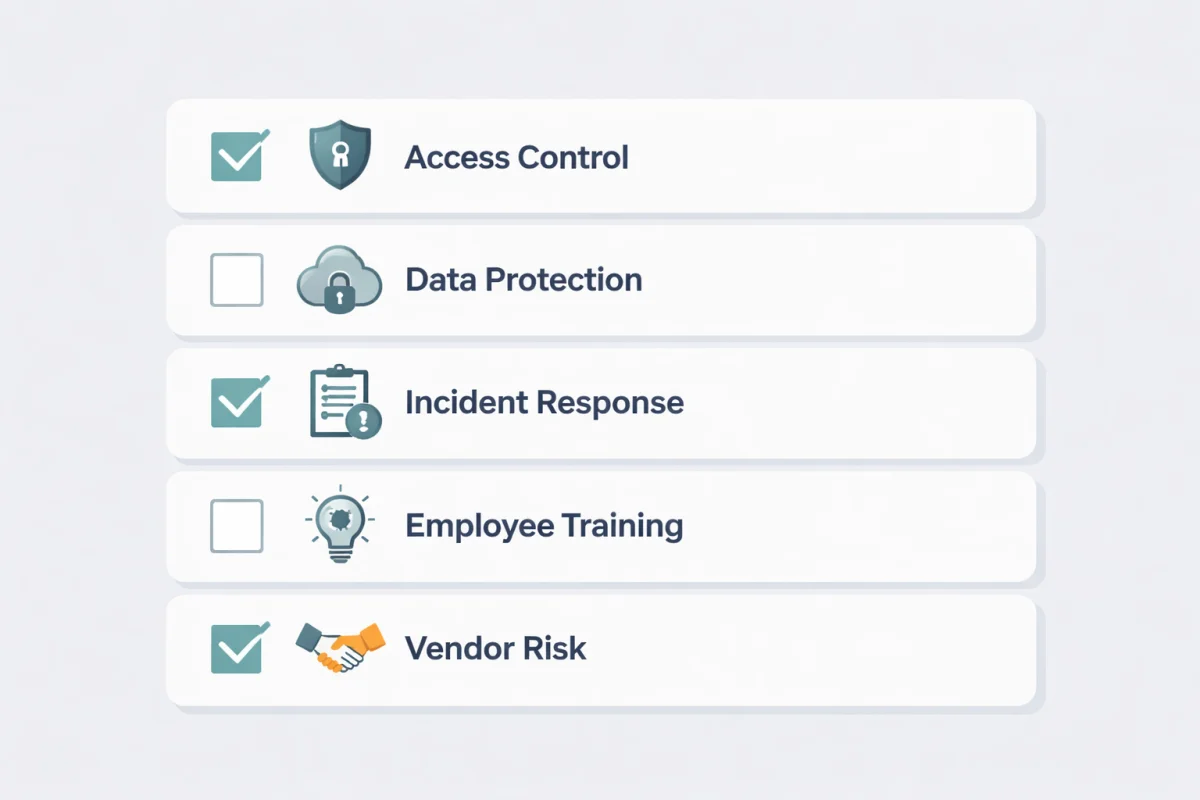
The guidance in this article gives you everything you need to build something better. Use the template as a scaffold. Use the checklist as an audit tool. Use the framework comparisons to decide which compliance path fits your situation. Then — most importantly — implement it. Train your people. Test your controls. Review it every year. Cybersecurity is not a product you buy. It is a practice you build. Your cybersecurity policy is the document that makes that practice consistent, accountable, and defensible.
Frequently Asked Questions (FAQs)
What is the difference between a cybersecurity policy and a cybersecurity framework?
A framework (like NIST CSF or ISO 27001) is a standardized set of best practices and guidelines developed by an external body. A cybersecurity policy is your organization’s internal document that defines how you implement those principles. Think of the framework as the blueprint and the policy as the construction plan specific to your building.
How long should a cybersecurity policy be?
Length depends on organizational size and complexity. A small business might cover the essentials in 5–10 pages. A large enterprise might have a master policy with separate sub-policies for each domain (access control, incident response, data classification) totaling 30–50+ pages. Prioritize clarity and completeness over length.
How often should a cybersecurity policy be reviewed?
At minimum, annually. Additionally, trigger a review after any significant security incident, material change to your IT environment, or relevant regulatory update. In the current threat environment, many organizations are moving to semi-annual reviews.
Do small businesses need a cybersecurity policy?
Absolutely. Small businesses are frequently targeted precisely because attackers know their defenses are weaker. A simple, well-enforced policy covering access control, acceptable use, incident reporting, and employee training dramatically reduces your risk profile — and can be a deciding factor in landing enterprise customers or passing vendor security assessments.
What is the first step in creating a cybersecurity policy?
Start with a risk assessment. You cannot build an effective policy without understanding what you are protecting, the most likely threats, and where your current gaps lie. Risk assessment is the foundation on which every other element of your policy is built.
Can I use a free template as my cybersecurity policy?
Templates are an excellent starting point — SANS, NIST, and CIS all provide strong free resources. But a template alone is not a policy. You need to customize it for your specific operations, regulatory requirements, and risk profile. An unadapted template is unenforceable and will not protect you during an audit.